
Catalogue Search | MBRL


Are you sure you want to remove the book from the shelf?

{{itemTitle}}
664,912
result(s) for
"Presidential candidates."
Sort by:

Twenty-five years of GOP presidential nominations : threading the needle
Examines the recent presidential nominees of the Republican Party. The author explores the idea that the presidential defeats of Republican nominees begin with the primary election choice of a moderate candidate in hopes that the chosen candidate's conservative rhetoric will translate into a general election victory. Written in a unique and dynamic style, this book details the recent history of the party's successes and failures through notable figures such as George H.W. Bush and Bob Dole.
Book

Jokowi's Pyrrhic Victory
Prabowo Subianto's victory in Indonesia's 2024 presidential elections was decisive, and it is widely accepted that incumbent President Joko Widodo's de facto endorsement of him played a significant role in this outcome. But the motivations of Widodo (commonly known as \"Jokowi\") for picking his former adversary as his heir, and the reasons for his determination to get Prabowo elected in a landslide, remain poorly understood. This article demonstrates that Jokowi selected Prabowo after other options had fallen through, and that he made his choice with full awareness of the risks and uncertainties involved. By implication, he also tolerated the danger a Prabowo presidency could pose to Indonesian democracy. Tempted by Prabowo's offer to make Jokowi's son, Gibran Rakabuming Raka, his vice-presidential candidate, Jokowi went all-in and mobilized state resources to secure their triumph. Based on interviews with key actors, this article delivers a detailed picture of the factors that made Prabowo president—and that gave Jokowi few guarantees of continued influence.
Journal Article

My teacher for President
A second-grader writes a television station with reasons why his teacher would make a good president, but only if she can continue teaching till the end of the year.
Book

Debating stereotypes: Online reactions to the vice-presidential debate of 2020
The 2020 Vice-Presidential debate afforded the opportunity to examine online reactions toward a woman of color, Kamala Harris, and a white man, Mike Pence, as they vied for the same position. We collected tweets from the Twitter API related to Harris and Pence, mainly using neutral hashtags. We examined keywords for gender and race slurs and conducted a multivariate analysis of tweet sentiment. Gender and racial slurs surface in both Harris and Pence datasets, showcasing the insidious nature of sexist and racist stereotypes that seep into online conversations regarding a high-status job debate. As anticipated, tweets regarding Harris contained a higher proportion of racist and sexist curse words, highlighting greater levels of harassment and “intersectional,” multi-ethnic/gender attacks. Racial insults targeting Blacks or Asians were more negative than those associated with Whites. Unexpectedly, tweets related to Harris were more positive in average sentiment than those regarding Pence. Yet, there were significantly more retweets, and more negativity of retweets, relating to Harris than to Pence, underscoring the relatively widespread broadcasting of derogatory messages about Harris. Overall, we found that harassing messages toward the candidates reinforced traditional race and gender stereotypes and bolstered the status of those who posted negative content by attaining more retweets. Harassers routinely invoked well-worn, stereotypical insults in their attacks, especially when targeting a multiracial woman.
Journal Article

Hillary's America : the secret history of the Democratic Party
Dinesh D'Souza has a warning: We are on the brink of losing our country forever. After eight years of Obama, four years -- or possibly eight years -- of Hillary Clinton as president of the United States would so utterly transform America as to make it unrecognizable. No more will America be a land of opportunity. Instead, it will be a land of rapacious crony capitalism, run solely for the benefit of friends of the Obamas and the Clintons and the Democratic Party. It will, in fact, be the fulfillment of a dream the Democratic Party has had from the beginning... a dream of stealing America for the politically favored few. D'Souza presents the sordid truth about Hillary and the secret history of the Democratic Party, including how Democrats transitioned from pro-slavery to pro-enslavement; the long-standing Democratic political war against women; how Hillary Clinton's political mentor was, literally, a cold-blooded gangster; how the Clintons and other Democrats see foreign policy not in terms of national interest, but in terms of personal profit; how Democratically controlled cities have turned into hotbeds of crime and corruption; and much, much more.
BOOK

Creatures of Politics
It's a common complaint that a presidential candidate's style matters more than substance and that the issues have been eclipsed by mass-media-fueled obsession with a candidate's every slip, gaffe, and peccadillo. This book explores political communication in American presidential politics, focusing on what political insiders call \"message.\" Message, Michael Lempert and Michael Silverstein argue, is not simply an individual's positions on the issues but the craft used to fashion the creature the public sees as the candidate. Lempert and Silverstein examine some of the revelatory moments in debates, political ads, interviews, speeches, and talk shows to explain how these political creations come to have a life of their own. From the pandering \"Flip-Flopper\" to the self-reliant \"Maverick,\" the authors demonstrate how these figures are fashioned out of the verbal, gestural, sartorial, behavioral-as well as linguistic-matter that comprises political communication.
eBook

The making of the presidential candidates 2020
\"Based on original analysis from leading experts on presidential elections, Making of the Presidential Candidates 2020 describes all of the systematic aspects of the nomination campaign today: party rules, fundraising, media attention, voter coalitions, prospects for female candidates, and more. The contributors carefully consider the nature of modern political parties and the ways that expanded parties affect the dynamics of the campaign. The analysis is current up to the 2016 election, including a thorough examination of the most fascinating candidate of recent times: Donald Trump. The only authoritative book on the all-important nominating process, Making of the Presidential Candidates 2020 will be valuable for college courses at all levels as well as practitioners and political junkies who want to understand the fundamental forces that shape nomination campaigns in the modern era.\"-- Back cover.
Book

THE FEY EFFECT: YOUNG ADULTS, POLITICAL HUMOR, AND PERCEPTIONS OF SARAH PALIN IN THE 2008 PRESIDENTIAL ELECTION CAMPAIGN
Using panel data of young adults, we find evidence that exposure to Tina Fey's impersonation of Sarah Palin's performance in the 2008 vice-presidential debate on Saturday Night Live is associated with changes in attitudes toward her selection as VP candidate and presidential vote intentions. These effects are most pronounced among self-identified Independents and Republicans.
Journal Article

Historic firsts : how symbolic empowerment changes U.S. politics /
\"The 2008 presidential election made American history. Yet before Barack Obama and Hillary Clinton, there were other 'historic firsts': Shirley Chisholm, who ran for president in 1972, and Jesse Jackson, who ran in 1984 and 1988. While unsuccessful, these campaigns were significant, as they rallied American voters across various racial, ethnic, and gender groups. One can also argue that they heightened the electoral prospects of future candidates. Can 'historic firsts' bring formerly politically inactive people (those who previously saw no connection between campaigns and their own lives) into the electoral process, making it both relevant and meaningful?\"--Amazon.com.
Book
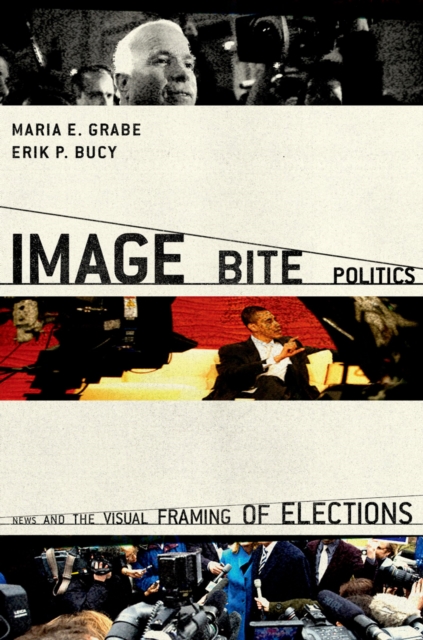
Image bite politics : news and the visual framing of elections
Image Bite Politics is the first book to systematically assess the visual presentation of presidential candidates in network news coverage of elections and to connect these visual images with shifts in public opinion. Presenting the results of a comprehensive visual analysis of general election news from 1992-2004, encompassing four presidential campaigns, the authors highlight the remarkably potent influence of television images when it comes to evaluating leaders. The book draws from a variety of disciplines, including political science, behavioral biology, cognitive neuroscience, and media studies in order to investigate the visual framing of elections in an interdisciplinary fashion. Moreover, the book presents findings that are counterintuitive and which challenge widely held assumptions; yet are supported by systematic data. For example, Republicans receive consistently more favorable visual treatment than Democrats, countering the conventional wisdom of a “liberal media bias”; and image bites are more prevalent, and in some elections more potent, in shaping voter opinions of candidates than sound bites. Finally, the authors provide a foundation for promoting visual literacy among news audiences and bring the importance of visual analysis to the forefront of research.
eBook