
Catalogue Search | MBRL


Are you sure you want to remove the book from the shelf?

{{itemTitle}}
48
result(s) for
"Presidents Election Corrupt practices."
Sort by:

Exonerated : the failed takedown of President Donald Trump by the swamp
\"[This book] reveals how Deep State actors relied on a cynical plug-and-play template to manufacture the now-discredited Russiagate scandal ... [The author] exposes who masterminded the dangerous playbook to take down Trump, their motives, and how a plan filled with faked allegations backfired--forcing investigators to up the ante and hide their missteps and half-truths in a desperate effort to prove a collusion case that never happened. The result? The misguided multimillion Mueller investigation that tore the nation apart, tried to destabilize the presidency and led, as the world now knows, to nowhere!\"--Dust jacket flap.
Book
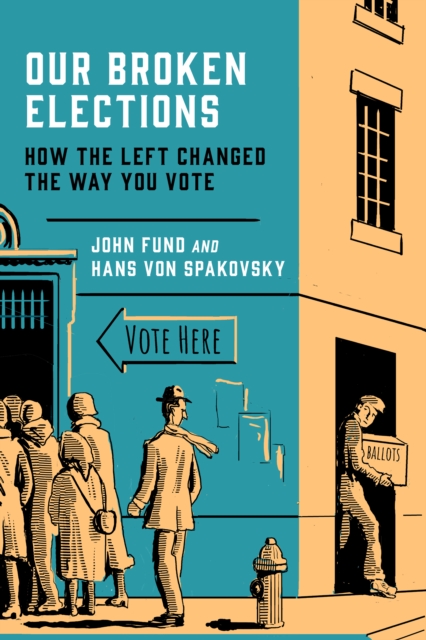
Our Broken Elections
Behind the deeply contentious 2020 election stands a real story of a broken election process. Election fraud that alters election outcomes and dilutes legitimate votes occurs all too often, as is the bungling of election bureaucrats. Our election process is full of vulnerabilities that can be – and are –taken advantage of, raising questions about, and damaging public confidence in, the legitimacy of the outcome of elections. This book explores the reality of the fraud and bureaucratic errors and mistakes that should concern all Americans and offers recommendations and solutions to fix those problems.
eBook

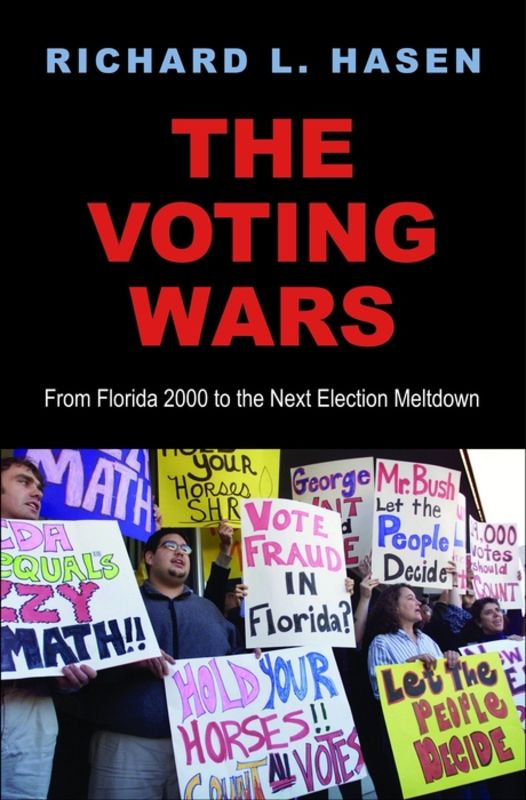
The voting wars : from Florida 2000 to the next election meltdown
In 2000, just a few hundred votes out of millions cast in the state of Florida separated Republican presidential candidate George W. Bush from his Democratic opponent, Al Gore. The outcome of the election rested on Florida's 25 electoral votes, and legal wrangling continued for 36 days. Then, abruptly, one of the most controversial Supreme Court decisions in U.S. history, Bush v. Gore, cut short the battle. Since the Florida debacle we have witnessed a partisan war over election rules. Election litigation has skyrocketed, and election time brings out inevitable accusations by political partisans of voter fraud and voter suppression. These allegations have shaken public confidence, as campaigns deploy \"armies of lawyers\" and the partisan press revs up when elections are expected to be close and the stakes are high.Richard L. Hasen, a respected authority on election law, chronicles and analyzes the battles over election rules from 2000 to the present. From a nonpartisan standpoint he explores the rising number of election-related lawsuits and charges of voter fraud as well as the decline of public confidence in fair results. He explains why future election disputes will be worse than previous ones-more acrimonious, more distorted by unsubstantiated allegations, and amplified by social media. No reader will fail to conclude with Hasen that election reform is an urgent priority, one that demands the attention of conscientious citizens and their elected representatives.Also available: The Fraudulent Fraud Squad, an e-excerpt from The Voting WarsReleased February 2012 9780300187489 $1.99
eBook

The Mueller report
\"Read the findings of the Special Counsel's investigation into Russian interference in the 2016 election, complete with accompanying analysis by the Post reporters who've covered the story from the beginning. This edition from The Washington Post/Scribner contains: --The long-awaited report -- An introduction by The Washington Post titled 'A President, a Prosecutor, and the Protection of American Democracy' --A timeline of the major events of the Special Counsel's investigation from May 2017, when Robert Mueller was appointed, to the present day --A guide to individuals involved, including in the Special Counsel's Office, the Department of Justice, the FBI, the Trump Campaign, the White House, the Trump legal defense team, and the Russians --Key documents in the Special Counsel's investigation, including filings pertaining to General Michael T. Flynn, Paul Manafort, Michael Cohen, Roger Stone, and the Russian internet operation in St. Petersburg. Each document is introduced and explained by Washington Post reporters. One of the most urgent and important investigations ever conducted, the Mueller inquiry focuses on Donald Trump, his presidential campaign, and Russian interference in the 2016 election, and draws on the testimony of dozens of witnesses and the work of some of the country's most seasoned prosecutors. The Special Counsel's investigation looms as a turning point in American history.\"-- Provided by publisher.
BOOK

Regulating the “Most Accessible Marketplace of Ideas in History”
The libertarian regulatory environment of online political advertising has come under scrutiny again, as news reports continue to come out describing the extent of Russian interference with the 2016 presidential election. For years, Silicon Valley has resisted Washington, D.C.’s efforts to regulate online political advertising. Tech companies feared regulation would threaten not only their business models, but also the Internet’s status as the “most accessible marketplace of ideas in history.” But can America’s democracy continue to tolerate lax regulation of online political advertising? Overwhelming evidence of Russian operatives spreading divisive messages across online platforms during the 2016 presidential election demands a government response. In fact, Congress is now debating the Honest Ads Act, and the Federal Election Commission is considering implementing regulations to increase the transparency of online political advertisements. With the specter of regulation, Facebook, Google, and Twitter have updated their policies governing online political advertising.
This Note argues that Congress should pass the Honest Ads Act, which requires disclosure for online political advertising and makes reasonable efforts to stop foreign interference with elections. Disclosure requirements are important because they provide information to voters, deter corruption, and facilitate enforcement of campaign laws. The Supreme Court has long upheld disclosure requirements, including in its controversial Citizens United v. Federal Election Commission decision. But disclosure requirements are likely only a partial solution. Laws and regulations may struggle to reach the trolls and bots that spread Russian disinformation during the 2016 presidential election without infringing the First Amendment. To rein in these bad actors, American democracy will have to rely on Silicon Valley to police online platforms rather than on Washington, D.C.
This Note first provides an overview of the development of disclosure requirements in the Supreme Court’s jurisprudence. It then describes the libertarian regulatory environment of online political advertising and Silicon Valley’s efforts to self-regulate in the wake of the 2016 presidential election. Finally, the Note advocates for the passage of the Honest Ads Act and discusses the limits of regulating online political advertising.
Journal Article

Crime in progress : inside the Steele dossier and the Fusion GPS investigation of Donald Trump
\"The never-before-told inside story of the high-stakes, four-year-long investigation into Donald Trump's Russia ties--culminating in the Steele dossier, and sparking the Mueller report--from the founders of political opposition research company Fusion GPS\"-- From publisher's website.
Book

ACCESS GRANTED
Data scraping—the automated collection of data on the internet—is used in a variety of contexts. On the commercial side, scraping might be used as a means of competition—such as scraping by one company to retrieve information on prices for services provided by a competitor. On the noncommercial side, scraping could be used as a research tool—such as scraping by a news outlet to investigate Amazon’s pricing algorithm. Despite the varied applications of data scraping, courts’ varying interpretations of the Computer Fraud and Abuse Act (CFAA) can impose both civil and criminal liability for scraping. This Note argues that there are competing First Amendment interests both in favor of and against scraping, depending on the type of scraping conducted. Because the CFAA does not distinguish between various types of scraping and balance these competing interests, a legislative solution is needed to comport with both First Amendment interests of accountability and political self-governance on one end, and privacy on the other end.
Journal Article

CAN “LOVE” BE A CRIME? THE SCOPE OF THE FOREIGN NATIONAL SPENDING BAN IN CAMPAIGN FINANCE LAW
Federal campaign finance law prohibits foreign nationals from making contributions or expenditures of “money or other thing of value” in connection with American elections and prohibits anyone from soliciting such a contribution or expenditure. The revelation that officials from Donald Trump’s 2016 presidential campaign met with Russian nationals after being told they would receive “information that would incriminate” Hillary Clinton, Trump’s political opponent, raised the question of how broadly the foreign national spending ban extended.
This Note uses the circumstances of the June 2016 meeting to examine the scope of the foreign national spending ban. It analyzes whether “thing of value” should be construed to encompass intangibles such as information about a political rival. It then questions whether a broad reading of the statute would violate the First Amendment. It concludes by suggesting ways in which institutional actors such as the courts, Congress, and the Federal Election Commission might consider clarifying this area of the law.
Journal Article