
Catalogue Search | MBRL


Are you sure you want to remove the book from the shelf?

{{itemTitle}}
588,861
result(s) for
"Presidents Election."
Sort by:


Popular Choice and Managed Democracy: The Russian Elections of 1999 and 2000
Twice in the winter of 1999-2000, citizens of the Russian Federation flocked to their neighborhood voting stations and scratched their ballots in an atmosphere of uncertainty, rancor, and fear. This book is a tale of these two elections -one for the 450-seat Duma, the other for President. Despite financial crisis, a national security emergency in Chechnya, and cabinet instability, Russian voters unexpectedly supported the status quo. The elected lawmakers prepared to cooperate with the executive branch, a gift that had eluded President Boris Yeltsin since he imposed a post-Soviet constitution by referendum in 1993. When Yeltsin retired six months in advance of schedule, the presidential mantle went to Vladimir Putin -a career KGB officer who fused new and old ways of doing politics. Putin was easily elected President in his own right. This book demonstrates key trends in an extinct superpower, a troubled country in whose stability, modernization, and openness to the international community the West still has a huge stake.
eBook


VP Advantage
A widespread perception exists among political commentators, campaign operatives and presidential candidates that vice presidential (VP) running mates can deliver their home state's electoral votes in a presidential election. In recent elections, presidential campaigns have even changed their strategy in response to the perceived VP home state advantage. But is the advantage real? And could it decide a presidential election? In the most comprehensive analysis to date, Devine and Kopko demonstrate that the VP home state advantage is actually highly conditional and rarely decisive in the Electoral College. However, it could change the outcome of a presidential election under narrow but plausible conditions. Sophisticated in its methodology and rich in historical as well as contemporary insight, The VP Advantage is essential and accessible reading for anyone interested in understanding how running mates influence presidential elections.
eBook


Why Americans split their tickets
Why do some voters split their ballots, selecting a Republican for one office and a Democrat for another? Why do voters often choose one party to control the White House while the other controls the Congress? Citizens and politicians have been grappling with the consequences of such \"divided government\" for thirty years. In Why Americans Split their Tickets, Barry C. Burden and David C. Kimball address these fundamental puzzles of American elections. Burden and Kimball explain the causes of divided government and, rejecting the dominant explanations for split-ticket voting, they debunk the myth that voters prefer divided government to one-party control. Likewise, they make a case against interpreting the frequency of divided government as a mandate for compromise between the parties' extremist positions. Instead, the authors argue that ticket splitting and divided government are the unintentional results of lopsided campaigns and the blurring of party differences. In Why Americans Split their Tickets, Burden and Kimball use new quantitative methods to analyze the important changes in presidential, House, and Senate campaigns in the latter half of the twentieth century. Their approach explains the effects on voters' behavior of such developments as the rise of incumbency advantage and the increasing importance of money to campaigns in the 1960s and 1970s. The authors also observe that ticket splitting has declined in recent years. They link this emerging voting pattern to the sharpening policy differences between parties, illuminating the ways that ideological positions of candidates still matter in American elections.
eBook


The 2000 Presidential Election and the Foundations of Party Politics
In the aftermath of the 2000 presidential election, campaigns suddenly seem to matter, as do questions about the electoral process. Professors Johnston, Hagen and Jamieson have examined the US electoral process as an integrated event spanning a full year, drawing upon a data set that is massive in scale and novel in execution: the Annenberg 2000 Election Study. The scale of their fieldwork is such that they have been able to isolate key turning points and that dynamics can be studied within certain segments. The interviews are rich in opinion about policy, perception, information and judgement about candidates, media use and strategy. What is more, the authors have used candidate appearances, news coverage, and campaign advertising to provide the first integrated account of this or any US campaign.
eBook

Understanding presidential elections
\"This book for elementary readers highlights the sequence of events from idea to implementation. Engaging photographs and a timeline support each step in the process, from campaigning through primary elections, general elections and the final vote. A glossary, further resources, and an index are included\"-- Provided by publisher.
Book
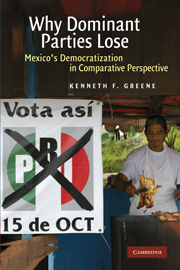
Why Dominant Parties Lose
Why have dominant parties persisted in power for decades in countries spread across the globe? Why did most eventually lose? Why Dominant Parties Lose develops a theory of single-party dominance, its durability, and its breakdown into fully competitive democracy. Greene shows that dominant parties turn public resources into patronage goods to bias electoral competition in their favor and virtually win elections before election day without resorting to electoral fraud or bone-crushing repression. Opposition parties fail because their resource disadvantages force them to form as niche parties with appeals that are out of step with the average voter. When the political economy of dominance erodes, the partisan playing field becomes fairer and opposition parties can expand into catchall competitors that threaten the dominant party at the polls. Greene uses this argument to show why Mexico transformed from a dominant party authoritarian regime under PRI rule to a fully competitive democracy.
eBook