
Catalogue Search | MBRL


Are you sure you want to remove the book from the shelf?

{{itemTitle}}
174
result(s) for
"Primatologists."
Sort by:

You can be a primatologist
\"Come along with Dr. Jill Pruetz as she heads to the wilds of Africa to study chimpanzees and other primates. Through simple, accessible text in question-and-answer format and bright, friendly photography, young scientists will learn all about this exciting science career. Do all primates live in the jungle? Do primatologists live there with them? What's a primatologist's day like? Explore these questions and more!\"-- Provided by publisher.
Book
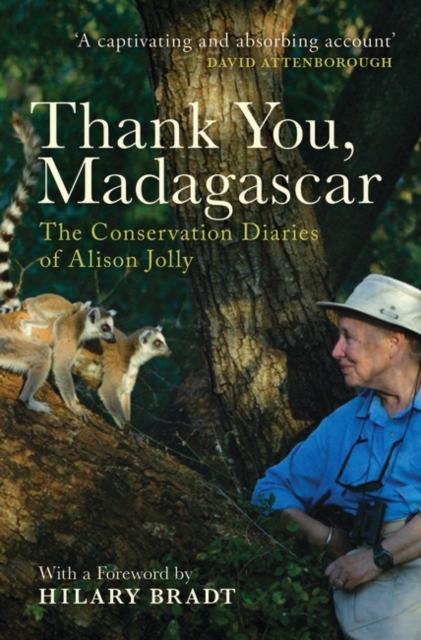
Thank You, Madagascar
'An enchanting book…poignant and passionate.' Geographical 'A captivating and absorbing account.' Sir David Attenborough Madagascar is one of the world's natural jewels, with over ninety per cent of its wildlife found nowhere else on Earth. Few people knew it better than the pioneering primatologist and conservationist, Alison Jolly. Thank You, Madagascar is her eyewitness account of the extraordinary biodiversity of the island, and the environment of its people. At the book's heart is a conflict between three different views of nature. Is the extraordinary forest treasure-house of Madagascar a heritage for the entire world? Is it a legacy of the forest dwellers' ancestors, bequeathed to serve the needs of their living descendants? Or is it an economic resource to be pillaged for short-term gain and to be preserved only to deliver benefits for those with political power? Exploring and questioning these different views, this is a beautifully written diary and a tribute to Madagascar.
eBook


Lemurs in Context
An interview with ethnoprimatology researcher Ian Colquhoun is presented. Among other things, Colquhoun talks about understanding primates in the context of their environment.
Journal Article


The bonobo and the atheist : in search of humanism among the primates
A renowned primatologist argues that ethical behavior witnessed in animals is the evolutionary and biological origin of human fairness and explains that morality has more to do with natural instincts than with religion.
Book


Animal scientist and activist Jane Goodall
\"Jane Goodall spent her childhood drawing animals and dreaming of visiting Africa to observe these animals up close. Learn what discoveries she made after her dream came true, along with the impact of her research\"-- Provided by publisher.
Book

Witnessing Chimpanzee–Human Closeness: Jane Goodali at Gombe and Since./Testemunhando a Proximidade Chimpanze-Humano: Jane Goodall em Gombe e Desde Entao
This article identifies a standardized account, now in wide circulation, of Jane Goodall's discovery in 1960 of chimpanzee \"tool-making,\" thereby demonstrating (Goodall claimed) the distinctive closeness of chimpanzees and humans. The piece traces this standardized account to Goodall's own 1971 work, In the Shadow of Man. Comparing the 1971 account of the incident to both a) reports of Goodall's work before then and b) her own field notes from 1960, the piece shows that Goodall's 1971 work projected back into the initial moment of observation encodings and interpretations not present in the initial moment of observation. In so doing, the 1971 account empiricized (and de-historicized) its encodings and interpretations. Specifically obscured by this instance of retrospective empiricizing, moreover, is Goodall's reliance on a functionalist (and thus culture-free) understanding of human tools and tool-making, in her larger claims about the closeness of chimpanzees to humans. A final section of the piece looks at the ideological work done by the pervasive signifying of chimpanzee-human closeness by Goodall's public persona in our time, taking that persona to be an instance of a rare type--a \"serious celebrity.\" Along the way, the piece registers elements of historical specificity in Goodall's relationship to her mentor Louis Leakey, the Gombe field site in Tanzania, professionalized science, and more.
Journal Article