
Catalogue Search | MBRL


Are you sure you want to remove the book from the shelf?

{{itemTitle}}
1,960
result(s) for
"Prince Edward"
Sort by:


Brown's battleground
\"When the U.S. Supreme Court handed down its decision in Brown v. Board of Education in 1954, Prince Edward County, Virginia, home to one of the five cases combined by the Court under Brown, abolished its public school system rather than integrate. Jill Titus situates the crisis in Prince Edward County within the seismic changes brought by Brown and Virginia's decision to resist desegregation. While school districts across the South temporarily closed a building here or there to block a specific desegregation order, only in Prince Edward did local authorities abandon public education entirely--and with every intention of permanence. When the public schools finally reopened after five years of struggle--under direct order of the Supreme Court--county authorities employed every weapon in their arsenal to ensure that the newly reopened system remained segregated, impoverished, and academically substandard. Intertwining educational and children's history with the history of the black freedom struggle, Titus draws on little-known archival sources and new interviews to reveal the ways that ordinary people, black and white, battled, and continue to battle, over the role of public education in the United States.\" -- Provided by publisher.
eBook


Rural Protest on Prince Edward Island
Who has the more legitimate claim to land, settlers who occupy and improve it with their labour, or landlords who claim ownership on the basis of imperial grants? This question of property rights, and their construction, was at the heart of rural protest on Prince Edward Island for a century. Tenants resisted landlord claims by squatting and refusing to pay rent. They fought for their vision of a just rural order through petitions, meetings, rallies, electoral campaigns, and direct action. Landlords responded with their own collective action to protect their interests. In Rural Protest on Prince Edward Island Rusty Bittermann examines this conflict and the dynamic of rural protest on the Island from its establishment as a British colony in the 1760s to the early 1840s.
The focus of Bittermann's study is the remarkable mass movement known as the Escheat movement, which emerged in the 1830s in the context of growing popular challenges elsewhere in the Atlantic World. The Escheat movement aimed at resolving the land question in favour of tenants by having the state resume (escheat) the large grants of land that created landlordism on the Island. Although it ultimately gained control of the assembly in the late 1830s, the Escheat movement did not produce the land policies that tenants and their allies advocated. The movement did, however, synthesize years of rural protest and produce a persistent legacy of language and ideas concerning land, justice, and the rights of small producers that helped to make landlordism on the Island unsustainable in the long term. Rural Protest on Prince Edward Island is a comprehensive and fascinating examination of an important, but often overlooked, period in the history of Canada's smallest province.
eBook


Prince Edward Island Sayings
A long-awaited companion volume to Pratt?s Dictionary of Prince Edward Island English, this delightful collection includes more than 1,000 proverbs, folk sayings, and catchphrases characteristic of the speech and attitudes of Prince Edward Islanders.
eBook

A little child shall lead them : a documentary account of the struggle for school desegregation in Prince Edward County, Virginia
\"... a collection of primary documents addressing the civil rights-era struggle for public education in Prince Edward County, Virginia\"--ECIP pre-chapter.
Book
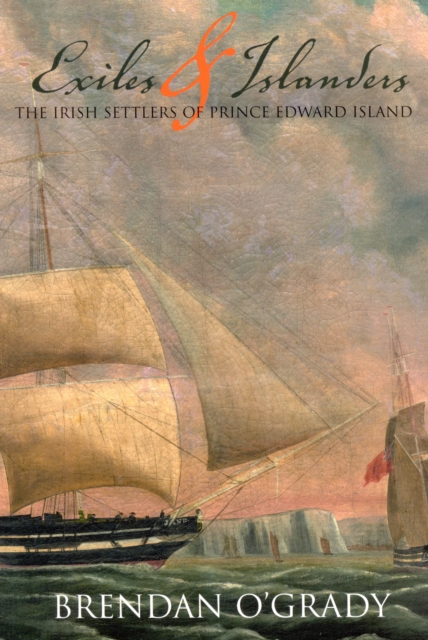
Exiles and Islanders
Over ten thousand Irish settled in PEI in the nineteenth century; by 1850 they comprised about a quarter of the Island's population. They were mainly pre-Famine immigrants and mostly Catholic. They came from all thirty-two counties of Ireland and settled in all sixty-seven townships of PEI. They took up farming, fishing, and rural occupations; raised large families; and retained their Irishness for several generations. Exiles and Islanders includes family names and places of origin that will be of particular interest to the Island's Irish descendants. An intriguing cultural history, the book provides new insight into the early settlers of Prince Edward Island.
eBook

Anne of Ingleside
Anne Shirely has enough to worry about, with five children, another on the way, and a prolongued visit from insufferable Aunt Mary Maria, without the additional worry that her husband Gilbert does not love her any longer.
Book

Physical Transport Mechanisms Driving Sub-Antarctic Island Marine Ecosystems
The Southern Ocean is undergoing rapid environmental change, which has impacted its ecosystems and food webs. There is need for ecosystem models that incorporate all levels of the biotic system and consider physical context. Using an end-to-end ecosystem model of the Prince Edward Islands (PEIs), we investigated the importance of the input of oceanic nutrients, oceanic plankton, and run-off of terrestrial ammonium to nearshore production. We compared ecosystem state as group production rates and as the relative scale of pelagic versus demersal food web pathways under alternate ocean current regimes, assumptions of macrozooplankton advection into shelf waters, and assumptions of plankton retention within the nearshore region. The major outcomes are: (1) oceanic plankton, more than oceanic nutrients or terrestrial nutrients, is the major driver of production for all groups within the nearshore ecosystem. Island run-off of ammonium is a minor driver of production but is most important among groups with higher reliance upon detrital food chains (benthic invertebrates, demersal fishes, Gentoo penguins); (2) groups most sensitive to changes in ocean current regime and assumptions of macrozooplankton advection into shelf waters are planktivores (southern rockhopper penguins, Macaroni penguins) and piscivores whose diets rely heavily upon planktivorous fishes; (3) zooplankton populations cannot support estimated levels of predation pressure within the nearshore ecosystem if they behave as purely passive drifters. Our findings suggest changes to physical processes, such as a postulated southward shift in the position of the sub-Antarctic front leading to intensification of currents approaching the islands, has already had and will continue to have significant impacts on the PEIs ecosystem.
Journal Article