
Catalogue Search | MBRL


Are you sure you want to remove the book from the shelf?

{{itemTitle}}
175,071
result(s) for
"Principle"
Sort by:


Navigating the Tensions: ESA, EU, the Geographical Return Principle, and Competitiveness in the European Ambit
This academic paper explores the relationship between the European Space Agency (ESA) and the European Union (EU), that has been marked by perceived incompatibilities, particularly regarding the ESA’s Geographical Return Principle (GRP) and the EU’s principles of unrestricted trade in the single market. The GRP, aimed at distributing contracts based on Member States’ financial contributions, has raised concerns about restricted competition, conflicting with the EU’s objective of fostering a fair and competitive market. Frictions have also arisen concerning EU competition rules and state aid regulations. While the ESA has incorporated certain EU procurement regulations into its procedures to enhance competitiveness, reconciling the unique characteristics of the space sector and long-term projects remains essential. The compatibility between the ESA and the EU has been debated, with some highlighting exemptions in the EU treaty and the scientific nature of the ESA. However, aligning the GRP with the EU single market presents significant challenges due to conflicting principles and potential discrimination among Member States. The ESA-EU relationship continues to grapple with the tension between the GRP and the EU’s single market principles. The creation of the European Union Agency for the Space Programme (EUSPA) reflects the EU’s recognition of its lack of technical capabilities and the need to align with market-driven competitiveness. The evolving landscape suggests a potential future where a centralized EU agency oversees the European space sector, but questions about fairness and state aid remain.
Journal Article

Beyond the pleasure principle
Beyond the Pleasure Principle, first published in 1920, is the first clear statement of Freud's changed drive theory: love and life now stand over against aggression and death. The book represents an important theoretical revision of Freud's earlier ideas and a turning point in psychoanalytic theory.
BOOK

Smart Contracts and the Principles of the Law of Obligations
Introduction: the digitalization of public relations and the emergence of smart contracts have created the need to study what a smart contract is and whether it is subject to the general principles of the law of obligations. Methods: the methodological framework for the research is a set of methods of scientific knowledge, among which the main ones are the methods of historicism, consistency, and analysis. Results: the possibility of extending the principles of the law of obligations to the relations of the parties when they conclude a smart contract is analyzed. Conclusions: the conclusion is made about the extension of the principles of the law of obligations to smart contracts with the features due to the nature of smart contracts.
Journal Article


Multiplicity and Stability of the Pohozaev Obstruction for Hardy-Schrödinger Equations with Boundary Singularity
Let
On the other hand, the sharp blow-up analysis also allows us to show that if the mean curvature at
eBook


The Virtue of Violence in Sport
This paper explores the ethical dimensions of violence in sporting contexts, proposing that violence can be a virtue when characterized by controlled physicality. While society often views violence negatively, the paper argues that within rule-governed sports, certain forms of violence are morally permissible, strategically valuable, and essential to upholding the integrity of the game. Drawing on Suitsian terms and Kantian ethics, the paper develops a theory of lusory violence, distinguishing it from uncontrolled physicality or unmitigated violence. By examining the roles of enforcers in hockey, the development of MMA, and the ethics of sport jiu-jitsu, the paper suggests that violence is acceptable within a lusory framework only when it is purposive, strategically relevant, and constrained by rules that prioritize technical skill over raw damage. Ultimately, the paper argues that the ability to modulate violent behaviour represents a form of moral development, framing virtuous violence as a necessary tool for maintaining natural justice and personal excellence within specific sporting environments. Yet, virtuous violence is subordinate to technique, justice, and other defining elements of sports.
Journal Article
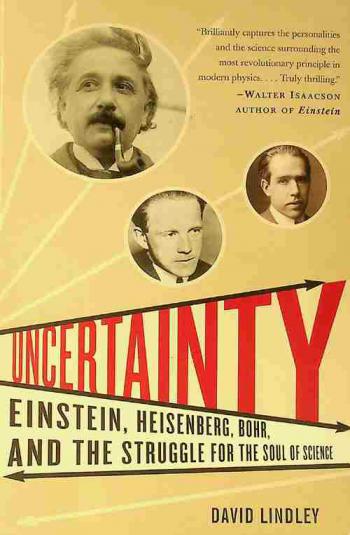
Uncertainty : Einstein, Heisenberg, Bohr, and the struggle for the soul of science
The remarkable story of a startling scientific idea that ignited a battle among the greatest minds of the twentieth century and profoundly influenced intellectual inquiry in fields ranging from physics to literary criticism, anthropology and journalism. In 1927, young German physicist Werner Heisenberg challenged centuries of scientific understanding when he introduced what came to be known as \"the uncertainty principle.\" Heisenberg proved that in many physical measurements, you can obtain one bit of information only at the price of losing another. This proposition, undermining the cherished belief that science could reveal the physical world with limitless detail and precision, placed Heisenberg in direct opposition to the revered Albert Einstein. Niels Bohr, Heisenberg's mentor and Einstein's long-time friend, found himself caught between the two. Bohr understood that Heisenberg was correct, but he also recognized the vital necessity of gaining Einstein's support as the world faced the shocking implications of Heisenberg's principle.--From publisher description.
Book

On the strong maximum principle for nonlocal operators
In this paper we derive a strong maximum principle for weak supersolutions of nonlocal equations of the form
I
u
=
c
(
x
)
u
in
Ω
,
where
Ω
⊂
R
N
is a domain,
c
∈
L
∞
(
Ω
)
and
I
is an operator of the form
I
u
(
x
)
=
P
.
V
.
∫
R
N
(
u
(
x
)
-
u
(
y
)
)
j
(
x
-
y
)
d
y
with a nonnegative kernel function
j
. We formulate minimal positivity assumptions on
j
corresponding to a class of operators, which includes highly anisotropic variants of the fractional Laplacian. Somewhat surprisingly, this problem leads to the study of general lattices in
R
N
. Our results extend to the regional variant of the operator
I
and, under weak additional assumptions, also to the case of
x
-dependent kernel functions.
Journal Article