
Catalogue Search | MBRL


Are you sure you want to remove the book from the shelf?

{{itemTitle}}
419
result(s) for
"Printing Specimens."
Sort by:


A Preliminary Study of the Effect of 3D Printing Orientation on Mechanical Properties and Fracture of Samples Made from AlSi10Mg
The significant advancement in additive technologies has made it possible to manufacture metal components in diverse shapes and sizes. Despite this progress, numerous processes and phenomena, along with the implications of producing components layer by layer on their performance under stress, remain inadequately explored. These factors not only affect microstructure but subsequently also the mechanical properties. The positioning of objects within the 3D printer’s workspace can thus significantly play a crucial role in their operational functionality, reliability, and safety of the equipment in an application. This article studies anisotropic properties and the influence of the printing orientation of aluminum alloy (AlSi10Mg) cylindrical tensile samples fabricated through an additive approach on their mechanical properties under tensile loading. Tensile testing of specimens covering seven different spatial orientations in the workspace of a 3D printing machine was performed according to ISO 6892-1 international standard. Minimum and maximum tensile properties (yield and ultimate tensile strength) have been observed in Y-sample and X-sample series, respectively. In contrast, elastic modulus of the 3D printed specimens was minimal for X-sample series, and maximal for Y-sample series. Fracture surfaces of the samples in seven basic spatial orientations were evaluated in synergy with the mechanical testing results determined by optical, electron microscopy, and electron backscatter diffraction (EBSD) textural analysis to find correlation between the strength of the samples and the orientation of grains, their size and morphology. Furthermore, thermodynamic and Scheil–Gulliver simulation has been employed in order to explain the formation of intermetallic phases during additive manufacturing and further justifying observations in microstructure and mechanical properties. The disparity in texture intensity between these regions for samples Y(3) is likely responsible for localized mechanical incompatibilities and strain heterogeneity, resulting in preferential crack paths and reduced mechanical strength compared to the sample Z(3), which presented a more randomized orientation distribution with less distinguishable texture zones, enabling better strain accommodation and more uniform plastic deformation, which correlates with its higher tensile and yield strength.
Journal Article

Specimens of chromatic wood type, borders, &c.
Specimens of Chromatic Wood Type, Borders, &c.' is a vintage volume with an established cultlike status within the bibliophile, typographic, and design worlds. Originally published as a catalogue for William H. Page's Connecticut wood type foundry considered one of the best in the world this 1874 type specimen book features elaborate display typefaces meant to announce tent revivals and circuses. In addition to the beautifully intricate typefaces and playful designs, the original author designed the pages in such a random sequence that the text reads as humorous and strange experimental poetry. Accidental or not, this beautiful book will delight readers with the humor and the beauty of each print. This edition reproduces all 102 pages of the original book. A charming gift or perfect addition to any serious art-book library, this volume will be loved by typographers, designers, artists, poets, DIYers, and anyone with a wicked sense of style.
Book

Adrian Frutiger
Based on conversations with Frutiger himself and on extensive research in France, England, Germany, and Switzerland, this publication provides a highly detailed and accurate account of the type designer's artistic development and his work. With the support of Pro Helvetia, Swiss Arts Council
eBook

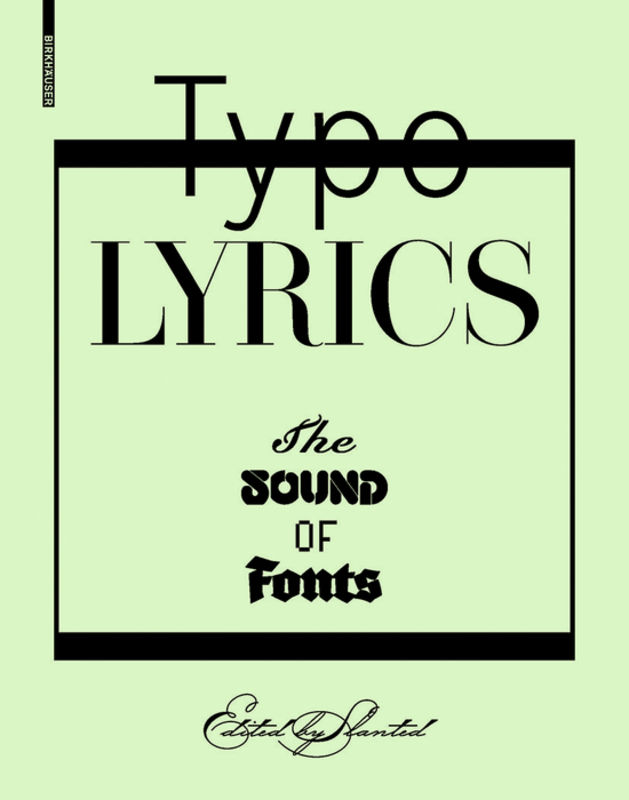
TypoLyrics
Graphic designers love music. This is attested not least by the tremendous enthusiasm that readers of the typography magazine Slanted bring to its \"Typo Lyrics\" column, in which designers interpret music in entirely new ways with the help of fonts. For this publication of the same name, celebrated graphic designers like Fons Hickmann as well as talented young designers from all over the world have taken song lyrics and used them as the inspiration for innovative font designs. The result is a collection of fascinating visuals - \"typographic images\" that present contemporary fonts a little bit differently. The extraordinary interplay of type design and music brings the fonts to life and practically sets them dancing. In contrast to classical pattern books and font fans, this volume provides a special, more emotional experience of typography and illustrates the great expressive potential of typefaces. On analogy with the traditional classification of fonts, the book is organized into eleven chapters, each of which treats a particular font family and song lyrics from a particular musical style.
eBook
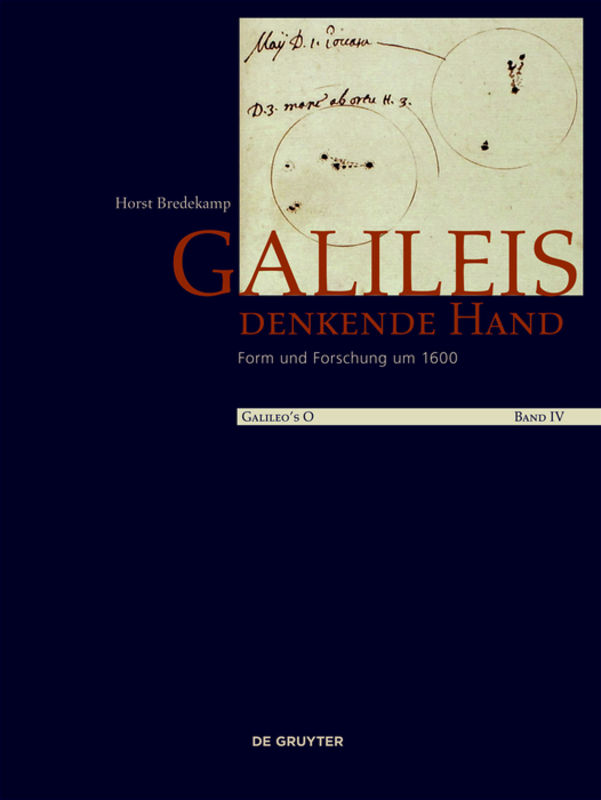
Galileo's O
Galileis denkende Hand stellt eine grundlegende Überarbeitung des im Jahr 2007 erschienenen Werkes Galilei, der Künstler dar. Bereinigt um eine fehlerhafte Zuschreibung, entfaltet es auf stark erweiterter Grundlage das künstlerische Element von Galileis Forscherleben. Nach einer Rekonstruktion von Galileis künstlerischer Ausbildung erschließt es mit seinem künstlerischen Freundeskreis auch seinen zeitkritischen Stilbegriff und seine Kunsttheorie. Die Untersuchung von Galileis Darstellungs- und Analysemittel bei der Erkundung des Mondes, der Sonne, der Jupitermonde und der Fixsterne führt zu zahlreichen neuen Ergebnissen; so erweisen sich die berühmtem Florentiner Mondzeichnungen nicht als Modelle, sondern als Korrekturen der Mondradierungen im Sternenboten von 1610. Schließlich revidiert das Buch die herkömmliche Deutung von Galileis Diktum, dass die Philosophie im geometrischen Buch der Natur ihr Ziel finde. Galilei zufolge besteht die Natur nicht nur aus geometrischer Präzision, sondern auch aus dem Überfluss des Wirren und Wuchernden. Da die Kunst beide Elemente im Blick hat, ist sie für Galilei das Modell aller Philosophie.
eBook

Back to the Future - Part 2. Post-mortem assessment and evolutionary role of the bio-medicolegal sciences
Part 2 of the review “
Back to the Future
” is dedicated to the evolutionary role of the bio-medicolegal sciences, reporting the historical profiles, the state of the art, and prospects for future development of the main related techniques and methods of the ancillary disciplines that have risen to the role of “
autonomous
” sciences, namely, Genetics and Genomics, Toxicology, Radiology, and Imaging, involved in historic synergy in the “
post-mortem assessment
,” together with the mother discipline Legal Medicine, by way of its primary fundament, universally denominated as Forensic Pathology. The evolution of the scientific research and the increased accuracy of the various disciplines will be oriented towards the elaboration of an
“algorithm,”
able to weigh the value of “
evidence
” placed at the disposal of the “
justice system
” as real truth and proof.
Journal Article