
Catalogue Search | MBRL


Are you sure you want to remove the book from the shelf?

{{itemTitle}}
2,006
result(s) for
"Prison administration United States."
Sort by:

Enforcing the convict code : violence and prison culture
The author used qualitative data collected in 2005 and 2006 in California to explore how former inmates (men and women) understand and explain prison violence and inmate culture--Chapter 1.
Book

The Globalization of Supermax Prisons
\"Supermax\" prisons, conceived by the United States in the early 1980s, are typically reserved for convicted political criminals such as terrorists and spies and for other inmates who are considered to pose a serious ongoing threat to the wider community, to the security of correctional institutions, or to the safety of other inmates. Prisoners are usually restricted to their cells for up to twenty-three hours a day and typically have minimal contact with other inmates and correctional staff. Not only does the Federal Bureau of Prisons operate one of these facilities, but almost every state has either a supermax wing or stand-alone supermax prison.
The Globalization of Supermax Prisonsexamines why nine advanced industrialized countries have adopted the supermax prototype, paying particular attention to the economic, social, and political processes that have affected each state. Featuring essays that look at the U.S.-run prisons of Abu Ghraib and Guantanemo, this collection seeks to determine if the American model is the basis for the establishment of these facilities and considers such issues as the support or opposition to the building of a supermax and why opposition efforts failed; the allegation of human rights abuses within these prisons; and the extent to which the decision to build a supermax was influenced by developments in the United States. Additionally, contributors address such domestic matters as the role of crime rates, media sensationalism, and terrorism in each country's decision to build a supermax prison.
eBook


Hard time
Hard Time: A Fresh Look at Understanding and Reforming the Prison, 4th Edition, is a revised and updated version of the highly successful text addressing the origins, evolution, and promise of America's penal system. Draws from both ethnographic and professional material, and situates the prison experience within both contemporary and historical contexts Features first person accounts from male and female inmates and staff, revealing what it's actually like to live and work in prison Includes all-new chapters on prison reform and on supermax correctional facilities, including the latest research on confinement, long-term segregation, and death row Explores a wide range of topics, including the nature of prison as punishment; prisoner personality types and coping strategies; gang violence; prison officers' custodial duties; and psychological, educational, and work programs Develops policy recommendations for the future based on qualitative and quantitative research and evidence-based initiatives
eBook

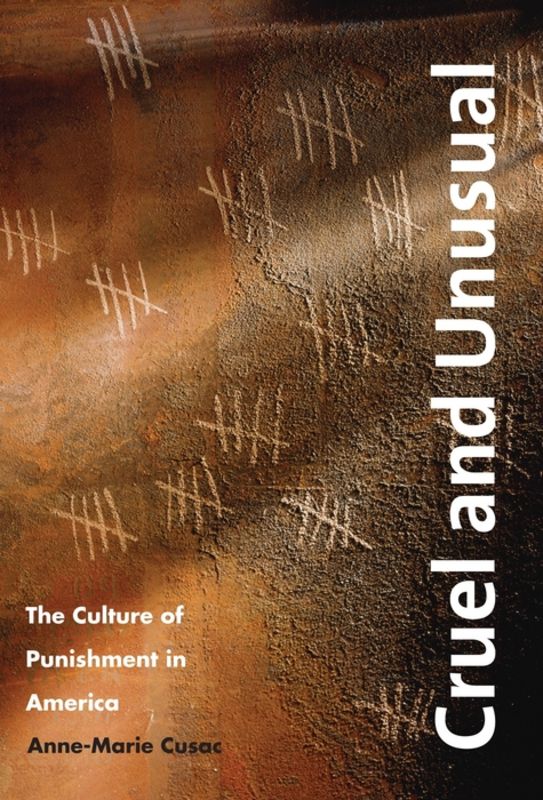
Cruel and Unusual
The statistics are startling. Since 1973, America's imprisonment rate has multiplied over five times to become the highest in the world. More than two million inmates reside in state and federal prisons. What does this say about our attitudes toward criminals and punishment? What does it say about us?
This book explores the cultural evolution of punishment practices in the United States. Anne-Marie Cusac first looks at punishment in the nation's early days, when Americans repudiated Old World cruelty toward criminals and emphasized rehabilitation over retribution. This attitude persisted for some 200 years, but in recent decades we have abandoned it, Cusac shows. She discusses the dramatic rise in the use of torture and restraint, corporal and capital punishment, and punitive physical pain. And she links this new climate of punishment to shifts in other aspects of American culture, including changes in dominant religious beliefs, child-rearing practices, politics, television shows, movies, and more.
America now punishes harder and longer and with methods we would have rejected as cruel and unusual not long ago. These changes are profound, their impact affects all our lives, and we have yet to understand the full consequences.
eBook

Prison Rape
Focusing on discourse generated between 1969 and 2006 in the legal arena and in the print news media, the author takes an historical-interpretive approach to illuminate the role of cultural forces and attendant ideologies in shaping the contours of the phenomenon commonly known as \"prison rape.\" Locating this work within the sociology of punishment, the author employs frame analysis and draws on two previously unrelated literatures – Garland's cultural analytic model and constitutive legal scholarship – to produce a genealogy of discourse about sexual assault in carceral settings as manifest in two important arenas of meaning making. In addition to providing a detailed analysis of the often counterintuitive relationship between these discourses over time, the book considers the recent unanimous passage of the Prison Rape Elimination Act (2003) at a highly punitive historical moment in a nation that has traditionally preferred to litigate rather than legislate questions around the treatment of those it incarcerates.
eBook

Race to incarcerate : a graphic retelling
\"Presents a compelling argument about mass incarceration's tragic impact on communities of color--if current trends continue, one of every three black males and one of every six Latino males born today can expect to do time in prison. The race to incarcerate is not only a failed social policy, but also one that prevents a just, diverse society from flourishing.\"--Publisher's website.
Book
