
Catalogue Search | MBRL


Are you sure you want to remove the book from the shelf?

{{itemTitle}}
19,921
result(s) for
"Prison administration."
Sort by:

Enforcing the convict code : violence and prison culture
The author used qualitative data collected in 2005 and 2006 in California to explore how former inmates (men and women) understand and explain prison violence and inmate culture--Chapter 1.
Book

Doing Time in the Depression
As banks crashed, belts tightened, and cupboards emptied across
the country, American prisons grew fat. Doing Time in the
Depression tells the story of the 1930s as seen from the cell
blocks and cotton fields of Texas and California prisons, state
institutions that held growing numbers of working people from
around the country and the world-overwhelmingly poor,
disproportionately non-white, and displaced by economic crisis.
Ethan Blue paints a vivid portrait of everyday life inside Texas
and California's penal systems. Each element of prison life-from
numbing boredom to hard labor, from meager pleasure in popular
culture to crushing pain from illness or violence-demonstrated a
contest between keepers and the kept. From the moment they arrived
to the day they would leave, inmates struggled over the meanings of
race and manhood, power and poverty, and of the state itself. In
this richly layered account, Blue compellingly argues that
punishment in California and Texas played a critical role in
producing a distinctive set of class, race, and gender identities
in the 1930s, some of which reinforced the social hierarchies and
ideologies of New Deal America, and others of which undercut and
troubled the established social order. He reveals the underside of
the modern state in two very different prison systems, and the
making of grim institutions whose power would only grow across the
century.
eBook


Dilemmas Behind Bars
Prison officers have been described as key determinants of the prison experience for prisoners, yet up until recently this occupational group was largely ignored in academic research.Although society often sees prison officers simply as 'keepers of the keys', the existing research has shown the job to be much more complex.
eBook


The Globalization of Supermax Prisons
\"Supermax\" prisons, conceived by the United States in the early 1980s, are typically reserved for convicted political criminals such as terrorists and spies and for other inmates who are considered to pose a serious ongoing threat to the wider community, to the security of correctional institutions, or to the safety of other inmates. Prisoners are usually restricted to their cells for up to twenty-three hours a day and typically have minimal contact with other inmates and correctional staff. Not only does the Federal Bureau of Prisons operate one of these facilities, but almost every state has either a supermax wing or stand-alone supermax prison.
The Globalization of Supermax Prisonsexamines why nine advanced industrialized countries have adopted the supermax prototype, paying particular attention to the economic, social, and political processes that have affected each state. Featuring essays that look at the U.S.-run prisons of Abu Ghraib and Guantanemo, this collection seeks to determine if the American model is the basis for the establishment of these facilities and considers such issues as the support or opposition to the building of a supermax and why opposition efforts failed; the allegation of human rights abuses within these prisons; and the extent to which the decision to build a supermax was influenced by developments in the United States. Additionally, contributors address such domestic matters as the role of crime rates, media sensationalism, and terrorism in each country's decision to build a supermax prison.
eBook


Prison vocational education and policy in the United States : a critical perspective on evidence-based reform
This book explores California's prison system in the context of vocational education reform. For prisons in the early twenty-first century, ideologies of evidence-based management meant that reform efforts to change the purpose of prisons from punishment to rehabilitation through vocational education required “evidence” to justify policy prescriptions. Yet who determines what constitutes evidence? In political environments, solutions are typically pre-conceived, which means that the nature of the evidence collected is also preconceived. As a result, key assumptions about outcomes are often wished away to show improvement and be accountable. Through a detailed analysis interspersed with stories from the authors' experiences “behind the wall” among California's prison population, the authors challenge the nature of evidence-based research as used in the prison environment. In the process they describe the thorny problems facing reformers. Summary from publisher
Book
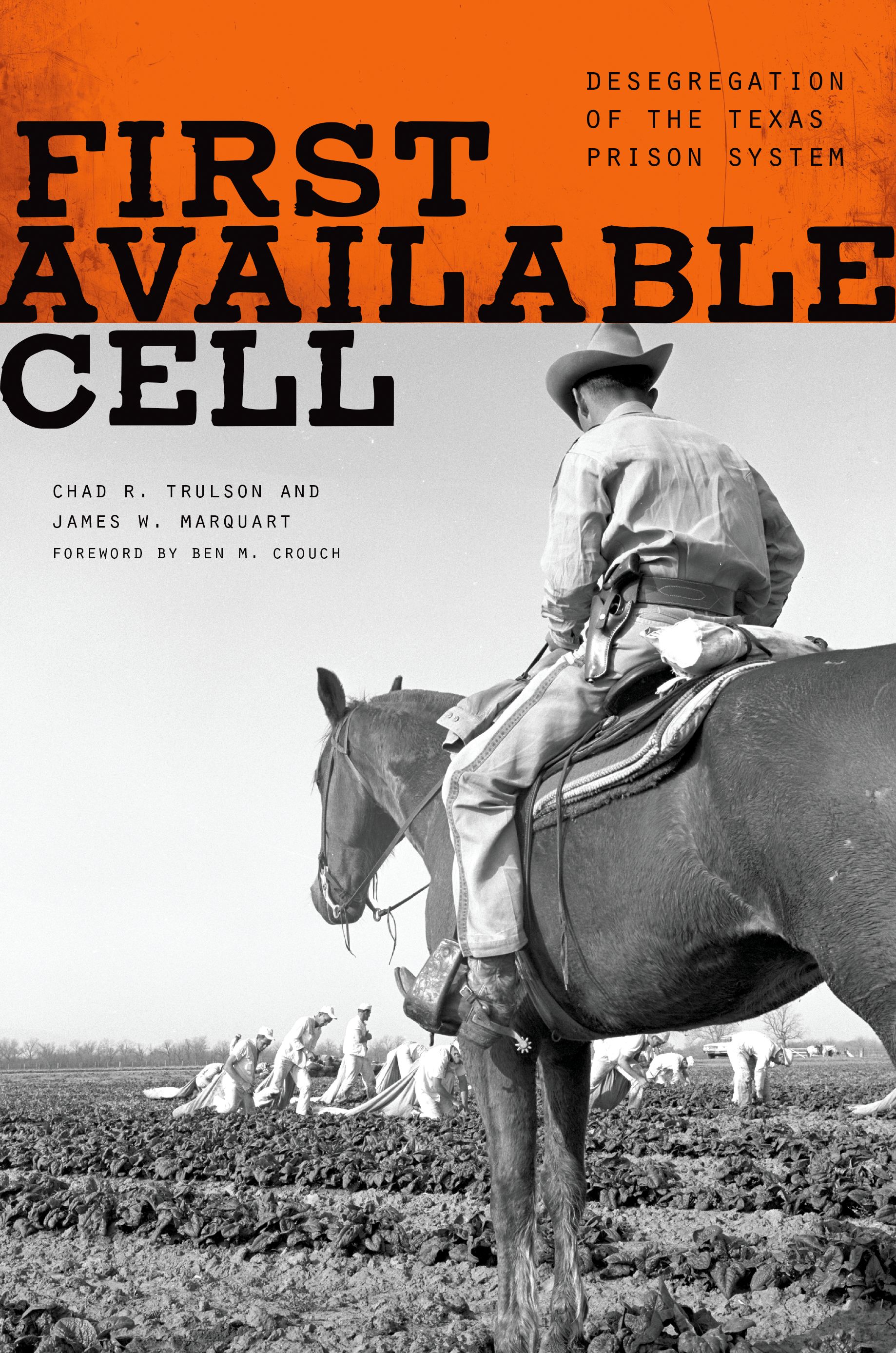
First Available Cell
Decades after the U.S. Supreme Court and certain governmental actions struck down racial segregation in the larger society, American prison administrators still boldly adhered to discriminatory practices. Not until 1975 did legislation prohibit racial segregation and discrimination in Texas prisons. However, vestiges of this practice endured behind prison walls. Charting the transformation from segregation to desegregation in Texas prisons—which resulted in Texas prisons becoming one of the most desegregated places in America—First Available Cell chronicles the pivotal steps in the process, including prison director George J. Beto's 1965 decision to allow inmates of different races to co-exist in the same prison setting, defying Southern norms. The authors also clarify the significant impetus for change that emerged in 1972, when a Texas inmate filed a lawsuit alleging racial segregation and discrimination in the Texas Department of Corrections. Perhaps surprisingly, a multiracial group of prisoners sided with the TDC, fearing that desegregated housing would unleash racial violence. Members of the security staff also feared and predicted severe racial violence. Nearly two decades after the 1972 lawsuit, one vestige of segregation remained in place: the double cell. Revealing the aftermath of racial desegregation within that 9 x 5 foot space, First Available Cell tells the story of one of the greatest social experiments with racial desegregation in American history.
eBook