
Catalogue Search | MBRL


Are you sure you want to remove the book from the shelf?

{{itemTitle}}
9,946
result(s) for
"Prisoners - history"
Sort by:


The Furnace of Affliction
Focusing on the intersection of Christianity and politics in the American penitentiary system, Jennifer Graber explores evangelical Protestants' efforts to make religion central to emerging practices and philosophies of prison discipline from the 1790s through the 1850s.Initially, state and prison officials welcomed Protestant reformers' and ministers' recommendations, particularly their ideas about inmate suffering and redemption. Over time, however, officials proved less receptive to the reformers' activities, and inmates also opposed them. Ensuing debates between reformers, officials, and inmates revealed deep disagreements over religion's place in prisons and in the wider public sphere as the separation of church and state took hold and the nation's religious environment became more diverse and competitive. Examining the innovative New York prison system, Graber shows how Protestant reformers failed to realize their dreams of large-scale inmate conversion or of prisons that reflected their values. To keep a foothold in prisons, reformers were forced to relinquish their Protestant terminology and practices and instead to adopt secular ideas about American morals, virtues, and citizenship. Graber argues that, by revising their original understanding of prisoner suffering and redemption, reformers learned to see inmates' afflictions not as a necessary prelude to a sinner's experience of grace but as the required punishment for breaking the new nation's laws.
eBook


Doing Time in the Depression
As banks crashed, belts tightened, and cupboards emptied across
the country, American prisons grew fat. Doing Time in the
Depression tells the story of the 1930s as seen from the cell
blocks and cotton fields of Texas and California prisons, state
institutions that held growing numbers of working people from
around the country and the world-overwhelmingly poor,
disproportionately non-white, and displaced by economic crisis.
Ethan Blue paints a vivid portrait of everyday life inside Texas
and California's penal systems. Each element of prison life-from
numbing boredom to hard labor, from meager pleasure in popular
culture to crushing pain from illness or violence-demonstrated a
contest between keepers and the kept. From the moment they arrived
to the day they would leave, inmates struggled over the meanings of
race and manhood, power and poverty, and of the state itself. In
this richly layered account, Blue compellingly argues that
punishment in California and Texas played a critical role in
producing a distinctive set of class, race, and gender identities
in the 1930s, some of which reinforced the social hierarchies and
ideologies of New Deal America, and others of which undercut and
troubled the established social order. He reveals the underside of
the modern state in two very different prison systems, and the
making of grim institutions whose power would only grow across the
century.
eBook

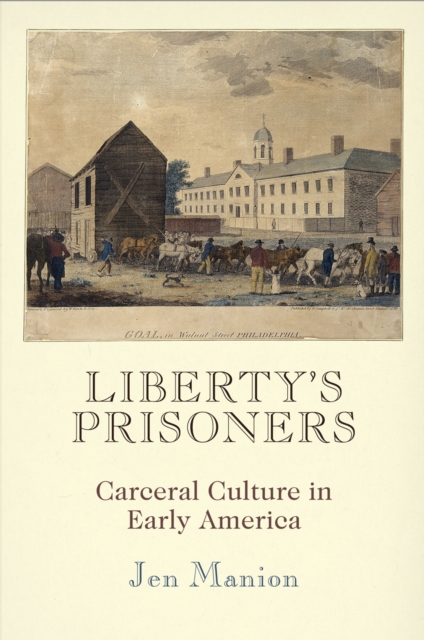
Liberty's Prisoners
Liberty's Prisonersexamines how changing attitudes about work, freedom, property, and family shaped the creation of the penitentiary system in the United States. The first penitentiary was founded in Philadelphia in 1790, a period of great optimism and turmoil in the Revolution's wake. Those who were previously dependents with no legal standing-women, enslaved people, and indentured servants-increasingly claimed their own right to life, liberty, and happiness. A diverse cast of women and men, including immigrants, African Americans, and the Irish and Anglo-American poor, struggled to make a living. Vagrancy laws were used to crack down on those who visibly challenged longstanding social hierarchies while criminal convictions carried severe sentences for even the most trivial property crimes.
The penitentiary was designed to reestablish order, both behind its walls and in society at large, but the promise of reformative incarceration failed from its earliest years. Within this system, women served a vital function, and Liberty's Prisoners is the first book to bring to life the experience of African American, immigrant, and poor white women imprisoned in early America. Always a minority of prisoners, women provided domestic labor within the institution and served as model inmates, more likely to submit to the authority of guards, inspectors, and reformers. White men, the primary targets of reformative incarceration, challenged authorities at every turn while African American men were increasingly segregated and denied access to reform.
Liberty's Prisonerschronicles how the penitentiary, though initially designed as an alternative to corporal punishment for the most egregious of offenders, quickly became a repository for those who attempted to lay claim to the new nation's promise of liberty.
eBook

Dance in chains : political imprisonment in the modern world
\"What part does the imprisoned activist play in the conflict between regimes and their opponents around the world? Political incarceration today seems to offer the clearest evidence of a repressive regime, and of a determined political opposition. Yet surely there are more effective alternatives, for both states and their opponents, than incarceration. Imprisoned opponents, like those of the African National Congress in South Africa, or of Solidarity in Poland, or of the Irish Republican Army in Northern Ireland, may eventually claim or share power, while those who are executed or exiled will not pose the same threat. From the opposition's point of view, imprisonment, even though it deprives the movement of a valued contributor, is often a badge of honor. Our perceptions of political prisoners are awash in clichés and archetypes. We think of Nelson Mandela, or perhaps Václav Havel: good men, engaged in a moral struggle. But can that really be an acceptable definition, when Adolph Hitler too was a political prisoner? Can we understand what political prisoners are and what they do if we do not include those whose goals or ethics are different from our own? Dance in Chains--the title inspired by a song composed by a socialist on death row in a Warsaw prison 120 years ago--draws upon research in Poland, Ireland, South Africa and includes over a dozen different regimes over the last 150 years. These cases serve as pillars holding up a global investigation of the phenomenon. In each case, generations of political opponents have gone to prison since at least the turn of the twentieth century. Yet they also vary widely. Taken together, they yield a sufficiently wide spectrum to allow the reader to understand one of the central characters of modern political history\"--Provided by publisher.
Book

Andersonvilles of the North
Soon after the close of military operations in the American Civil War, another war began over how it would be remembered by future generations. The prisoner-of-war issue has figured prominently in Northern and Southern writing about the conflict. Northerners used tales of Andersonville to demonize the Confederacy, while Southerners vilified Northern prison policies to show the depths to which Yankees had sunk to attain victory. Over the years the postwar Northern portrayal of Andersonville as fiendishly designed to kill prisoners in mass quantities has largely been dismissed. The Lost Cause characterization of Union prison policies as criminally negligent and inhumane, however, has shown remarkable durability. Northern officials have been portrayed as turning their military prisons into concentration camps where Southern prisoners were poorly fed, clothed, and sheltered, resulting in inexcusably high numbers of deaths. Andersonvilles of the North, by James M. Gillispie, represents the first broad study to argue that the image of Union prison officials as negligent and cruel to Confederate prisoners is severely flawed. This study is not an attempt to “whitewash” Union prison policies or make light of Confederate prisoner mortality. But once the careful reader disregards unreliable postwar polemics, and focuses exclusively on the more reliable wartime records and documents from both Northern and Southern sources, then a much different, less negative, picture of Northern prison life emerges. While life in Northern prisons was difficult and potentially deadly, no evidence exists of a conspiracy to neglect or mistreat Southern captives. Confederate prisoners’ suffering and death were due to a number of factors, but it would seem that Yankee apathy and malice were rarely among them. In fact, likely the most significant single factor in Confederate (and all) prisoner mortality during the Civil War was the halting of the prisoner exchange cartel in the late spring of 1863. Though Northern officials have long been condemned for coldly calculating that doing so aided their war effort, the evidence convincingly suggests that the South’s staunch refusal to exchange black Union prisoners was actually the key sticking point in negotiations to resume exchanges from mid-1863 to 1865. Ultimately Gillispie concludes that Northern prisoner-of-war policies were far more humane and reasonable than generally depicted. His careful analysis will be welcomed by historians of the Civil War, the South, and of American history.
eBook


Slaves of the State
The Thirteenth Amendment to the United States Constitution, passed in 1865, has long been viewed as a definitive break with the nation's past by abolishing slavery and ushering in an inexorable march toward black freedom.Slaves of the Statepresents a stunning counterhistory to this linear narrative of racial, social, and legal progress in America.
Dennis Childs argues that the incarceration of black people and other historically repressed groups in chain gangs, peon camps, prison plantations, and penitentiaries represents a ghostly perpetuation of chattel slavery. He exposes how the Thirteenth Amendment's exception clause-allowing for enslavement as \"punishment for a crime\"-has inaugurated forms of racial capitalist misogynist incarceration that serve as haunting returns of conditions Africans endured in the barracoons and slave ship holds of the Middle Passage, on plantations, and in chattel slavery.
Childs seeks out the historically muted voices of those entombed within terrorizing spaces such as the chain gang rolling cage and the modern solitary confinement cell, engaging the writings of Toni Morrison and Chester Himes as well as a broad range of archival materials, including landmark court cases, prison songs, and testimonies, reaching back to the birth of modern slave plantations such as Louisiana's \"Angola\" penitentiary.
Slaves of the Statepaves the way for a new understanding of chattel slavery as a continuing social reality of U.S. empire-one resting at the very foundation of today's prison industrial complex that now holds more than 2.3 million people within the country's jails, prisons, and immigrant detention centers.
eBook