
Catalogue Search | MBRL


Are you sure you want to remove the book from the shelf?

{{itemTitle}}
1,622
result(s) for
"Prisons California."
Sort by:


Doing Time in the Depression
As banks crashed, belts tightened, and cupboards emptied across
the country, American prisons grew fat. Doing Time in the
Depression tells the story of the 1930s as seen from the cell
blocks and cotton fields of Texas and California prisons, state
institutions that held growing numbers of working people from
around the country and the world-overwhelmingly poor,
disproportionately non-white, and displaced by economic crisis.
Ethan Blue paints a vivid portrait of everyday life inside Texas
and California's penal systems. Each element of prison life-from
numbing boredom to hard labor, from meager pleasure in popular
culture to crushing pain from illness or violence-demonstrated a
contest between keepers and the kept. From the moment they arrived
to the day they would leave, inmates struggled over the meanings of
race and manhood, power and poverty, and of the state itself. In
this richly layered account, Blue compellingly argues that
punishment in California and Texas played a critical role in
producing a distinctive set of class, race, and gender identities
in the 1930s, some of which reinforced the social hierarchies and
ideologies of New Deal America, and others of which undercut and
troubled the established social order. He reveals the underside of
the modern state in two very different prison systems, and the
making of grim institutions whose power would only grow across the
century.
eBook


Golden gulag
Since 1980, the number of people in U.S. prisons has increased more than 450%. Despite a crime rate that has been falling steadily for decades, California has led the way in this explosion, with what a state analyst called “the biggest prison building project in the history of the world.” Golden Gulag provides the first detailed explanation for that buildup by looking at how political and economic forces, ranging from global to local, conjoined to produce the prison boom. In an informed and impassioned account, Ruth Wilson Gilmore examines this issue through statewide, rural, and urban perspectives to explain how the expansion developed from surpluses of finance capital, labor, land, and state capacity. Detailing crises that hit California’s economy with particular ferocity, she argues that defeats of radical struggles, weakening of labor, and shifting patterns of capital investment have been key conditions for prison growth. The results—a vast and expensive prison system, a huge number of incarcerated young people of color, and the increase in punitive justice such as the “three strikes” law—pose profound and troubling questions for the future of California, the United States, and the world. Golden Gulag provides a rich context for this complex dilemma, and at the same time challenges many cherished assumptions about who benefits and who suffers from the state’s commitment to prison expansion.
eBook


Appealing to justice
Having gained unique access to California prisoners and corrections officials and to thousands of prisoners' written grievances and institutional responses, Kitty Calavita and Valerie Jenness take us inside one of the most significant, yet largely invisible, institutions in the United States. Drawing on sometimes startlingly candid interviews with prisoners and prison staff, as well as on official records, the authors walk us through the byzantine grievance process, which begins with prisoners filing claims and ends after four levels of review, with corrections officials usually denying requests for remedies.Appealing to Justiceis both an unprecedented study of disputing in an extremely asymmetrical setting and a rare glimpse of daily life inside this most closed of institutions. Quoting extensively from their interviews with prisoners and officials, the authors give voice to those who are almost never heard from. These voices unsettle conventional wisdoms within the sociological literature-for example, about the reluctance of vulnerable and/or stigmatized populations to name injuries and file claims, and about the relentlessly adversarial subjectivities of prisoners and correctional officials-and they do so with striking poignancy. Ultimately,Appealing to Justicereveals a system fraught with impediments and dilemmas, which delivers neither justice, nor efficiency, nor constitutional conditions of confinement.
eBook

Where is Alcatraz?
\"The island of Alcatraz has always been a place that's fascinated visitors, from the Native American tribes who believed it was home to evil spirits to the Spanish explorers who discovered the island. In modern times, it was a federal prison for only 29 years, but now draws over a million visitors each year. Learn the history of America's most famous prison, from its initial construction as a fort in the 1800s, to its most famous residents such as Al Capone and 'Machine Gun' Kelly. Where Is Alcatraz? also chronicles some of the most exciting escape attempts--even one that involved chipping through stone with spoons and constructing rafts out of raincoats!\"--Provided by publisher.
Book
Alcatraz
Al Capone, George \"Machine Gun\" Kelly, Alvin Karpis, \"Dock\" Barker--these were just a few of the legendary \"public enemies\" for whom America's first supermax prison was created. In Alcatraz: The Gangster Years, David Ward brings their stories to life, along with vivid accounts of the lives of other infamous criminals who passed through the penitentiary from 1934 to 1948. Ward, who enjoyed unprecedented access to FBI, Federal Bureau of Prisons, and Federal Parole records, conducted interviews with one hundred former Alcatraz convicts, guards, and administrators to produce this definitive history of \"The Rock.\" Alcatraz is the only book with authoritative answers to questions that have swirled about the prison: How did prisoners cope psychologically with the harsh regime? What provoked the protests and strikes? How did security flaws lead to the sensational escape attempts? And what happened when these \"habitual, incorrigible\" convicts were finally released? By shining a light on the most famous prison in the world, Ward also raises timely questions about today's supermax prisons.
eBook

Doing Time in the Depression
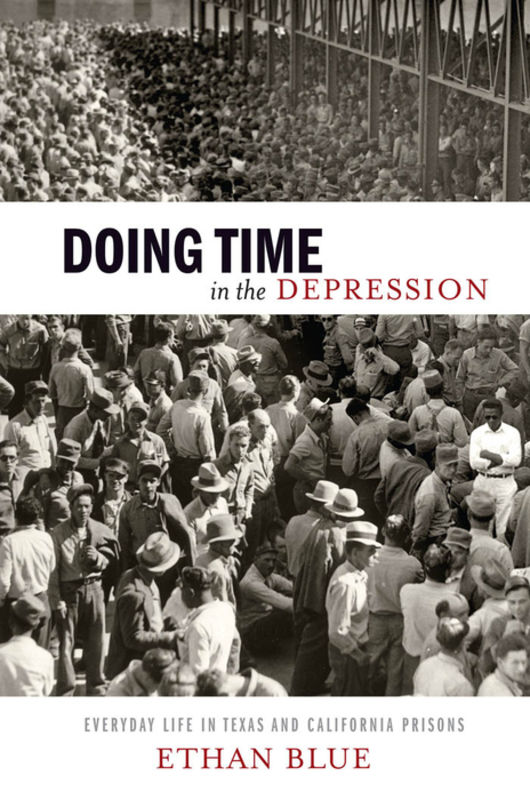
As banks crashed, belts tightened, and cupboards emptied across the country, American prisons grew fat. Doing Time in the Depression tells the story of the 1930s as seen from the cell blocks and cotton fields of Texas and California prisons, state institutions that held growing numbers of working people from around the country and the world—overwhelmingly poor, disproportionately non-white, and displaced by economic crisis. Ethan Blue paints a vivid portrait of everyday life inside Texas and California’s penal systems. Each element of prison life—from numbing boredom to hard labor, from meager pleasure in popular culture to crushing pain from illness or violence—demonstrated a contest between keepers and the kept. From the moment they arrived to the day they would leave, inmates struggled over the meanings of race and manhood, power and poverty, and of the state itself. In this richly layered account, Blue compellingly argues that punishment in California and Texas played a critical role in producing a distinctive set of class, race, and gender identities in the 1930s, some of which reinforced the social hierarchies and ideologies of New Deal America, and others of which undercut and troubled the established social order. He reveals the underside of the modern state in two very different prison systems, and the making of grim institutions whose power would only grow across the century.
eBook