
Catalogue Search | MBRL


Are you sure you want to remove the book from the shelf?

{{itemTitle}}
16,266
result(s) for
"Probabilities -- Data processing"
Sort by:


Practical probabilistic programming
Data accumulated about customers, products, and website users can not only help interpret the past, it can help predict the future! Probabilistic programming is a programming paradigm in which code models are used to draw probabilistic inferences from data. By applying specialized algorithms, programs assign degrees of probability to conclusions and make it possible to forecast future events like sales trends, computer system failures, experimental outcomes, and other critical concerns. This book explains how to use the PP paradigm to model application domains and express those probabilistic models in code.
Book

Digital Dice
Some probability problems are so difficult that they stump the smartest mathematicians. But even the hardest of these problems can often be solved with a computer and a Monte Carlo simulation, in which a random-number generator simulates a physical process, such as a million rolls of a pair of dice. This is whatDigital Diceis all about: how to get numerical answers to difficult probability problems without having to solve complicated mathematical equations.
Popular-math writer Paul Nahin challenges readers to solve twenty-one difficult but fun problems, from determining the odds of coin-flipping games to figuring out the behavior of elevators. Problems build from relatively easy (deciding whether a dishwasher who breaks most of the dishes at a restaurant during a given week is clumsy or just the victim of randomness) to the very difficult (tackling branching processes of the kind that had to be solved by Manhattan Project mathematician Stanislaw Ulam). In his characteristic style, Nahin brings the problems to life with interesting and odd historical anecdotes. Readers learn, for example, not just how to determine the optimal stopping point in any selection process but that astronomer Johannes Kepler selected his second wife by interviewing eleven women.
The book shows readers how to write elementary computer codes using any common programming language, and provides solutions and line-by-line walk-throughs of a MATLAB code for each problem.
Digital Dicewill appeal to anyone who enjoys popular math or computer science. In a new preface, Nahin wittily addresses some of the responses he received to the first edition.
eBook

Digital dice : computational solutions to practical probability problems
Some probability problems are so difficult that they stump the smartest mathematicians. This text shows readers how to get numerical answers to difficult probability problems without having to solve complicated mathematical questions.
Book

Statistics with JMP
Peter Goos, Department of Statistics, University of Leuven, Faculty of Bio-Science Engineering and University of Antwerp, Faculty of Applied Economics, Belgium David Meintrup, Department of Mathematics and Statistics, University of Applied Sciences Ingolstadt, Faculty of Mechanical Engineering, Germany Thorough presentation of introductory statistics and probability theory, with numerous examples and applications using JMP JMP: Graphs, Descriptive Statistics and Probability provides an accessible and thorough overview of the most important descriptive statistics for nominal, ordinal and quantitative data with particular attention to graphical representations. The authors distinguish their approach from many modern textbooks on descriptive statistics and probability theory by offering a combination of theoretical and mathematical depth, and clear and detailed explanations of concepts. Throughout the book, the user-friendly, interactive statistical software package JMP is used for calculations, the computation of probabilities and the creation of figures. The examples are explained in detail, and accompanied by step-by-step instructions and screenshots. The reader will therefore develop an understanding of both the statistical theory and its applications. Traditional graphs such as needle charts, histograms and pie charts are included, as well as the more modern mosaic plots, bubble plots and heat maps. The authors discuss probability theory, particularly discrete probability distributions and continuous probability densities, including the binomial and Poisson distributions, and the exponential, normal and lognormal densities. They use numerous examples throughout to illustrate these distributions and densities. Key features: * Introduces each concept with practical examples and demonstrations in JMP. * Provides the statistical theory including detailed mathematical derivations. * Presents illustrative examples in each chapter accompanied by step-by-step instructions and screenshots to help develop the reader's understanding of both the statistical theory and its applications. * A supporting website with data sets and other teaching materials. This book is equally aimed at students in engineering, economics and natural sciences who take classes in statistics as well as at masters/advanced students in applied statistics and probability theory. For teachers of applied statistics, this book provides a rich resource of course material, examples and applications.
eBook

Python for probability, statistics, and machine learning
This book, fully updated for Python version 3.6+, covers the key ideas that link probability, statistics, and machine learning illustrated using Python modules in these areas. All the figures and numerical results are reproducible using the Python codes provided. The author develops key intuitions in machine learning by working meaningful examples using multiple analytical methods and Python codes, thereby connecting theoretical concepts to concrete implementations. Detailed proofs for certain important results are also provided. Modern Python modules like Pandas, Sympy, Scikit-learn, Tensorflow, and Keras are applied to simulate and visualize important machine learning concepts like the bias/variance trade-off, cross-validation, and regularization. Many abstract mathematical ideas, such as convergence in probability theory, are developed and illustrated with numerical examples. This updated edition now includes the Fisher Exact Test and the Mann-Whitney-Wilcoxon Test. A new section on survival analysis has been included as well as substantial development of Generalized Linear Models. The new deep learning section for image processing includes an in-depth discussion of gradient descent methods that underpin all deep learning algorithms. As with the prior edition, there are new and updated *Programming Tips* that the illustrate effective Python modules and methods for scientific programming and machine learning. There are 445 run-able code blocks with corresponding outputs that have been tested for accuracy. Over 158 graphical visualizations (almost all generated using Python) illustrate the concepts that are developed both in code and in mathematics. We also discuss and use key Python modules such as Numpy, Scikit-learn, Sympy, Scipy, Lifelines, CvxPy, Theano, Matplotlib, Pandas, Tensorflow, Statsmodels, and Keras. This book is suitable for anyone with an undergraduate-level exposure to probability, statistics, or machine learning and with rudimentary knowledge of Python programming. -- Backside cover.
Book
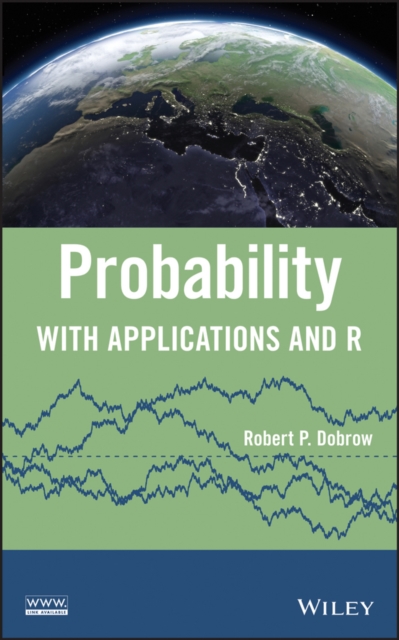
Probability
An introduction to probability at the undergraduate level Chance and randomness are encountered on a daily basis. Authored by a highly qualified professor in the field, Probability: With Applications and R delves into the theories and applications essential to obtaining a thorough understanding of probability. With real-life examples and thoughtful exercises from fields as diverse as biology, computer science, cryptology, ecology, public health, and sports, the book is accessible for a variety of readers. The book's emphasis on simulation through the use of the popular R software language clarifies and illustrates key computational and theoretical results. Probability: With Applications and R helps readers develop problem-solving skills and delivers an appropriate mix of theory and application. The book includes: Chapters covering first principles, conditional probability, independent trials, random variables, discrete distributions, continuous probability, continuous distributions, conditional distribution, and limits An early introduction to random variables and Monte Carlo simulation and an emphasis on conditional probability, conditioning, and developing probabilistic intuition An R tutorial with example script files Many classic and historical problems of probability as well as nontraditional material, such as Benford's law, power-law distributions, and Bayesian statistics A topics section with suitable material for projects and explorations, such as random walk on graphs, Markov chains, and Markov chain Monte Carlo Chapter-by-chapter summaries and hundreds of practical exercises Probability: With Applications and R is an ideal text for a beginning course in probability at the undergraduate level.
eBook

Foundations of Probabilistic Logic Programming
Probabilistic Logic Programming extends Logic Programming by enabling the representation of uncertain information by means of probability theory. Probabilistic Logic Programming is at the intersection of two wider research fields: the integration of logic and probability and Probabilistic Programming. Logic enables the representation of complex relations among entities while probability theory is useful for model uncertainty over attributes and relations. Combining the two is a very active field of study. Probabilistic Programming extends programming languages with probabilistic primitives that can be used to write complex probabilistic models. Algorithms for the inference and learning tasks are then provided automatically by the system. Probabilistic Logic programming is at the same time a logic language, with its knowledge representation capabilities, and a Turing complete language, with its computation capabilities, thus providing the best of both worlds. Since its birth, the field of Probabilistic Logic Programming has seen a steady increase of activity, with many proposals for languages and algorithms for inference and learning. Foundations of Probabilistic Logic Programming aims at providing an overview of the field with a special emphasis on languages under the Distribution Semantics, one of the most influential approaches. The book presents the main ideas for semantics, inference, and learning and highlights connections between the methods. Many examples of the book include a link to a page of the web application http://cplint.eu where the code can be run online.
eBook

Statistics with JMP
Statistics with JMP: Hypothesis Tests, ANOVA and Regression Peter Goos, University of Leuven and University of Antwerp, Belgium David Meintrup, University of Applied Sciences Ingolstadt, Germany A first course on basic statistical methodology using JMP This book provides a first course on parameter estimation (point estimates and confidence interval estimates), hypothesis testing, ANOVA and simple linear regression. The authors approach combines mathematical depth with numerous examples and demonstrations using the JMP software. Key features: * Provides a comprehensive and rigorous presentation of introductory statistics that has been extensively classroom tested. * Pays attention to the usual parametric hypothesis tests as well as to non-parametric tests (including the calculation of exact p-values). * Discusses the power of various statistical tests, along with examples in JMP to enable in-sight into this difficult topic. * Promotes the use of graphs and confidence intervals in addition to p-values. * Course materials and tutorials for teaching are available on the book's companion website. Masters and advanced students in applied statistics, industrial engineering, business engineering, civil engineering and bio-science engineering will find this book beneficial. It also provides a useful resource for teachers of statistics particularly in the area of engineering.
eBook