
Catalogue Search | MBRL


Are you sure you want to remove the book from the shelf?

{{itemTitle}}
2,178
result(s) for
"Probability in literature."
Sort by:

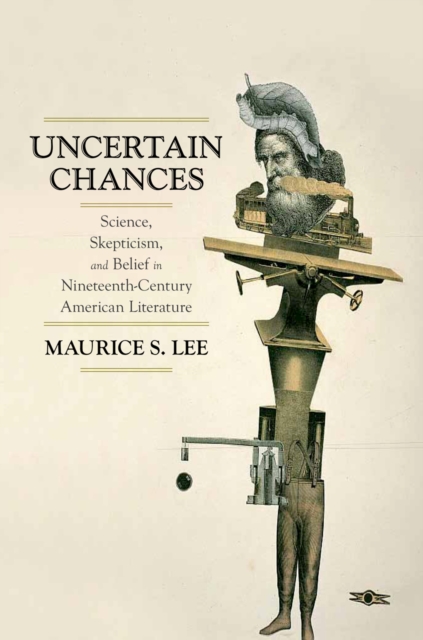
Uncertain Chances
This book reveals how changing concepts of chance shaped the way American writers struggled with doubt and belief. The nineteenth century witnessed a probabilistic revolution—in emerging sciences of chance (from mathematics to statistical sociology to Darwinism), new cultural practices (involving gambling, warfare, weather forecasting, and financial speculation), and religious faith (including theological and popular understandings of providence). Though traditionally dismissed as a nominal concept indicating human ignorance of causes, chance became increasingly acknowledged as a natural force to be managed but never mastered. Nineteenth-century literary figures made distinctive contributions to the probabilistic revolution by imaginatively pursuing moral, political, psychological, and aesthetic lines of inquiry not usually associated with the subject. The unsettling, wonderful possibilities of chance play out across literature of the time—in
Poe’s meta-critical detective fiction, in Melville’s struggles with moral action, in Douglass’s fight against scientific racism, in Thoreau’s empirical skepticism, and in Dickinson’s efforts to render poetically a faith and aesthetics of surprise. Uncertain Chances shows how American writers in and around the Civil War anticipate subsequent attitudes toward chance in pragmatist thought and beyond. Their work may even help to navigate extremes that remain with us today—fundamentalism and relativism, determinism and chaos, hubristic risk management and terrorism, the rational confidence of the Enlightenment and the debilitating doubts of modernity.
eBook


The game of probability : literature and calculation from Pascal to Kleist
There exist literary histories of probability and scientific histories of probability, but it has generally been thought that the two did not meet. Campe begs to differ. Mathematical probability, he argues, took over the role of the old probability of poets, orators, and logicians, albeit in scientific terms. Indeed, mathematical probability would not even have been possible without the other probability, whose roots lay in classical antiquity.
The Game of Probability revisits the seventeenth and eighteenth-century \"probabilistic revolution,\" providing a history of the relations between mathematical and rhetorical techniques, between the scientific and the aesthetic. This was a revolution that overthrew the \"order of things,\" notably the way that science and art positioned themselves with respect to reality, and its participants included a wide variety of people from as many walks of life. Campe devotes chapters to them in turn. Focusing on the interpretation of games of chance as the model for probability and on the reinterpretation of aesthetic form as verisimilitude (a critical question for theoreticians of that new literary genre, the novel), the scope alone of Campe's book argues for probability's crucial role in the constitution of modernity.
eBook

Subversions of Verisimilitude: Reading Narrative from Balzac to Sartre
Subversions of Verisimilitude focuses on the ways in which a number of French literary narratives written in the realist tradition show a dynamic balance between the desire of the author/narrator to present a verisimilar world and the need for aesthetic balance. While the works studied-narratives by Balzac, Flaubert, Zola, Colette, Proust, and Sartre-range over the course of a century, from 1835 to 1938, they share a perspective on the relations between and the need to engage questions of realist verisimilitude and narrative interest and aesthetics. The book discusses some of the subversive paths taken in realism and, specifically, in canonical narratives solidly anchored in the tradition. The goal here is to analyze these realist texts, regardless of the narrative mode chosen, in order to see the deviations and detours from realism, mostly for aesthetic ends.The book contributes to our understanding of nineteenth- and twentieth-century narrative and furthers our knowledge of the ways in which critical theory illuminates such canonical works.
eBook


A systematic review of regional and global climate extremes in CMIP6 models under shared socio-economic pathways
Climate extremes pose significant risks to human health, agriculture, and water resources. These extremes are defined as long-term, unusual events that fall into the 10th or 90th percentile of a probability density function derived from observations at a certain location (e.g., drought and wildfire). The quantification of future climate risks is based on climate model predictions. Here, we present a review of literature focusing on extreme climate projections in the latest generation of climate models, namely, Coupled Model Intercomparison Project Phase 6 (CMIP6) from 2020 to the present. We highlight the extreme events that could cause potential societal risks, including precipitation (the 90th percentile of the cumulative frequency distribution of daily precipitation), temperature (the 10th or 90th percentile of daily temperature within a reference period), droughts (meteorological, hydrological, and agricultural), floods, heat waves, and compound/concurrent extremes. Regionally, the precipitation extremes are projected to increase in North Africa (Ethiopia, Uganda, and Kenya), followed by drying in South Africa. Heatwaves will increase in a warming scenario (SSP3-7.0) in Asia (Indo-Gangetic Plain) and Afghanistan. The rise in heat stress intensity in Asia will augment the climate risks to agriculture under the SSP2-4.5 and SSP5-8.5 scenarios. On a global scale, land areas are projected to face severe drought specifically in higher biomass regions, under the SSP5-8.5 scenario. Future droughts bring hazards to Europe and the Amazon River basin with severe aridification over Australia, the Middle East, South and North Africa, and Central Asia. The CMIP6 model projections on a regional and global scale over the US Southwest predict intense drought and hot dry summers. The study supplements the discussion section by providing insights on sources of uncertainty in extreme event projections, the role of emergent constraints in uncertainty reduction, and the impact of extremes on water resources, agriculture, and human health.
Journal Article

Dirichlet–Laplace Priors for Optimal Shrinkage
Penalized regression methods, such as L ₁ regularization, are routinely used in high-dimensional applications, and there is a rich literature on optimality properties under sparsity assumptions. In the Bayesian paradigm, sparsity is routinely induced through two-component mixture priors having a probability mass at zero, but such priors encounter daunting computational problems in high dimensions. This has motivated continuous shrinkage priors, which can be expressed as global-local scale mixtures of Gaussians, facilitating computation. In contrast to the frequentist literature, little is known about the properties of such priors and the convergence and concentration of the corresponding posterior distribution. In this article, we propose a new class of Dirichlet–Laplace priors, which possess optimal posterior concentration and lead to efficient posterior computation. Finite sample performance of Dirichlet–Laplace priors relative to alternatives is assessed in simulated and real data examples.
Journal Article

Managing inventories for perishable e-groceries: The value of probabilistic information
E-grocery retailing allows customers to order products online for delivery within a chosen future time slot. To remain competitive, retailers aim to meet high customer expectations regarding product availability by strategically setting very high service level targets. However, maintaining excess inventory incurs holding costs and leads to spoilage of perishable products, with associated environmental impacts. Retailers face multiple sources of uncertainty, including stochastic customer demand, stochastic spoilage, and potential supply shortages. This renders the determination of optimal replenishment quantities both challenging and crucial for long-term business growth. Fortunately, comprehensive new data sets routinely collected by retailers enable a data-driven approach to controlling inventory levels. This approach includes predictive and prescriptive analytics to (1) estimate suitable underlying probability distributions to represent the inherent uncertainty in the inventory process and to (2) integrate those forecasts into a comprehensive multi-period optimisation framework. In this paper, we propose a stochastic lookahead policy to solve the corresponding optimisation problem, thus supporting the retailers’ inventory management decisions by minimising expected costs while maintaining a specified service level target. By explicitly deriving the value of probabilistic information, we provide guidance for retailers on which sources of uncertainty warrant investments in data collection and processing.
Journal Article