
Catalogue Search | MBRL


Are you sure you want to remove the book from the shelf?

{{itemTitle}}
8,391
result(s) for
"Probate law"
Sort by:

Succession, wills and probate
\"Succession, Wills and Probate provides a comprehensive guide to all areas of succession law. It considers the passing of property outside a will as well as dealing with intestate estates. It looks at the nature of wills and gives full details of the capacity and formalities for creating valid wills, including special wills, as well as altering and revoking them. In implementing wills, the principles of construction are dealt with, as well as what happens if a gift fails. There is a comprehensive introduction to the functions and administrative duties of personal representatives, and a substantial chapter covers the highly topical area of family provision. Cases are presented in detail throughout. The student is offered summaries of the mainstream criticisms of each area as an introduction to a more critical approach.This third edition includes new material on religious wills and expanded coverage of foreign wills. It has been thoroughly updated throughout to incorporate recent case law on capacity, formalities mutual wills, intestacy and undue influence, amongst other areas, and to reflect the considerable developments since publication of the previous edition such as the Civil Partnership Act 2004 and its impact on the Family Provision Act, Lasting Powers of Attorney, the Mental Capacity Act 2005, Estates of Deceased Persons Act 2011 and changes to the structure of Inheritance Tax. \"-- Provided by publisher.
Book

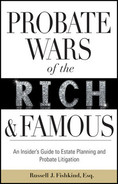
Probate wars of the rich and famous
Surrogate Court dockets are filled with cases involving family members fighting over the assets and intentions of a deceased parent or spouse. Probate Wars of the Rich & Famous: An Insider's Guide to Estate Planning and Probate Litigation tracks the estate litigation cases of Anna Nicole Smith, Brooke Astor, Michael Jackson, Nina Wang, Jerry Garcia and Leona Helmsley and identifies the five universal factors that caused such disputes. Each chapter provides estate planning insights designed to help individuals plan their estates without causing litigation. If, however, probate litigation cannot be avoided, the book also provides invaluable lessons about undue influence claims, how to remove a fiduciary, demanding an estate accounting and claims seeking to set aside lifetime transfers that undermined the decedents intentions. Few - if any – estate planning books utilize colorful celebrity accounts to provide meaningful insights and actionable advice.
eBook

Probate standing
Few topics in civil justice have sparked as much criticism as the standing doctrine. The US 'Constitution' and some of its state counterparts require plaintiffs to allege that they suffered an \"injury-in-fact\" that the defendant caused and that a court can redress. A veritable ocean of commentary argues that this requirement is confusing, ahistorical, and unmoored from its objectives. Yet a different manifestation of the standing doctrine has long lurked in obscurity. Standing issues are also common in state probate courts, where the transmission of assets from the dead to the living can affect a variety of parties. But in sharp contrast to the vast literature on standing in general civil litigation, probate standing has never received sustained scholarly attention. This article explores this unique nexus of civil procedure and decedents' estates. First, it demonstrates that probate standing principles have long been a tangled mess. For hundreds of years, probate judges have tried to control their dockets by limiting the right to file petitions and objections to people who are \"interested\" in the outcome. However, \"interest\" is a slippery concept in a field where rights are often contingent. Indeed, the impact of an inheritance dispute can hinge on unknown variables, like future births, deaths, the validity of estate planning documents, or the result of other litigation. Thus, courts reach wildly different conclusions about basic probate standing matters. Second, the article argues that the costs of the standing mandate outweigh the benefits. For starters, the leading rationales for the standing doctrine - ensuring that claimants litigate zealously and preventing courts from ruling on issues that are better addressed by elected officials - do not apply to a system that is often inquisitorial and features questions about private rights, not social policy. Even worse, the standing mandate closes the probate courthouse door to assertions of grave misconduct. Thus, the article concludes that probate judges should presumptively grant standing to anyone who might gain something from their claim. Third, the article uses this insight to propose solutions to festering standing puzzles in will contests, creditor's claims, lawsuits for elder abuse, fiduciary litigation, and other forms of estate-related conflict.
Journal Article
Probate Standing
Few topics in civil justice have sparked as much criticism as the standing doctrine. The U.S. Constitution and some of its state counterparts require plaintiffs to allege that they suffered an “injury-in-fact” that the defendant caused and that a court can redress. A veritable ocean of commentary argues that this requirement [is confusing, ahistorical, and unmoored from its objectives. Yet a different manifestation of the standing doctrine has long lurked in obscurity. Standing issues are also common in state probate courts, where the transmission of assets from the dead to the living can affect a variety of parties. But in sharp contrast to the vast literature on standing in general civil litigation, probate standing has never received sustained scholarly attention. This Article explores this unique nexus of civil procedure and decedents’ estates. First, it demonstrates that probate standing principles have long been a tangled mess. For hundreds of years, probate judges have tried to control their dockets by limiting the right to file petitions and objections to people who are “interested” in the outcome. However, “interest” is a slippery concept in a field where rights are often contingent. Indeed, the impact of an inheritance dispute can hinge on unknown variables, like future births, deaths, the validity of estate planning documents, or the result of other litigation. Thus, courts reach wildly different conclusions about basic probate standing matters. Second, the Article argues that the costs of the standing mandate outweigh the benefits. For starters, the leading rationales for the standing doctrine—ensuring that claimants litigate zealously and preventing courts from ruling on issues that are better addressed by elected officials—do not apply to a system that is often inquisitorial and features questions about private rights, not social policy. Even worse, the standing mandate closes the probate courthouse door to assertions of grave misconduct. Thus, the Article concludes that probate judges should presumptively grant standing to anyone who might gain something from their claim. Third, the Article uses this insight to propose solutions to festering standing puzzles in will contests, creditor’s claims, lawsuits for elder abuse, fiduciary litigation, and other forms of estate-related conflict.
Journal Article

Inheritance Law And The Evolving Family
Nontraditional families are today an important part of American family life. Yet when a loved one dies, our inheritance laws are often stingy even towards survivors in the nuclear family. With humor, enthusiasm, and a bit of righteous outrage, Ralph C. Brashier explores how probate laws ignore gender roles and marital contributions of the spouse, often to the detriment of the surviving widow; how probate laws pretend that unmarried couples—particularly gay and lesbian ones—do not exist; how probate laws allow a parent to disinherit even the neediest child; and how probate laws for nonmarital children, adopted children, and children born of surrogacy or other forms of assisted reproductive technology are in flux or simply don't exist. A thoughtful examination of the current state of probate law and the inability of legislators to recognize and provide for the broad range of families in America today, this book will be read by those with an interest in the relationship between families and the law across a wide range of academic disciplines.
eBook


REVOCATION ON DIVORCE AND THE STATE AS HEIR: FIXING THE UNIFORM PROBATE CODE
Synopsis: Suppose that, prior to a divorce, a testator devises the residue of his estate to his spouse if she survives him, otherwise \"one half to my heirs and one half to my spouse's heirs.\" If the testator dies after the divorce and without revising the will, who is entitled to the residue? The answer under the Uniform Probate Code (UPC) will come as a surprise. One half of the residue will escheat to the state as the heir of the former spouse. The result arises from a glitch in the UPC inadvertently introduced when the UPC was revised in 1990. This Article identifies and analyzes the glitch and proposes a statutory solution for the Uniform Law Commission and the legislatures of enacting states.
Journal Article

MPs for Sale? Returns to Office in Postwar British Politics
Many recent studies show that firms profit from connections to influential politicians, but less is known about how much politicians financially benefit from wielding political influence. We estimate the returns to serving in Parliament, using original data on the estates of recently deceased British politicians. Applying both matching and a regression discontinuity design to compare Members of Parliament (MPs) with parliamentary candidates who narrowly lost, we find that serving in office almost doubled the wealth of Conservative MPs, but had no discernible financial benefits for Labour MPs. Conservative MPs profited from office largely through lucrative outside employment they acquired as a result of their political positions; we show that gaining a seat in Parliament more than tripled the probability that a Conservative politician would later serve as a director of a publicly traded firm—enough to account for a sizable portion of the wealth differential. We suggest that Labour MPs did not profit from office largely because trade unions collectively exerted sufficient control over the party and its MPs to prevent members from selling their services to other clients.
Journal Article

Can a charitable trust be valid, notwithstanding the existence of non-charitable purposes? The landmark decision of the Royal Court of Jersey In the Matter of the Estate of the Late Constantin Mattas
In a recent judgment regarding the Jersey moveable estate of a Greek national (In the Matter of the Estate of the Late Constantin Mattas [2024]JRC068), the Royal Court decided several issues of trusts and probate law, some novel, and some which go to the very heart of the question of what constitutes a valid Jersey trust. Most notably, the Court held that, in the present case involving a trust for both charitable and non-charitable purposes, the failure of the non-charitable purpose resulted in the whole of the assets of the Trust being held for the benefit of the charitable purpose, rather than the failure of the trust as a whole.
Journal Article