
Catalogue Search | MBRL
Search Results Heading
Explore the vast range of titles available.
MBRLSearchResults
-
DisciplineDiscipline
-
Is Peer ReviewedIs Peer Reviewed
-
Reading LevelReading Level
-
Content TypeContent Type
-
YearFrom:-To:
-
More FiltersMore FiltersItem TypeIs Full-Text AvailableSubjectPublisherSourceDonorLanguagePlace of PublicationContributorsLocation
Done
Filters
Reset
9
result(s) for
"Problem solving Miscellanea."
Sort by:
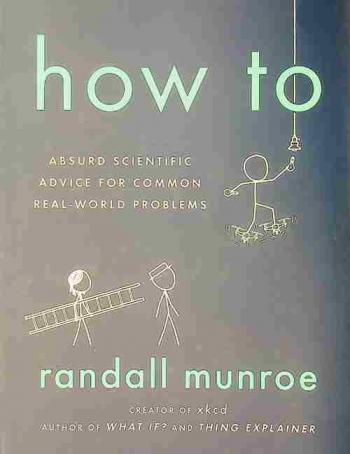
How to : absurd scientific advice for common real-world problems
For any task you might want to do, there's a right way, a wrong way, and a way so monumentally complex, excessive, and inadvisable that no one would ever try it. Munroe has created a guide to the third kind of approach. He provides highly impractical advice for everything from landing a plane to digging a hole. Cartoonist Randall Munroe (xkcd) explains how to predict the weather by analyzing the pixels of your Facebook photos. He teaches you how to tell if you're a baby boomer or a 90's kid by measuring the radioactivity of your teeth. He offers tips for taking a selfie with a telescope, crossing a river by boiling it, and powering your house by destroying the fabric of space-time. And if you want to get rid of the book once you're done with it, he walks you through your options for proper disposal, including dissolving it in the ocean, converting it to a vapor, using tectonic plates to subduct it into the Earth's mantle, or launching it into the Sun. By exploring the most complicated ways to do simple tasks, Munroe invites us to explore the most absurd reaches of the possible and helps us better understand the science and technology underlying the things we do every day.-- adapted from jacket
Guesstimation 2.0
2012
Guesstimation 2.0reveals the simple and effective techniques needed to estimate virtually anything--quickly--and illustrates them using an eclectic array of problems. A stimulating follow-up toGuesstimation, this is the must-have book for anyone preparing for a job interview in technology or finance, where more and more leading businesses test applicants using estimation questions just like these.
The ability to guesstimate on your feet is an essential skill to have in today's world, whether you're trying to distinguish between a billion-dollar subsidy and a trillion-dollar stimulus, a megawatt wind turbine and a gigawatt nuclear plant, or parts-per-million and parts-per-billion contaminants. Lawrence Weinstein begins with a concise tutorial on how to solve these kinds of order of magnitude problems, and then invites readers to have a go themselves. The book features dozens of problems along with helpful hints and easy-to-understand solutions. It also includes appendixes containing useful formulas and more.
Guesstimation 2.0shows how to estimate everything from how closely you can orbit a neutron star without being pulled apart by gravity, to the fuel used to transport your food from the farm to the store, to the total length of all toilet paper used in the United States. It also enables readers to answer, once and for all, the most asked environmental question of our day: paper or plastic?
Guesstimation
2008,2009
Guesstimationis a book that unlocks the power of approximation--it's popular mathematics rounded to the nearest power of ten! The ability to estimate is an important skill in daily life. More and more leading businesses today use estimation questions in interviews to test applicants' abilities to think on their feet.Guesstimationenables anyone with basic math and science skills to estimate virtually anything--quickly--using plausible assumptions and elementary arithmetic.
Lawrence Weinstein and John Adam present an eclectic array of estimation problems that range from devilishly simple to quite sophisticated and from serious real-world concerns to downright silly ones. How long would it take a running faucet to fill the inverted dome of the Capitol? What is the total length of all the pickles consumed in the US in one year? What are the relative merits of internal-combustion and electric cars, of coal and nuclear energy? The problems are marvelously diverse, yet the skills to solve them are the same. The authors show how easy it is to derive useful ballpark estimates by breaking complex problems into simpler, more manageable ones--and how there can be many paths to the right answer. The book is written in a question-and-answer format with lots of hints along the way. It includes a handy appendix summarizing the few formulas and basic science concepts needed, and its small size and French-fold design make it conveniently portable. Illustrated with humorous pen-and-ink sketches,Guesstimationwill delight popular-math enthusiasts and is ideal for the classroom.
Probability-based Latin hypercube designs for slid-rectangular regions
by
AMEMIYA, YASUO
,
WU, CHIEN-FU JEFF
,
HUNG, YING
in
Algorithms
,
Applications
,
Biology, psychology, social sciences
2010
Existing space-filling designs are based on the assumption that the experimental region is rectangular, while in practice this assumption can be violated. Motivated by a data centre thermal management study, a class of probability-based Latin hypercube designs is proposed to accommodate a specific type of irregular region. A heuristic algorithm is proposed to search efficiently for optimal designs. Unbiased estimators are proposed, their variances are given and their performances are compared empirically. The proposed method is applied to obtain an optimal sensor placement plan to monitor and study the thermal distribution in a data centre.
Journal Article
Yet More Everyday Science Mysteries
2011
In the fourth book of this award-winning series, author Richard Konicek-Moran explores 15 new mysteries children and adults encounter in their daily lives. Relating the mysteries to experiences familiar to elementary and middle school students, the stories show how science is part of everyday life and initiate inquiry-based learning by leaving each mystery without an ending. Students identify the problem to be solved, formulate questions, form hypotheses, test their ideas, and come up with possible explanations.
Rediscovering Mathematics
Rediscovering Mathematics is an eclectic collection of mathematical topics and puzzles aimed at talented youngsters and inquisitive adults who want to expand their view of mathematics. By focusing on problem solving, and discouraging rote memorization, the book shows how to learn and teach mathematics through investigation, experimentation, and discovery. Rediscovering Mathematics is also an excellent text for training math teachers at all levels. Topics range in difficulty and cover a wide range of historical periods, with some examples demonstrating how to uncover mathematics in everyday life. Rediscovering Mathematics provides a fresh view of mathematics for those who already like the subject, and offers a second chance for those who think they don’t.
International Mathematical Olympiads 1959–1977
by
International Mathematical Olympiads
,
Greitzer, Samuel L.
,
Mathematical Association of America
in
Mathematics
,
Mathematics -- Problems, exercises, etc
1978
Every year 100 of the most mathematically talented high school students in the country compete in the USA Mathematical Olympiad (USAMO). The USAMO is the third stage of a three-tiered mathematical competition for high school students in the United States and Canada that begins with the AHSME taken by over 400,000 students, continues with the American Invitational Mathematics Exam involving 2,000 students, and culminates with the 100-contestant USAMO. Winners of the USAMO go on to compete in the International Mathematical Olympiad. Compilation of 116 problems of arresting ingenuity given to high school students competing in the International Mathematical Olympiads. All are accessible to secondary school students. The alternative solutions are particularly interesting because they show that there are many ways to solve a problem.


