
Catalogue Search | MBRL


Are you sure you want to remove the book from the shelf?

{{itemTitle}}
212
result(s) for
"Procedural due process"
Sort by:

TRANSFORMING 'SUMMARY JUSTICE' THROUGH POLICE-LED PROSECUTION AND 'VIRTUAL COURTS'
The administration of 'summary' justice in the lower criminal courts in England and Wales is undergoing significant transformation. Broadly, this sits within the desire to create a modernized and more streamlined system. But, criminal justice scholars state 'swift justice' is not necessarily fair justice, and 'procedural due process' might be challenged by objectives of economics and speed. This paper centres on two areas of change-the expanded role of the police in prosecutorial decision making and the introduction of 'virtual courts' where accused defendants appear via video link from police stations to the criminal courts. It is argued these two alterations call into question fundamental principles of procedural due process.
Journal Article

The Judiciary: Breathing Life into the Human Right to Life
The UN General Assembly (UNGA) recognized the human right to the environment on July 28, 2022 (resolution. 76/300). It came as a sequel to the Human Rights Council (HRC) resolution (48/13) of October 8, 2021 on the identical theme. The right is the foundation for all other human rights and for the UN Sustainable Development Goals 2030 (SDGs 2030). Most States have recognized the right in national constitutions and law. While international tribunals can be expected to clarify and enforce the human right to the environment, it is the national and sub-national courts where the right will be invoked and enforced. These national legal proceedings have begun. They face significant opposition by vested interests, as well as the inertia favoring business as usual. A case study examining the initial decisions in the State of New York (USA) illustrates the character of opposition to observing the right to the environment. Ultimately, procedural “due process of law” will combine with the substantive “human right to the environment” to build needed rigor into laws mandating stewardship of the nature and human wellbeing.
Journal Article

Immunities and the Right of Access to Court under Article 6 of the European Convention on Human Rights
Combining immunities under public international law and privileges afforded to certain bodies and persons by domestic law, this book discusses the case-law of the European Court of Human Rights on the conflict between immunities and Article 6 of the European Convention on Human Rights.
eBook

Human rights transformed : positive rights and positive duties
This book moves beyond the artificial boundary between socio-economic and civil and political rights and instead focuses on the positive duties to which all rights give rise. Human rights have traditionally been understood as protecting individual freedom against intrusion by the State. This book argues that human rights are based on a far richer view of freedom, going beyond absence of coercion and focusing on the ability to exercise such freedom. This requires positive action to facilitate freedom, and substantive equality. It also recognizes the essentially social nature of human beings, and the crucial role of social interaction in advancing freedom. Drawing on political theory and social policy, as well as comparative experience from India, South Africa, the European Convention on Human Rights, the EU, US, Canada, and the UK, the book aims to create a theoretical and applied framework for understanding positive human rights duties. The first part focuses on creating an analytic framework for understanding positive duties. Chapter 1 aims to refashion the underlying values of liberty, equality and solidarity to yield the rich understanding of human rights argued for in this book. Chapter 2 focuses on the State, examining the role of positive human rights duties in furthering democracy, and in respect of globalization and privatization. Part II aims to fashion a democratic role for courts as well as examining alternative compliance methods, while Part III applies the analysis to specific rights, firstly equality, and then the traditional socio-economic rights to housing, education, and welfare.
eBook
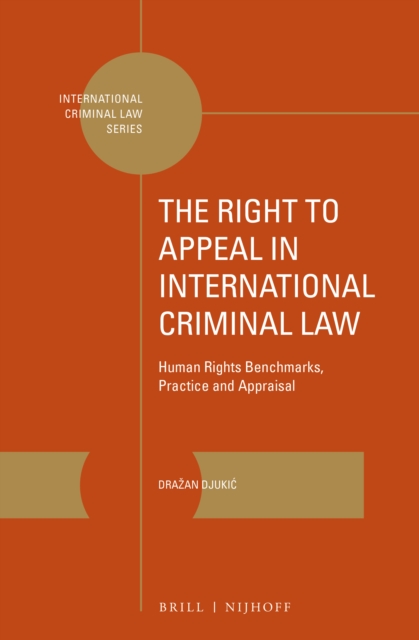
The right to appeal in international criminal law : human rights benchmarks, practice and appraisal
In The Right to Appeal in International Criminal Law Drazan Djukic describes appeal proceedings in international criminal law and evaluates them against human rights benchmarks. While international criminal courts and tribunals mainly comply with these benchmarks, they have fallen short in certain important areas. Despite their importance to the legal process, appeal proceedings tend to receive limited attention. On the basis of benchmarks arising from international human rights law, Drazan Djukic systematically assesses the law and practice concerning appeal proceedings in international criminal law.
eBook

Children, Autonomy and the Courts
In this book Aoife Daly reframes the status of children where courts decide their best interests, arguing that the Convention on the Rights of the Child 'right to be heard' is insufficient, and that autonomy should instead be the focus.
eBook

The Conscience of the Constitution
This book follows Tooley in his travels from the largest shanty town in Africa to the mountains of Gansu, China, and of the children, parents, teachers, and entrepreneurs who taught him that the poor are not waiting for educational handouts. They are building their own schools and learning to save themselves.
eBook

Privacy, Due Process and the Computational Turn
Privacy, Due process and the Computational Turn: The Philosophy of Law Meets the Philosophy of Technology engages with the rapidly developing computational aspects of our world including data mining, behavioural advertising, iGovernment, profiling for intelligence, customer relationship management, smart search engines, personalized news feeds, and so on in order to consider their implications for the assumptions on which our legal framework has been built. The contributions to this volume focus on the issue of privacy, which is often equated with data privacy and data security, location privacy, anonymity, pseudonymity, unobservability, and unlinkability. Here, however, the extent to which predictive and other types of data analytics operate in ways that may or may not violate privacy is rigorously taken up, both technologically and legally, in order to open up new possibilities for considering, and contesting, how we are increasingly being correlated and categorizedin relationship with due process - the right to contest how the profiling systems are categorizing and deciding about us.
eBook

European judicial responses to Security Council Resolutions : a consequentialist assessment
In this volume Kushtrim Istrefi explores the normative and policy effects of European court decisions as regards Security Council targeted sanctions and security detentions interfering with fundamental rights.
eBook

Civil Justice in the Age of Human Rights
The end of the last century witnessed two major events in the field of civil justice: the Civil Procedure Rules (CPR) came into force and the Human Rights Act (HRA) gave effect to the European Convention on Human Rights. This volume assesses the effect of the Act and attempts to reconcile the expediency and efficiency essential to modern civil justice with the need for recognition of human dignity and equality inherent to human rights.
The book is primarily concerned with the effects of the HRA on civil procedure and, in particular, the effects on the CPR. It examines the view that the new civil procedure regime could be susceptible to HRA challenges. More specifically, the work discusses whether there are differences between the CPR and the ECHR ideas of what constitutes a fair trial or just decision and between their views of proportionality. The study notes the differences between common and civil law and discusses whether there is any coming together with other European systems.
This book will be a valuable resource for academics and researchers as well as lawyers and judges with an interest in the practical implications of the HRA.
eBook