
Catalogue Search | MBRL


Are you sure you want to remove the book from the shelf?

{{itemTitle}}
6,925
result(s) for
"Processions"
Sort by:

Staging the world : spoils, captives, and representations in the Roman triumphal procession
This book is about the Roman triumphal procession in its capacity as spectacle and performance. It analyses the triumphs as visually emphatic events that both conveyed and constructed Roman views of the world. Aiming at approaching issues of identity, the book analyses how Rome presented and perceived the defeated on triumphal display. Spoils, captives, and representations are the objects, and the basic questions strive to establish both contents and context: What was displayed? How was it paraded? What was the response? Arms, ships and rams, coins and bullion, sculptures and paintings, art and valuables, golden crowns, prisoners, hostages, animals, and trees are all examined in separate chapters, as are the representations that were made specifically for the occasion: models and personifications of cities, peoples, rivers, and vivid tableaux staging scenes from the war. To be able to engage in issues of processional contents and sequence, acted roles, visual interplay, spectator participation, and emotional effect, the study embraces the complete corpus of ancient sources of the historical triumph, literary and pictorial. The approach includes discussions of the triumph as a religious rite and as a political act. But performance is the key word, and attention is in the first place paid to the visual expressions and schemes of the parade, and the interplay between these and the spectators.
eBook


Proceedings of the Second Symposium of the Dionysius Circle: Beauty and Divine Processions: Synthesizing Dionysius, Thomas Aquinas and their Interpretive Traditions
Dionysius’ account of God’s processions has been interpreted in a range of ways. Thomas Aquinas interprets divine processions as created likenesses of God. The Byzantine tradition interprets them as ἐνέργειαι in God. Neoplatonist readers of Dionysius read them as both divine self-differentiations and activities performed by creatures. Each reading can accommodate some of Dionysius’ claims, but not others. After considering reasons for and against each interpretation, I show how Dionysius’ texts on beauty, which present a phenomenological metaphysics of beauty, provide grounds for synthesizing significant aspects of each. The paper closes with a presentation of that synthesis.
Journal Article
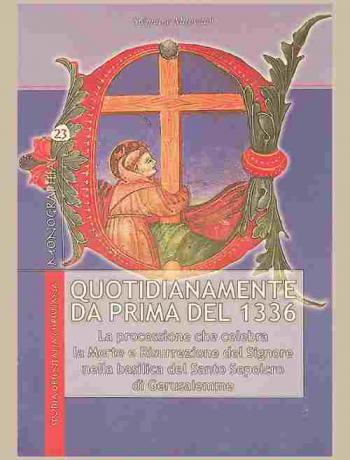
Quotidianamente da prima del 1336 : la processione che celebra la morte e la risurrezione del Signore nella Basilica del Santo Sepolcro di Gerusalemme
\"Il volume analizza la processione che i frati minori quotidianamente svolgono nella basilica del Santo Sepolcro di Gerusalemme, fin dal loro arrivo in Terra Santa nella prima met�a del secolo XIV. Quotidianamente, in questa basilica, per mandato della Chiesa cattolica, i francescani, insieme ai presenti, compiono una processione in quattordici stazioni presso i vari altari della basilica. A ogni stazione si svolge un programma rituale connesso con il luogo santo. Per la prima volta, questi rituali vengono analizzati dettagliamente nel loro sviluppo storico e liturgico.L'opera �e destinata ad appassionati di antiche liturgie e della storia della presenza cristiana in Terra Santa.\"-- https://www.libreriadelsanto.it/libri/9788862402071/quotidianamente-da-prima-del-1336.html? (viewed July 13, 2017).
Book

What Is a Divine Procession? Liturgy, Pure Perfection, and the Filioque and Essence–Energy Debates
Many debates in Christian theology and philosophy, especially debates having to do with the Trinity (like the debate over the filioque) and with divine action (like the debate over whether there is a distinction between God’s essence and God’s energies), have made use of the idea of divine processions. But with rare exceptions, theologians have said little about how the terms used for divine processions are the same terms used for liturgical, military, and state processions and marches. Rather, in general, theologians have treated these terms in a purely technical metaphysical sense. I contend that progress will be made on solving these debates if we attend to the image of actual processions that is conveyed by words originally used for divine processions (including Latin words like ‘processio’ and ‘procedere’ and Greek words like ‘proodos’ and ‘ekporeusis’). After describing the relevant debates, I outline a method for recovering the experiences and images conveyed by those procession words; this perceptual and aesthetic method draws upon the work of a range of phenomenologists and phenomenologically-inspired thinkers. I then use this method to draw out the content of procession words, and to show that procession as such is a pure perfection, a property of being, a privileged manifestation of persons, and a divine attribute. Finally, I show how this more holistic approach to divine processions allows for a defense of the Western Christian doctrine of the filioque, without losing essential Eastern Christian insights about the procession of the Holy Spirit, and a defense of the Eastern doctrine of the essence–energies distinction, without losing crucial Western insights about divine simplicity. While it is of course beyond the scope of a single paper to solve such complex debates, this paper lays a foundation for future synthesis between Eastern and Western views.
Journal Article

Censorship of the Sacred and the Rationalisation of Society in the Early Years of the Communist Regime in Romania: Combating Pilgrimages, Processions and Miraculous Phenomena
During the parliamentary elections in Italy after World War II, rumours spread in the public sphere about the occurrence of “miracles.” These “miracles” were interpreted as warning messages from the divine about the danger posed by the Communist Party. This was considered part of a strategy to promote Christian Democrats by representatives of the Catholic Church and was viewed with concern by communist countries in Eastern Europe as the phenomenon began to spread. In the second half of 1948, the Romanian authorities initiated measures to abolish the Greek Catholic Church and persecute the Roman Catholic Church. In this context, rumours spread in Catholic circles about “miracles” intended to stimulate the resistance of believers in the face of persecution. The phenomenon of “miracles” also spread among Orthodox believers, who were dissatisfied with the elimination of religious education in schools and the beginning of the collectivization of agriculture. For this reason, this phenomenon was considered a danger by the communist authorities in Romania. In this study, we aim to examine how the authorities dealt with the issue of “miracles,” what measures were taken, which institutions were involved, and what the consequences were for long-term religious policy in communist Romania.
Journal Article

Triumphs in the age of civil war : the late Republic and the adaptability of triumphal tradition
\"Many of the wars of the late Republic were largely civil conflicts. There was, therefore, a tension between the traditional expectation that triumphs should be celebrated for victories over foreign enemies and the need of the great commanders to give full expression to their prestige and charisma, and to legitimize their power. Triumphs in the Age of Civil War rethinks the nature and the character of the phenomenon of civil war during the Late Republic. At the same time it focuses on a key feature of the Roman socio-political order, the triumph, and argues that a commander could in practice expect to triumph after a civil war victory if it could also be represented as being over a foreign enemy, even if the principal opponent was clearly Roman. Significantly, the civil aspect of the war did not have to be denied. Carsten Hjort Lange provides the first study to consider the Roman triumph during the age of civil war, and argues that the idea of civil war as 'normal' reflects the way civil war permeated the politics and society of the Late Roman Republic\"-- Provided by publisher.
Book

Expanded Ritual: Shii Islamic Videography in Lahore
Many Shii religious media stores that operate beside shrines, along procession routes, or in Shia-majority neighborhoods, began in the early 1980s documenting Muharram processions on nascent home recording technology. Unlike the footage broadcast on national television, the recordings released by Shii videographers are intricately connected to the pulse of the atmosphere of the processions: their sonic mood, ambient materiality, and concomitant bodies in mourning. Through ethnographic fieldwork among Shii media producers in the Pakistani city of Lahore, this article explores the strategies deployed by one videographer to disclose love and mourning for Imam Hussain and the Ahl-e Bait, the family of the Prophet Muhammad. This article asks, what sequence of events and techniques of montage did this videographer choose to deploy to make his recordings of Lahore's Muharram commemorations commensurable with the experiences of those participating?
Journal Article