
Catalogue Search | MBRL


Are you sure you want to remove the book from the shelf?

{{itemTitle}}
7
result(s) for
"Processions, Religious Jerusalem."
Sort by:
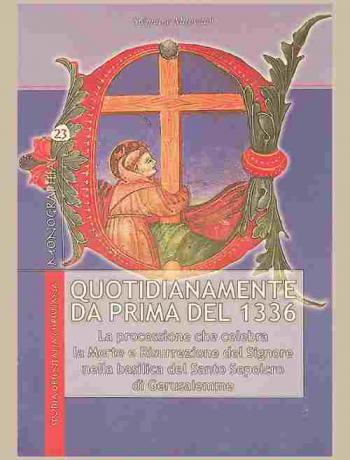
Quotidianamente da prima del 1336 : la processione che celebra la morte e la risurrezione del Signore nella Basilica del Santo Sepolcro di Gerusalemme
\"Il volume analizza la processione che i frati minori quotidianamente svolgono nella basilica del Santo Sepolcro di Gerusalemme, fin dal loro arrivo in Terra Santa nella prima met�a del secolo XIV. Quotidianamente, in questa basilica, per mandato della Chiesa cattolica, i francescani, insieme ai presenti, compiono una processione in quattordici stazioni presso i vari altari della basilica. A ogni stazione si svolge un programma rituale connesso con il luogo santo. Per la prima volta, questi rituali vengono analizzati dettagliamente nel loro sviluppo storico e liturgico.L'opera �e destinata ad appassionati di antiche liturgie e della storia della presenza cristiana in Terra Santa.\"-- https://www.libreriadelsanto.it/libri/9788862402071/quotidianamente-da-prima-del-1336.html? (viewed July 13, 2017).
Book

Palestinian rituals of identity : the Prophet Moses festival in Jerusalem, 1850-1948
Members of Palestine’s Muslim community have long honored al-Nabi Musa, or the Prophet Moses. Since the thirteenth century, they have celebrated at a shrine near Jericho believed to be the location of Moses’s tomb; in the mid-nineteenth century, they organized a civic festival in Jerusalem to honor this prophet. Considered one of the most important occasions for Muslim pilgrims in Palestine, the Prophet Moses festival yearly attracted thousands of people who assembled to pray, conduct mystical forms of worship, and hold folk celebrations.Palestinian Rituals of Identity takes an innovative approach to the study of Palestine’s modern history by focusing on the Prophet Moses festival from the late Ottoman period through the era of British rule. Halabi explores how the festival served as an arena of competing discourses, with various social groups attempting to control its symbols. Tackling questions about modernity, colonialism, gender relations, and identity, Halabi recounts how peasants, Bedouins, rural women, and Sufis sought to influence the festival even as Ottoman authorities, British colonists, Muslim clerics, and Palestinian national leaders did the same. Drawing on extensive research in Arabic newspapers and Islamic and colonial archives, Halabi reveals how the festival has encapsulated Palestinians’ responses to modernity, colonialism, and the nation’s growing national identity.
eBook

Christ on a Donkey – Palm Sunday, Triumphal Entries, and Blasphemous Pageants
Christ on a Donkey reveals Palm Sunday processions and related royal entries as both processional theatre and highly charged interpretations of the biblical narrative. Harris's narrative ranges from ancient Jerusalem to modern-day Bolivia, from veneration to iconoclasm, and from Christ to Ivan the Terrible. A curious theme emerges: those representations of Christ's entry into Jerusalem that were labelled blasphemous or idolatrous by those in power were most faithful to the biblical narrative of Palm Sunday, while those that exalted power and celebrated military triumph were arguably blasphemous pageants.
eBook


The Royal Entry
This is the first of two chapters discussing the pomp and pageantry of courtly ritual. We will first take a closer look at the ceremonial entries of kings into cities. The context will be kings visiting subjects. Chapter 12 will deal with centralised royal ritual; here the focus will be on subjects visiting the king. The main premise underlying the present discussion is that in entering particular cities Hellenistic kings played a variety of cultural roles – Egyptian, Greek, Judaean, Phoenician – but these roles were not necessarily ‘traditional’: tradition was constantly renegotiated, and manipulation by both parties of the formal aspects of the rituals ordering the royal entry was part of the bargaining process that determined the relationship of city and empire. The two forms of rituals, both involving a procession, overlapped: the Grand Procession of Ptolemy Philadelphos in Alexandria Chapter 12) was both a central event emanating from the palace and a ritual of entry, in which the king was equated with Dionysos victoriously returning from the east.RITUALS OF ENTRYMacedonian supremacy in the eastern Mediterranean was largely founded on the support of cities. A city was the key to routine access to the military resources of its hinterland. The ritual of entry into a city was therefore of prime importance, since it strengthened the bond between monarchy and town.
Book Chapter


The Church of Santo Stefano: A \Jerusalem\ in Bologna
The complex of churches dedicated to Santo Stefano in Bologna is the closest to the original of the numerous existing Romanesque copies of the Church of the Holy Sepulchre in Jerusalem. This study will attempt to clarify the architectural and functional relationship of S. Stefano with its prototype. Rebuilt in the twelfth century in a period of close contact with the Holy Land, S. Stefano bears a close resemblance to the Holy Sepulchre as restored by the Byzantines in 1048. The Bologna complex included a centrally-planned church of S. Sepolcro and a chapel of S. Croce; each contained imitations of the major relics of Jerusalem, and, like those at the Holy Sepulchre complex, the two buildings were joined by an open, colonnaded court. Elsewhere in Bologna, there were copies of the Mount of Olives and the Church of the Ascension, as well as a Valley of Josephat, Pool of Siloam, and Field of Aceldama. The intention, it appears, was to create a comprehensive, topographical copy not just of the Holy Sepulchre, but of the city of Jerusalem. The extent of the Romanesque copy, and the numerous dedications, suggest a special liturgical function for the Bologna shrines during Easter Week, related to the celebration in Jerusalem.
Journal Article