
Catalogue Search | MBRL


Are you sure you want to remove the book from the shelf?

{{itemTitle}}
37,041
result(s) for
"Product design -- Management"
Sort by:

Chief design officers at work : insights and strategies from CDOs on the frontlines of innovation
Meet the creative minds shaping our world in 'Chief Design Officers At Work'. Explore the realm of design management, unveiling unique perspectives, strategies, and innovative approaches to building businesses with design in mind. Through a collection of insightful interviews, gain an illuminating glimpse into the daily lives, challenges, and triumphs of prominent design executives from various industries, spanning zero-to-one products to established brands.
BOOK

Sketching user experiences : getting the design right and the right design
Sketching User Experiences approaches design and design thinking as something distinct that needs to be better understood—by both designers and the people with whom they need to work— in order to achieve success with new products and systems. So while the focus is on design, the approach is holistic. Hence, the book speaks to designers, usability specialists, the HCI community, product managers, and business executives. There is an emphasis on balancing the back-end concern with usability and engineering excellence (getting the design right) with an up-front investment in sketching and ideation (getting the right design). Overall, the objective is to build the notion of informed design: molding emerging technology into a form that serves our society and reflects its values. Grounded in both practice and scientific research, Bill Buxton’s engaging work aims to spark the imagination while encouraging the use of new techniques, breathing new life into user experience design.Covers sketching and early prototyping design methods suitable for dynamic product capabilities: cell phones that communicate with each other and other embedded systems, \"smart\" appliances, and things you only imagine in your dreamsThorough coverage of the design sketching method which helps easily build experience prototypes—without the effort of engineering prototypes which are difficult to abandonReaches out to a range of designers, including user interface designers, industrial designers, software engineers, usability engineers, product managers, and othersFull of case studies, examples, exercises, and projects, and access to video clips that demonstrate the principles and methods
eBook


The Design Management Task of Aligning Product Design with Production and Marketing Processes
A central task for the design management function is to coordinate the design efforts with other business functions, and often the success of new products depends on how well this is done. This design coordination is, in particular, relevant to the production and marketing functions. However, the literature that focuses on the role of the design function in relation to production, marketing, and consumption processes typically deals with this as separate issues, while the links between these areas involve a certain lack of clarity. To address this issue, this article develops a framework that connects product design to processes related to the production and consumption of products and their communication. The framework provides a means for understanding the reasons for consumer product failures caused by a lack of design coordination. This is demonstrated through sixteen empirical examples of product failures, taken from two ends of the consumer-product spectrum, namely fashion and consumer electronics. In this manner, the framework may serve as a checklist for design managers in design projects. For future research, the framework provides a link between different research areas to facilitate a clearer understanding of the role of design management.
Journal Article

Industrial project management : international standards and best practices for engineering and construction contracting
This rigorously academic book describes - in a precise but practical way - the most recent principles and techniques of project management, at the highest international standards, with a fully company-wide, process-based, multi-project approach.
Book
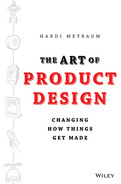
The art of product design
\"Embrace Open Engineering and accelerate the design and manufacturing processes. Product development is a team sport, but most companies don't practice it that way. Organizations should be drawing on the creativity of engaged customers and outsiders, but instead they rely on the same small group of internal 'experts' for new ideas. Designers and engineers should be connecting with marketing, sales, customer support, suppliers, and most importantly, customers. The Art of Product Design explains the rise of 'Open Engineering,' a way of breaking down barriers and taking advantage of web-based communities, knowledge, and tools to accelerate the design and manufacturing processes. Explains how to establish open flows of information inside and outside an organization, increasing the quality and frequency of input from different groups and stakeholders. Hardi Meybaum is the founder and CEO of GrabCad, the largest community of mechanical engineers and designers in the world. Open Engineering is crowdsourcing, it's collaborating, it's sharing and connecting. And it's helping a growing number of companies create better products faster than they ever imagined. The Art of Product Design shows you how to harness its power for your company\"-- Provided by publisher
eBook


design + environment
There is a huge scarcity of good, practical resources for designers and students interested in minimising the environmental impacts of products.
Design + Environment
has been specifically written to address this paucity.
The book first provides background information to help the reader understand how and why design for environment (DfE) has become so critical to design, with reference to some of the most influential writers, designers and companies in the field. Next,
Design + Environment
provides a step-by-step approach on how to approach DfE: to design a product that meets requirements for quality, cost, manufacturability and consumer appeal, while at the same time minimising environmental impacts. The first step in the process is to undertake an assessment of environmental impacts, using life-cycle assessment (LCA) or one of the many simpler tools available to help the designer. From then on, DfE becomes an integral part of the normal design process, including the development of concepts, design of prototypes, final design and development of marketing strategies.
Environmental assessment tools and strategies to reduce environmental impacts, such as the selection of appropriate materials, are then discussed. Next, some of the links between environmental problems, such as global warming, ozone depletion, water and air pollution and the everyday products we consume are considered. In order to design products with minimal environmental impact, we need to have a basic understanding of these impacts and the interactions between them.
The four subsequent chapters provide more detailed strategies and case studies for particular product groups: packaging, textiles, furniture, and electrical and electronic products. Guidelines are provided for each of the critical stages of a product’s life, from the selection of raw materials through to strategies for recovery and recycling.
Finally,
Design + Environment
takes a look at some of the emerging trends in DfE that are offering us the opportunity to make a more significant reduction in environmental impacts. Both the development of more sustainable materials and technologies and the growing interest in leasing rather than selling products are examined.
Design + Environment
is organised as a workbook rather than an academic text. It should be read once, and then used as a key reference source. This clear and informative book will prove to be invaluable to practising designers, to course directors and their students in need of a core teaching and reference text and to all those interested in learning about the tools and trends influencing green product design.
The authors have all been involved in an innovative demonstration programme, ‘EcoReDesign™’, which was developed by the Centre for Design at RMIT University with funding from the Australian government. The Centre successfully collaborated with Australian companies to improve the environmental performance of their products by following DfE principles.
eBook

Simplifying solution space : enabling non-expert users to innovate and design with toolkits
Hari Suman Naik takes the perspective of modular systems and investigates how to enable non-expert users to innovate and design, by simplifying toolkit solution space. New production technologies like digital fabrication and modular electronics along with appropriate toolkits can offer users a significant design flexibility to innovate solutions that meet their heterogeneous and sticky needs. The author contributes towards understanding and designing toolkit solution space, first using qualitative studies to explore mechanisms for simplifying the use and structure of toolkit solution space, and then using a design study of an innovative toolkit. The findings are relevant to innovation and product managers eager to incorporate user ideas with toolkits.
Book

The Future of Food: Scenarios for 2050
This background article addresses key challenges of adequately feeding a population of 9 billion by 2050, while preserving the agro‐ecosystems from which other services are also expected. One of the scenario‐buildings uses the Agrimonde platform, which considers the following steps: choosing the scenarios and their underlying building principles, developing quantitative scenarios, and building complete scenarios by combining quantitative scenarios with qualitative hypotheses. These scenarios consider how food issues link to production, for example, the percentage of animal vs. vegetal calorie intake in the full diet. The first section of this article discusses Agrimonde GO and Agrimonde 1 scenarios, which indicate that global economic growth and ecological intensification remain as main challenges for feeding the earth's growing population toward the mid‐21st century. The second section provides the outcomes of the analysis of alternative futures for agricultural supply and demand and food security to 2050, based on research done for the International Assessment of Agricultural Science and Technology for Development. The last section of this article provides a summary analysis of food systems and functions, as well as the role of food technology that address some of the global challenges affecting the supply of more nutritious and healthy diets. It also highlights the food production by novel means (e.g., alternatives for animal products based on plant materials) and increasing the presence of potentially health‐promoting compounds in food to improve human and animal health. Finally, this article proposes priority areas that should be included in further agri‐food research.
Journal Article