
Catalogue Search | MBRL


Are you sure you want to remove the book from the shelf?

{{itemTitle}}
26
result(s) for
"Producteurs et réalisateurs de cinéma États-Unis."
Sort by:

Kubrick : an odyssey
This immersive biography of the legendary director of films such as 2001: A Space Odyssey, The Shining and A Clockwork Orange is based on new research and interviews with family members and those who worked with him.
Book

Stroheim
Erich von Stroheim (1885-1957) was one of the giants in American film history. Stubborn, arrogant, and colorful, he saw himself as a cinema artist, which led to conflicts with producers and studio executives who complained about the inflated budgets and extraordinary length of his films. Stroheim achieved great notoriety and success, but he was so uncompromising that he turned his triumph into failure. He was banned from ever directing again and spent his remaining years as an actor. Stroheim's life has been wreathed in myths, many of his own devising. Arthur Lennig scoured European and American archives for details concerning the life of the actor and director, and he counters several long-accepted claims. Stroheim's tales of military experience are almost completely fictitious; the \"\"von\"\" in his name was an affectation adopted at Ellis Island in 1909; and, counter to his own claim, he did not participate in the production of The Birth of a Nation in 1914. Wherever Stroheim lived, he was an outsider: a Jew in Vienna, an Austrian in southern California, an American in France. This contributed to an almost pathological need to embellish and obscure his past; yet, it also may have been the key to his genius both behind and in front of the camera. As an actor, Stroheim threw himself into his portrayals of evil men, relishing his epithet, \"\"The Man You Love to Hate.\"\" As a director, he immersed himself in every facet of production, including script writing and costume design. In 1923 he created his masterpiece Greed, infamous for its eight-hour running time. Stroheim returned to acting, saving some of his finest performances for La Grande Illusion (1937) and Billy Wilder's Sunset Boulevard (1950), a role he hated, probably because it was too similar to the story of his own life.
eBook

The world is yours : the story of Scarface
\"An unflinching confrontation of humanity's dark side, Brian De Palma's crime drama film Scarface gave rise to a cultural revolution upon its release in 1983. Its impact was unprecedented, making globe-spanning waves as a defining portrait of the gritty Miami street life. From Al Pacino's masterful characterization of Tony Montana to the iconic 'Say hello to my little friend,' Scarface maintains its reputation as an unwavering game changer in cult classic cinema. With brand-new interviews and untold stories of the film's production, longtime film critic Glenn Kenny takes us on an unparalleled journey through the making of American depictions of crime. The World Is Yours highlights the influential characters and themes within Scarface, reflecting on how its storied legacy played such a major role in American culture.\" -- Book jacket.
BOOK

Walter Wanger, Hollywood Independent
The long, colorful career of Walter Wanger (1894-1968) is one of Hollywood’s greatest untold stories. An intellectual and a socially conscious movie executive who produced provocative message movies and glittering romantic melodramas, Wanger’s career started at Paramount studios in the 1920s and led him to work at virtually every major studio as either a contract producer or an independent. He produced a series of American film classics, including Queen Christina, Stagecoach, Foreign Correspondent, and Invasion of the Body Snatchers, as well as a few notable flops, such as Cleopatra. This comprehensive biography brings to life a distinctive film personality and offers a new appreciation of the role of the producer in the history of American cinema.
eBook

Devotion
Garrett Bradley works across narrative, documentary, and experimental modes of filmmaking to address themes such as race, class, familial relationships, social justice, and cultural histories in the United States. Her collaborative and research-based approach to filmmaking is often inspired by the real-life stories of her protagonists. This book explores Bradley's work through the lens of devotion and features conversations with the artist and contributions from the likes of Ashley Clark, Arthur Jafa, Joy James, Tyler Mitchell, Kevin Quashie, and Claudia Rankine. This is the first volume in a new series of readers copublished with Lisson Gallery entitled Re:, which will respond to a number of its artists and themes past and present. Adopting archival material alongside newly shot footage, Bradley's films exist simultaneously in the past, present, and future, not only disrupting our perception of time, but also breaking down our preconceived ideas about objectivity, perspective, and truth-telling. These narratives unfold naturally in both feature-length and short form, revealing a multitude of individual and collective stories. The social, economic, and racial politics of everyday life--its joys, pleasures, and pains--are lyrically and intimately rendered on screen.
Book
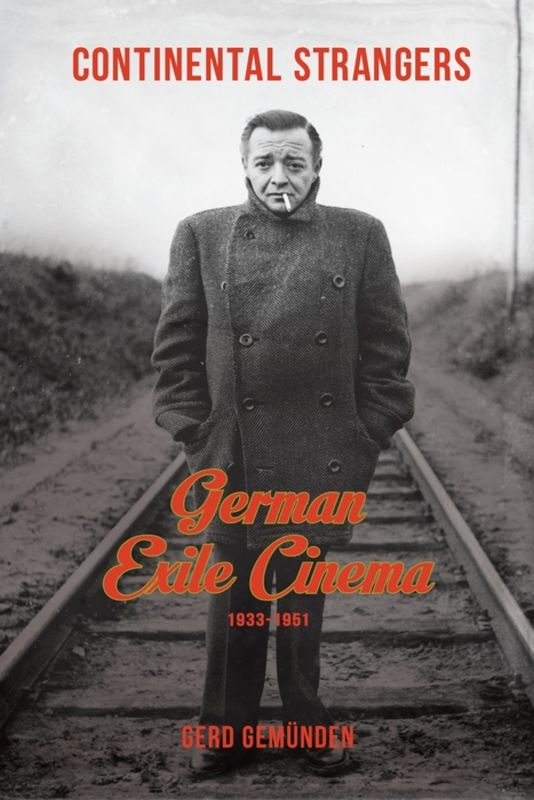
Continental Strangers
Hundreds of German-speaking film professionals took refuge in Hollywood during the 1930s and 1940s, making a lasting contribution to American cinema. Hailing from Austria, Hungary, Poland, Russia, and the Ukraine, as well as Germany, and including Ernst Lubitsch, Fred Zinnemann, Billy Wilder, and Fritz Lang, these multicultural, multilingual writers and directors betrayed distinct cultural sensibilities in their art. Gerd Gemünden focuses on Edgar G. Ulmer'sThe Black Cat(1934), William Dieterle'sThe Life of Emile Zola(1937), Ernst Lubitsch'sTo Be or Not to Be(1942), Bertolt Brecht and Fritz Lang'sHangmen Also Die(1943), Fred Zinnemann'sAct of Violence(1948), and Peter Lorre'sDer Verlorene(1951), engaging with issues of realism, auteurism, and genre while tracing the relationship between film and history, Hollywood politics and censorship, and exile and (re)migration.
eBook

The Wes Anderson collection : \Asteroid City\
\"The official behind-the-scenes companion to \"Asteroid City\" and the latest volume in the bestselling Wes Anderson Collection series. \"ASTEROID CITY\" - the eleventh feature film from Academy Award-winning director WES ANDERSON - follows a group of teen geniuses and their families as they attend the 1955 Junior Stargazers convention in the eponymous dusty hamlet. The events of the film, a representation of a fictional play, also titled Asteroid City, unfold in a parallel narrative to a televised broadcast of the creation of a theatrical production. As the lines between reality and theater blur, the audience is treated to stunning technicolor vistas and stark black and white sets, all while the promise of an extraterrestrial visit hangs overhead. In The Wes Anderson Collection: \"Asteroid City,\" the latest one-volume entry in The Wes Anderson Collection, cultural critic and New York Times bestselling author Matt Zoller Seitz presents the complete story behind the film's conception via interviews with Wes Anderson and Jason Schwartzman and illuminating behind-the-scenes photos, ephemera, storyboards, models, miniatures, and artwork. Contributions from Tom Hanks, Jeffrey Wright, Bryan Cranston, Rupert Friend, Hope Davis, Stephen Park, and the Junior Stargazers themselves provide reflections on the film's production and insight into the intricately layered characters\"--Publisher's description.
BOOK

Robert and Frances Flaherty
Previous biographical emphasis on Nanook has not only obscured Flaherty's early career but also neglected the critical contributions Frances made to his development as an artist. Robert and Frances Flaherty charts her transformation from a Bryn Mawr bluestocking to the partner of a frontier explorer and offers her unique perspective as his collaborator and publicist.
eBook

The path to paradise : a Francis Ford Coppola story
Granted total and unprecedented access to the Academy Award-winning director's archives, the author, drawing on hundreds of interviews with the artist and those who have worked closely with him, chronicles his attempt to reimagine the entire pursuit of movie making though his production company American Zoetrope.
BOOK

Studio affairs : my life as a film director
As a young Jewish boy growing up in Vienna, Georgia, Abe Orovitz could never have predicted the twists and turns his life would take.Many years later, as retired film director with more than thirty movies to his credit, Vincent Sherman is no less surprised when he looks back on that life.
eBook