
Catalogue Search | MBRL


Are you sure you want to remove the book from the shelf?

{{itemTitle}}
179,629
result(s) for
"Production control."
Sort by:


Designing an adaptive production control system using reinforcement learning
Modern production systems face enormous challenges due to rising customer requirements resulting in complex production systems. The operational efficiency in the competitive industry is ensured by an adequate production control system that manages all operations in order to optimize key performance indicators. Currently, control systems are mostly based on static and model-based heuristics, requiring significant human domain knowledge and, hence, do not match the dynamic environment of manufacturing companies. Data-driven reinforcement learning (RL) showed compelling results in applications such as board and computer games as well as first production applications. This paper addresses the design of RL to create an adaptive production control system by the real-world example of order dispatching in a complex job shop. As RL algorithms are “black box” approaches, they inherently prohibit a comprehensive understanding. Furthermore, the experience with advanced RL algorithms is still limited to single successful applications, which limits the transferability of results. In this paper, we examine the performance of the state, action, and reward function RL design. When analyzing the results, we identify robust RL designs. This makes RL an advantageous control system for highly dynamic and complex production systems, mainly when domain knowledge is limited.
Journal Article


Sharing Demand Information in Competing Supply Chains with Production Diseconomies
This paper studies the incentive for vertical information sharing in competing supply chains with production technologies that exhibit diseconomies of scale. We consider a model of two supply chains each consisting of one manufacturer selling to one retailer, with the retailers engaging in Cournot or Bertrand competition. For Cournot retail competition, we show that information sharing benefits a supply chain when (1) the production diseconomy is large and (2) either competition is less intense or at least one retailer's information is less accurate. A supply chain may become worse off when making its information more accurate or production diseconomy smaller, if such an improvement induces the firms in the rival supply chain to cease sharing information. For Bertrand retail competition, we show that information sharing benefits a supply chain when (1) the production diseconomy is large and (2) either competition is less intense or information is more accurate. Under Bertrand competition a manufacturer may be worse off by receiving information, which is never the case under Cournot competition. Information sharing in one supply chain triggers a competitive reaction from the other supply chain and this reaction is damaging to the first supply chain under Cournot competition but may be beneficial under Bertrand competition.
This paper was accepted by Martin Lariviere, operations management.
Journal Article


A novel throughput control algorithm for semi-heterarchical industry 4.0 architecture
Modern market scenarios are imposing a radical change in the production concept, driving companies’ attention to customer satisfaction through increased product customization and quick response strategies to maintain competitiveness. At the same time, the growing development of Industry 4.0 technologies made possible the creation of new manufacturing paradigms in which an increased level of autonomy is one of the key concepts to consider. Taking the advantage from the recent development around the semi-heterarchical architecture, this work proposes a first model for the throughput control of a production system managed by such an architecture. A cascade control algorithm is proposed considering work-in-progress (WIP) as the primary control lever for achieving a specific throughput target. It is composed of an optimal control law based on an analytical model of the considered production system, and of a secondary proportional-integral-derivative controller capable of performing an additional control action that addresses the error raised by the theoretical model’s. The proposed throughput control algorithm has been tested in different simulated scenarios, and the results showed that the combination of the control actions made it possible to have continuous adjustment of the WIP of the controlled production system, maintaining it at the minimum value required to achieve the requested throughput with nearly zero errors.
Journal Article

Designing an adaptive and deep learning based control framework for modular production systems
In today’s rapidly changing production landscape with increasingly complex manufacturing processes and shortening product life cycles, a company’s competitiveness depends on its ability to design flexible and resilient production processes. On the shop-floor, in particular, the production control plays a crucial role in coping with disruptions and maintaining system stability and resilience. To address challenges arising from volatile sales markets or other factors, deep learning algorithms have been increasingly applied in production to facilitate fast-paced operations. In particular deep reinforcement learning frequently surpassed conventional and intelligent approaches in terms of performance and computational efficiency and revealed high levels of control adaptability. However, existing approaches were often limited in scope and scenario-specific, which hinders a seamless transition to other control optimization problems. In this paper, we propose a flexible framework that integrates a deep learning based hyper-heuristic into modular production to optimize pre-defined performance indicators. The framework deploys a module recognition and agent experience sharing, enabling a fast initiation of multi-level production systems as well as resilient control strategies. To minimize computational and re-training efforts, a stack of trained policies is utilized to facilitate an efficient reuse of previously trained agents. Benchmark results reveal that our approach outperforms conventional rules in terms of multi-objective optimization. The simulation framework further encourages research in deep-learning-based control approaches to leverage explainability.
Journal Article
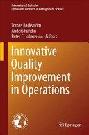
Innovative quality improvements in operations : introducing emergent quality management
\"This book examines current and emerging challenges in manufacturing related to the ideal of developing production processes with variability and agility on one level of the system, combined with structures ensuring stability and robustness on another level; close to what by other scholars has been discussed in terms of continuous innovation. However, this ideal has proven to be difficult to achieve in practice, and there is a need for enhanced and more sophisticated theoretical models dealing with the complexity surrounding organizational conditions to foster incremental as well as radical change in production systems, and, at the same time to ensure stability over time.\"--Back cover.
Book

Integrated Production and Outbound Distribution Scheduling: Review and Extensions
In many applications involving make-to-order or time-sensitive (e.g., perishable, seasonal) products, finished orders are often delivered to customers immediately or shortly after the production. Consequently, there is little or no finished product inventory in the supply chain such that production and outbound distribution are very intimately linked and must be scheduled jointly to achieve a desired on-time delivery performance at minimum total cost. Research on integrated scheduling models of production and outbound distribution is relatively recent but is growing very rapidly. In this paper, we provide a survey of such existing models. We present a unified model representation scheme, classify existing models into several different classes, and for each class of the models give an overview of the optimality properties, computational tractability, and solution algorithms for the various problems studied in the literature. We clarify the tractability of some open problems left in the literature and some new problems by providing intractability proofs or polynomial-time exact algorithms. We also identify several problem areas and issues for future research.
Journal Article