
Catalogue Search | MBRL


Are you sure you want to remove the book from the shelf?

{{itemTitle}}
14,571
result(s) for
"Production scheduling"
Sort by:

Integration of process planning and scheduling : approaches and algorithms
\"Both process planning and scheduling are very important functions of manufacturing, which affects together the cost to manufacture a product and the time to deliver it. This book contains various approaches proposed by researchers, to integrate the process planning and scheduling functions of manufacturing under varying configurations of shops. It is useful for both beginners and advanced researchers to understand and formulate the Integration Process Planning and Scheduling (IPPS) problem effectively\"-- Provided by publisher.
BOOK

MineLib: a library of open pit mining problems
Similar to the mixed-integer programming library (MIPLIB), we present a library of publicly available test problem instances for three classical types of open pit mining problems: the ultimate pit limit problem and two variants of open pit production scheduling problems. The ultimate pit limit problem determines a set of notional three-dimensional blocks containing ore and/or waste material to extract to maximize value subject to geospatial precedence constraints. Open pit production scheduling problems seek to determine when, if ever, a block is extracted from an open pit mine. A typical objective is to maximize the net present value of the extracted ore; constraints include precedence and upper bounds on operational resource usage. Extensions of this problem can include (
i
) lower bounds on operational resource usage, (
ii
) the determination of whether a block is sent to a waste dump, i.e., discarded, or to a processing plant, i.e., to a facility that derives salable mineral from the block, (
iii
) average grade constraints at the processing plant, and (
iv
) inventories of extracted but unprocessed material. Although open pit mining problems have appeared in academic literature dating back to the 1960s, no standard representations exist, and there are no commonly available corresponding data sets. We describe some representative open pit mining problems, briefly mention related literature, and provide a library consisting of mathematical models and sets of instances, available on the Internet. We conclude with directions for use of this newly established mining library. The library serves not only as a suggestion of standard expressions of and available data for open pit mining problems, but also as encouragement for the development of increasingly sophisticated algorithms.
Journal Article

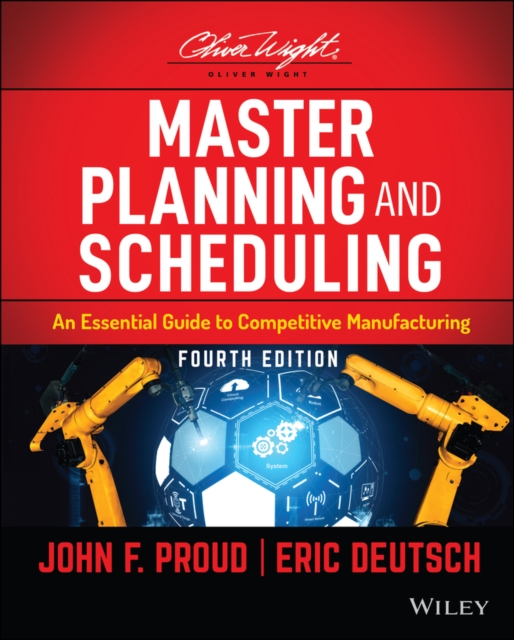
Master Planning and Scheduling
Discover the practical, real-world advantages of the Oliver Wight master planning and scheduling methodology.The newly revised Fourth Edition of Master Planning and Scheduling: An Essential Guide to Competitive Manufacturing delivers a masterful exploration of today's master planning and scheduling techniques, as well as an insightful discussion.
eBook


A memetic algorithm for multi-objective distributed production scheduling: minimizing the makespan and total energy consumption
The classical distributed production scheduling problem (DPSP) assumes that factories are identical, and each factory is composed of just some machines. Inspired by the fact that manufacturers these days typically work across different factories, and each of these factories normally has some workshops, we study an important extension of the DPSP with different factories and workshops (DPFW), where jobs can be processed and transferred between the factories, workshops and machines. To the best of our knowledge, this is the very first time distributed production scheduling with different factories and workshops is studied. We propose a novel memetic algorithm (MA) to solve this DPFW, aiming to minimize the makespan and total energy consumption. The proposed MA is incorporated with a well-designed chromosome encoding method and a balance-transfer initialization method to generate a good initial population. An effective local search operator is also presented to improve the MA’s convergence speed and fully exploit its solution space. A total of 50 DPFW benchmark instances are used to evaluate the performance of our MA. Computational experiments carried out confirm that the MA is able to easily obtain better solutions for the majority of the tested problem instances compared to three other well-known algorithms, demonstrating its superior performance over these algorithms in terms of solution quality. Our proposed method and the results presented here may be helpful for production managers who work with distributed manufacturing systems in scheduling their production activities by considering different factories and workshops. With this DPFW, imbalanced resource loads and unexpected bottlenecks, which regularly arise in traditional DPSP models, can be easily avoided.
Journal Article

A handbook for construction planning and scheduling
\"A Handbook for Construction Planning & Scheduling presents the key issues of planning and programming in scheduling in a clear, concise and practical way\"-- Provided by publisher.
Book

Competitive Two-Agent Scheduling and Its Applications
We consider a scheduling environment with
m (m
≥ 1) identical machines in parallel and two agents. Agent
A
is responsible for
n
1
jobs and has a given objective function with regard to these jobs; agent
B
is responsible for
n
2
jobs and has an objective function that may be either the same or different from the one of agent
A
. The problem is to find a schedule for the
n
1
+
n
2
jobs that minimizes the objective of agent
A
(with regard to his
n
1
jobs) while keeping the objective of agent
B
(with regard to his
n
2
jobs) below or at a fixed level
Q
. The special case with a single machine has recently been considered in the literature, and a variety of results have been obtained for two-agent models with objectives such as
f
max
, ∑ w
j
C
j
, and ∑
U
j
. In this paper, we generalize these results and solve one of the problems that had remained open. Furthermore, we enlarge the framework for the two-agent scheduling problem by including the total tardiness objective, allowing for preemptions, and considering jobs with different release dates; we consider also identical machines in parallel. We furthermore establish the relationships between two-agent scheduling problems and other areas within the scheduling field, namely rescheduling and scheduling subject to availability constraints.
Journal Article


Solving the problem of scheduling the production process based on heuristic algorithms
The paper deals with a production scheduling process, which is a problematic and it requires considering a lot of various factors while making the decision. Due to the specificity of the production system analysed in the practical example, the production scheduling problem was classified as a Job-shop Scheduling Problem (JSP). The production scheduling process, especially in the case of JSP, involves the analysis of a variety of data simultaneously and is well known as NP-hard problem. The research was performed in partnership with a company from the automotive industry. The production scheduling process is a task that is usually performed by process engineers. Thus, it can often be affected by mistakes of human nature e.g. habits, differences in experience and knowledge of engineers (their know-how), etc. The usage of heuristic algorithms was proposed as the solution. The chosen methods are genetic and greedy algorithms, as both of them are suitable to resolve a problem that requires analysing a lot of data. The paper presents both approaches: practical and theoretical aspects of the usefulness and effectiveness of genetic and greedy algorithms in a production scheduling process.
Journal Article