
Catalogue Search | MBRL


Are you sure you want to remove the book from the shelf?

{{itemTitle}}
5
result(s) for
"Professional sports-Law and legislation-United States"
Sort by:

How to Play the Game
There is a distinction between a sports lawyer and all other types of practitioners.It requires a deep understanding of the nuances that largely affect athletes, their representatives, and companies providing products and services in the space.
eBook

The Big Leagues Go to Washington
Between 1951 and 1989, Congress held a series of hearings to investigate the antitrust aspects of professional sports leagues. Among the concerns: ownership control of players, restrictions on new franchises, territorial protection, and other cartel-like behaviors. In The Big Leagues Go to Washington , David Surdam chronicles the key issues that arose during the hearings and the ways opposing sides used economic data and theory to define what was right, what was feasible, and what was advantageous to one party or another. As Surdam shows, the hearings affected matters as fundamental to the modern game as broadcasting rights, player drafts and unions, league mergers, and the dominance of the New York Yankees. He also charts how lawmakers from the West and South pressed for the relocation of ailing franchises to their states and the ways savvy owners dodged congressional interference when they could and adapted to it when necessary.
eBook

Baseball on Trial
The controversial 1922 Federal Baseball Supreme Court ruling held that the \"business of base ball\" was not subject to the Sherman Antitrust Act because it did not constitute interstate commerce. In Baseball on Trial, legal scholar Nathaniel Grow defies conventional wisdom to explain why the unanimous Supreme Court opinion authored by Justice Oliver Wendell Holmes, which gave rise to Major League Baseball's exemption from antitrust law, was correct given the circumstances of the time. Currently a billion dollar enterprise, professional baseball teams crisscross the country while the games are broadcast via radio, television, and internet coast to coast. The sheer scope of this activity would seem to embody the phrase \"interstate commerce.\" Yet baseball is the only professional sport--indeed the sole industry--in the United States that currently benefits from a judicially constructed antitrust immunity. How could this be? Drawing upon recently released documents from the National Baseball Hall of Fame, Grow analyzes how the Supreme Court reached this seemingly peculiar result by tracing the Federal Baseball litigation from its roots in 1914 to its resolution in 1922, in the process uncovering significant new details about the proceedings. Grow observes that while interstate commerce was measured at the time by the exchange of tangible goods, baseball teams in the 1910s merely provided live entertainment to their fans, while radio was a fledgling technology that had little impact on the sport. The book ultimately concludes that, despite the frequent criticism of the opinion, the Supreme Court's decision was consistent with the conditions and legal climate of the early twentieth century.
eBook
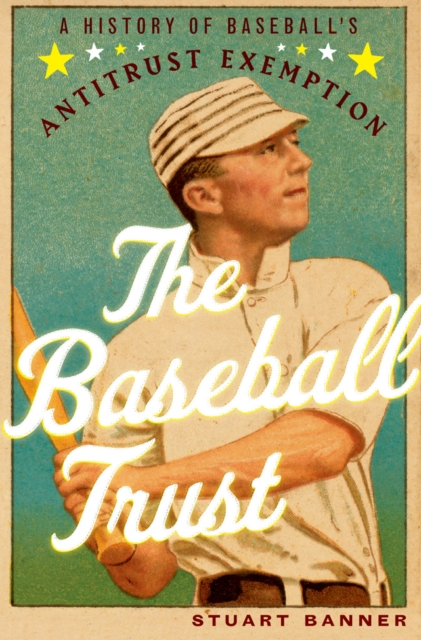
The baseball trust : a history of baseball's antitrust exemption
The impact of antitrust law on sports is in the news all the time, especially when there is labor conflict between players and owners, or when a team wants to move to a new city. And if the majority of Americans have only the vaguest sense of what antitrust law is, most know one thing about it—that baseball is exempt. This book illuminates the series of court rulings that resulted in one of the most curious features of our legal system: baseball's exemption from antitrust law. The book provides a history of the game as seen through the prism of an extraordinary series of courtroom battles, ranging from 1890 to the present. The book looks at such pivotal cases as the 1922 Supreme Court case which held that federal antitrust laws did not apply to baseball; the 1972 Flood v. Kuhn decision that declared that baseball is exempt even from state antitrust laws; and several cases from the 1950s, one involving boxing and the other football, that made clear that the exemption is only for baseball, not for sports in general. The book reveals that for all the well-documented foibles of major league owners, baseball has consistently received and followed antitrust advice from leading lawyers, shrewd legal advice that eventually won for baseball a protected legal status enjoyed by no other industry in America.
eBook

After civil rights
What role should racial difference play in the American workplace? As a nation, we rely on civil rights law to address this question, and the monumental Civil Rights Act of 1964 seemingly answered it: race must not be a factor in workplace decisions. InAfter Civil Rights, John Skrentny contends that after decades of mass immigration, many employers, Democratic and Republican political leaders, and advocates have adopted a new strategy to manage race and work. Race is now relevant not only in negative cases of discrimination, but in more positive ways as well. In today's workplace, employers routinely practice \"racial realism,\" where they view race as real--as a job qualification. Many believe employee racial differences, and sometimes immigrant status, correspond to unique abilities or evoke desirable reactions from clients or citizens. They also see racial diversity as a way to increase workplace dynamism. The problem is that when employers see race as useful for organizational effectiveness, they are often in violation of civil rights law.
After Civil Rightsexamines this emerging strategy in a wide range of employment situations, including the low-skilled sector, professional and white-collar jobs, and entertainment and media. In this important book, Skrentny urges us to acknowledge the racial realism already occurring, and lays out a series of reforms that, if enacted, would bring the law and lived experience more in line, yet still remain respectful of the need to protect the civil rights of all workers.
eBook