
Catalogue Search | MBRL


Are you sure you want to remove the book from the shelf?

{{itemTitle}}
35,163
result(s) for
"Program Improvement"
Sort by:

Transforming Education
Working away from trends in government policy, this book takes a future-oriented re-imagining of schools with a focus on four innate human capacities: collaboration, critical reflection, communication and creativity.
eBook

All systems go
Changing whole education systems for the better as measured by student achievement requires coordinated leadership at school, community, district, and government levels. This book lays out a comprehensive action plan for achieving whole-system reform.
eBook

School Culture Improvement
School Culture Improvement follows an abstract-concrete-abstract train of thought. The first three chapters answer the questions from the angle of abstract theory: what is the school culture and how is it managed? What is the school culture drive model? What is the school culture assessment? The two chapters thereafter solve major problems from the perspective of operations: how to develop the school culture solution and how to implement the school culture and promote cultural practices? The book concludes at the abstract theoretical level, on the position of sociological reflection, exploring what is the rationality and legitimacy of school culture and how does school culture happen? School Culture Improvement is one of the few school culture monographs which aims directly at management. Its contribution and features lie in two aspects: connecting school culture and school improvement and connecting research on project case and school culture, thus establishing a relatively complete system of school culture improvement theory. In this book, the author originates the following views and models: concept of school culture, school culture tripod structure theory, school culture spectrum theory, school culture drive model, and school culture unity and conflict.
eBook

An Age of Accountability
An Age of Accountability highlights the role of test-based accountability as a policy framework in American education from 1970 to 2020. For more than half a century, the quest to hold schools and educators accountable for academic achievement has relied almost exclusively on standardized assessment. The theory of change embedded in almost all test-based accountability programs held that assessment with stipulated consequences could lead to major improvements in schools. This was accomplished politically by proclaiming lofty goals of attaining universal proficiency and closing achievement gaps, which repeatedly failed to materialize. But even after very clear disappointments, no other policy framework has emerged to challenge its hegemony. The American public today has little confidence in institutions to improve the quality of goods and services they provide, especially in the public sector. As a consequence, many Americans continue to believe that accountability remains a vital necessity, even if educators and policy scholars disagree.
eBook

What makes a world-class school and how we can get there
For years, students in the United States have lagged behind students in many other countries on such measures of achievement as the PISA and TIMSS assessments. In an increasingly globalized world, such a gap is worrisome. Armed with statistics, examples, and cautionary tales from Scandinavia to Japan, James H. Stronge and Xianxuan Xu have written a book that can help educators better prepare students and close that gap.In What Makes a World-Class School and How We Can Get There, you will find:Careful analysis of recent international assessment results-what they mean and what can be done to improve them.In-depth profiles of high-achieving education systems around the globe-their histories, their lessons learned, and what they can teach educators and policymakers in the United States.Strategies for aligning successful educational approaches from international systems to U.S. schools-which strategies to use, in which subjects, and with which students.Transformative ideas for cultivating a truly world-class system of schooling-both simple and complex ways to raise the bar for all students, no matter what their background.Educators in every country must ensure that their students are as prepared as possible to lead a future generation of citizens. This thought-provoking and copiously researched book provides educators with a blueprint for radical improvement based on the hard-learned experiences of their peers around the world.
eBook

High-stakes reform
Performance accountability has been the dominant trend in education policy reform since the 1970s. State and federal policies set standards for what students should learn; require students to take \"high-stakes\" tests to measure what they have learned; and then hold students, schools, and school districts accountable for their performance. The goal of these policies is to push public school districts to ensure that all students reach a common threshold of knowledge and skills.High-Stakes Reformanalyzes the political processes and historical context that led to the enactment of state-level education accountability policies across the country. It also situates the education accountability movement in the broader context of public administration research, emphasizing the relationships among equity, accountability, and intergovernmental relations. The book then focuses on three in-depth case studies of policy development in Massachusetts, New Jersey, and Connecticut. Kathryn McDermott zeroes in on the most controversial and politically charged forms of state performance accountability sanctions, including graduation tests, direct state intervention in or closing of schools, and state takeovers of school districts. Public debate casts performance accountability as either a cure for the problems of US public education or a destructive mistake. Kathryn McDermott expertly navigates both sides of the debate detailing why particular policies became popular, how the assumptions behind the policies influenced the forms they took, and what practitioners and scholars can learn from the successes and failures of education accountability policies.
eBook

Developing the Emotionally Literate School
The book is a practical and up-to-date account of ways in which schools can use emotional literacy to realize their goals.
eBook

School improvement networks and collaborative inquiry : fostering systemic change in challenging contexts
This book describes the processes and challenges of implementing collaborative practices in School Improvement Networks, focussing specifically on examples from Chile. The Chilean case is significant for other challenging contexts, particularly rural communities, that still seek to implement collaborative inquiry projects.
eBook

Why Are We Still Doing That?
Old habits die hard, particularly when they are part of the unexamined norms of schooling. In \"Why Are We Still Doing That?,\" the best-selling authors of \"Total Participation Techniques\" lead a teacher-positive, empathetic inquiry into 16 common educational practices that can undermine student learning: (1) Round robin reading; (2) Teaching to learning styles; (3) Homework as the default; (4) Using interim assessments as \"formative assessments\"; (5) Asking, \"Does everybody understand?\"; (6) Traditional Q&A; (7) Data-driven everything; (8) Publicly displayed data walls; (9) Content breadth over depth; (10) Adhering to rigid pacing guides; (11) Teaching to test samplers; (12) An analysis-only approach to reading; (13) Elevating English language arts and mathematics over all other subjects; (14) Ignoring curriculum experts; (15) Using behavior charts; and (16) Withholding recess. Pérsida Himmele and William Himmele provide straightforward, research-informed accounts of what makes each of these practices problematic. And they share easy-to-implement instructional, assessment, and classroom management strategies you can use to meet the goals those problematic practices are intended to achieve . . . without the downsides or the damage. This book is for K-12 teachers at all stages of their career, including preservice teachers who will be educating the next generation of students. Read it and reflect on it with colleagues. Use it to focus your own inquiry into what is and is not working for your students and to replace ineffective and potentially harmful habits with more positive and effective ones.
eBook
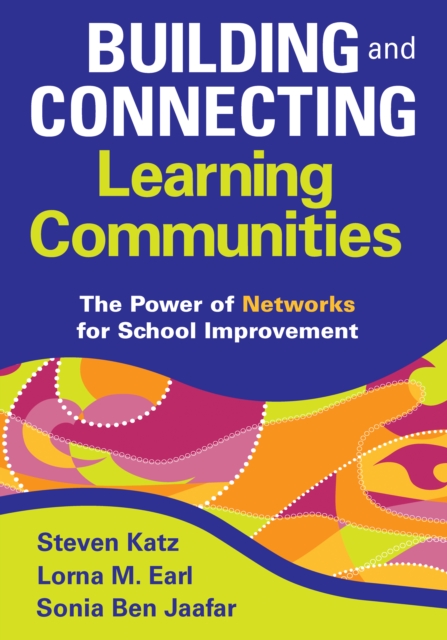
Building and connecting learning communities
Networked learning communities: A powerful school improvement strategy for school leaders! Drawing on their work with schools in North America and England, the authors demonstrate how linking professional learning communities across school or district boundaries creates networked learning communities (NLCs) that can share professional knowledge. Through a sample school narrative, the book illustrates how NLCs can significantly improve instruction, increase student performance, and promote deep and sustained change. This resource examines: Collaborative inquiry as a process that challenges teachers' thinking, generates new learning, and fosters trusting relationships Formal and informal leadership roles in NLCs How NLCs support systematic data analysis and accountability.
eBook