
Catalogue Search | MBRL


Are you sure you want to remove the book from the shelf?

{{itemTitle}}
10
result(s) for
"Proletarian nation"
Sort by:

Mussolini’s intellectuals
Fascism has traditionally been characterized as irrational and anti-intellectual, finding expression exclusively as a cluster of myths, emotions, instincts, and hatreds. This intellectual history of Italian Fascism--the product of four decades of work by one of the leading experts on the subject in the English-speaking world--provides an alternative account. A. James Gregor argues that Italian Fascism may have been a flawed system of belief, but it was neither more nor less irrational than other revolutionary ideologies of the twentieth century. Gregor makes this case by presenting for the first time a chronological account of the major intellectual figures of Italian Fascism, tracing how the movement's ideas evolved in response to social and political developments inside and outside of Italy.
Gregor follows Fascist thought from its beginnings in socialist ideology about the time of the First World War--when Mussolini himself was a leader of revolutionary socialism--through its evolution into a separate body of thought and to its destruction in the Second World War. Along the way, Gregor offers extended accounts of some of Italian Fascism's major thinkers, including Sergio Panunzio and Ugo Spirito, Alfredo Rocco (Mussolini's Minister of Justice), and Julius Evola, a bizarre and sinister figure who has inspired much contemporary \"neofascism.\"
Gregor's account reveals the flaws and tensions that dogged Fascist thought from the beginning, but shows that if we want to come to grips with one of the most important political movements of the twentieth century, we nevertheless need to understand that Fascism had serious intellectual as well as visceral roots.
eBook

The historical unreality of the proletariat as an ethnographic subject in Mexican anthropology
At the beginning of the twentieth century, the anthropological field became one of the main means of integrating indigenous populations utilized by the Mexican State in its enduring objective to integrate and assimilate the country’s native populations into the nation-state. However, far from achieving full integration, the envisioned national project that sought to assimilate them, resulted in the subjugation and progressive proletarianization of a large part of Mexico’s rural indigenous population in practice. Although this notorious transformation was common throughout the country, particularly in major cities after the 1950s, the proletarian remained overlooked as an ethnographic subject for Mexican anthropologist. In this context, this essay asks the following critical questions: what became of the proletariat in Mexican anthropology? What are the reasons for its long absence as an ethnographic subject for the discipline? This essay articulates a critique that accounts for the marginal place that the proletarian and the lumpen proletarian have had as ethnographic subjects in Mexican anthropology today. It calls for, on the one hand, the centering of the proletariat and its counterpart concept, the lumpen proletarian, and, on the other, for reflections on the possible theoretical and political possibilities a critical approach to these can open for the discipline in Mexico.
Journal Article

Ethnic politics in europe
This detailed account of ethnic minority politics explains when and how European institutions successfully used norms and incentives to shape domestic policy toward ethnic minorities and why those measures sometimes failed.
Going beyond traditional analyses, Kelley examines the pivotal engagement by the European Union, the Organization for Security and Cooperation in Europe, and the Council for Europe in the creation of such policies.
Following language, education, and citizenship issues during the 1990s in Latvia, Estonia, Slovakia, and Romania, she shows how the combination of membership conditionality and norm-based diplomacy was surprisingly effective at overcoming even significant domestic opposition. However, she also finds that diplomacy alone, without the offer of membership, was ineffective unless domestic opposition to the proposed policies was quite limited.
As one of the first systematic analyses of political rather than economic conditionality, the book illustrates under what conditions and through what mechanisms institutions influenced domestic policy in the decade, preparing the way for the historic enlargement of the European Union.
This thoughtful and thorough discussion, based on case studies, quantitative analysis, and interviews with nearly one hundred policymakers and experts, tells an important story about how European organizations helped facilitate peaceful solutions to ethnic tensions--in sharp contrast to the ethnic bloodshed that occurred in the former Yugoslavia during this time. This book's simultaneous assessment of soft diplomacy and stricter conditionality advances a long overdue dialogue between proponents rational choice models and social constructivists. As political requirements increasingly become part of conditionality, it also provides keen policy insights for the strategic choices made by actors in international institutions.
eBook
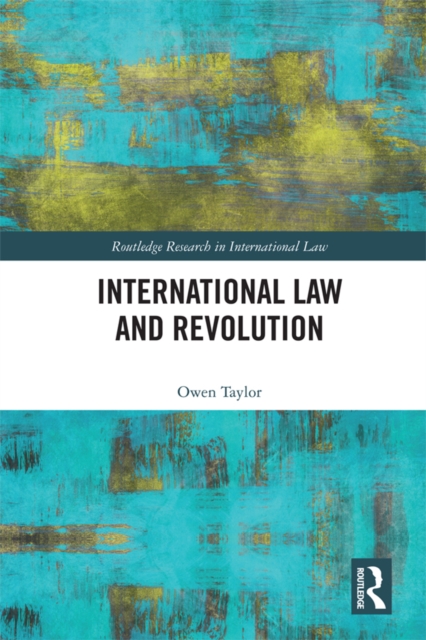
International Law and Revolution
This book explores the historical interrelations between international law and revolution, with a focus on how international anti-capitalist struggle plays out through law. The book approaches the topic by analysing the meaning of revolution and what revolutionary activity might look like, before comparing this with legal activity, to assess the basic compatibility between the two. It then moves on to examine two prominent examples of revolutionary movements engaging with international law from the twentieth century; the early Soviet Union and the Third World movement in the nineteen sixties and seventies. The book proposes that the ‘form of law’, or its base logic, is rooted in capitalist social relations of private property and contract, and that therefore the law is a particularly inhospitable place to advance revolutionary breaks with established distributions of power or wealth. This does not mean that the law is irrelevant to revolutionaries, but that turning to legal means comes with tendencies towards conservative outcomes. In the light of this, the book considers the possibility of how, or whether, international law might contribute to the pursuit of a more egalitarian future.
International Law and Revolution fills a significant gap in the field of international legal theory by offering a deep theoretical reflection on the meaning of the concept of revolution for the twenty-first century, and its link to the international legal system. It develops the commodity form theory of law as applied to international law, and explores the limits of law for progressive social struggle, informed by historical analysis. It will therefore appeal to students and scholars of public international law, legal history, human rights, international politics and political history.
eBook

Ciudad e inmigración: El conventillo de Luis Pascarella, novela de la transformación de Buenos Aires
Argentinean literature published during the first decades of the twentieth century has not always received the consideration it deserves. Multiple works have traditionally been ignored when they could elucidate relevant aspects of the Buenos Aires modernization process and the Argentine reformulation as a nation. My work analyzes the tensions at the basis of one of those generally ignored texts, El conventillo by Luis Pascarella. Through the study of the novel, I underline the importance that bourgeois Buenos Aires and proletarian immigration had for the development of Argentinean society and its literature.
Journal Article

The Foundation of the Indochinese Communist Party, 1929–1930
For perhaps a quarter of a century, from the mid-1930s to the year 1960, the Indochinese Communist Party—later the Workers' Party of Vietnam and now the Vietnamese Communist Party—celebrated the anniversary of its foundation on 6 January each year. The thirtieth anniversary (6 January 1960) was given special prominence in Hanoi and was marked by the publication of an official Party history in Vietnamese, French, English and other languages. Then, quite abruptly in September of the same year, the Party's Third National Congress approved a resolution to the effect that in future the anniversary would be commemorated on 3 February, which thereafter was held to be the ‘correct’ date.
Journal Article

Marx, Engels and the Manifesto: Working class, party, and proletariat
The article explores the manner in which Marx and Engels arrived at their conception of the proletariat. The distinction between the empirically given, flawed and disunited working class, and the universal mission of the proletariat as world historical actor, is teased out in the earlier works of Marx and Engels that anticipated the publication of the Communist Manifesto. The argument presented here is that the Communists, organized as a specific Party, constituted the crucial linkage (hitherto absent) between these two, and it was uniquely in the Manifesto that this linkage was developed. In defining the role of the Communists and the Party, however, Marx and Engels succeeded in writing themselves into the constitution of the proletarian Subject.
Journal Article


FRIEDLICHE KOEXISTENZ UND PROLETARISCHER INTERNATIONALISMUS
CONSTRASTS THE FREQUENT SOVIET STATEMENTS SUPPORTING PROLETARIAN INTERNATIONALISM WITH ACTUAL SOVIET FOREIGN POLICY. CONSIDERS THE REASONS FOR THE DISSOLUTION OF THE ALGERIAN AND EGYPTIAN COMMUNIST PARTIES IN THE 1960'S. CITES VARIOUS EXAMPLES OF SOVIET RECOGNITION OF INDIVIDUALS AND STATES ANTITHETICAL TO THE COMMUNIST MOVEMENT.
Journal Article