
Catalogue Search | MBRL


Are you sure you want to remove the book from the shelf?

{{itemTitle}}
4,344
result(s) for
"Propaganda, American"
Sort by:

The discourse of propaganda : case studies from the Persian Gulf War and the War on Terror
\"Using case studies from recent American military interventions, examines propaganda as an intertextual process, one in which discourse is recontextualized faithfully by multiple parties over time. Explores how messages are constructed, performed, and recontextualized in new and diverse situations\"--Provided by publisher.
Book

Selling the American Way
In 1955, the United States Information Agency published a lavishly illustrated booklet calledMy America. Assembled ostensibly to document \"the basic elements of a free dynamic society,\" the booklet emphasized cultural diversity, political freedom, and social mobility and made no mention of McCarthyism or the Cold War. Though hyperbolic,My Americawas, as Laura A. Belmonte shows, merely one of hundreds of pamphlets from this era written and distributed in an organized attempt to forge a collective defense of the \"American way of life.\"Selling the American Wayexamines the context, content, and reception of U.S. propaganda during the early Cold War. Determined to protect democratic capitalism and undercut communism, U.S. information experts defined the national interest not only in geopolitical, economic, and military terms. Through radio shows, films, and publications, they also propagated a carefully constructed cultural narrative of freedom, progress, and abundance as a means of protecting national security. Not simply a one-way look at propaganda as it is produced, the book is a subtle investigation of how U.S. propaganda was received abroad and at home and how criticism of it by Congress and successive presidential administrations contributed to its modification.
eBook


The Discourse of Propaganda
In the early 1990s, false reports of Iraqi soldiers in Kuwait
allowing premature infants to die by removing them from their
incubators helped to justify the Persian Gulf War, just as spurious
reports of weapons of mass destruction later undergirded support
for the Iraq War in 2003. In The Discourse of Propaganda ,
John Oddo examines these and other such cases to show how
successful wartime propaganda functions as a discursive
process.
Oddo argues that propaganda is more than just misleading
rhetoric generated by one person or group; it is an elaborate
process that relies on recontextualization, ideally on a massive
scale, to keep it alive and effective. In a series of case studies,
he analyzes both textual and visual rhetoric as well as the social
and material conditions that allow them to circulate, tracing how
instances of propaganda are constructed, performed, and repeated in
diverse contexts, such as speeches, news reports, and popular,
everyday discourse.
By revealing the agents, (inter)texts, and cultural practices
involved in propaganda campaigns, The Discourse of
Propaganda shines much-needed light on the topic and
challenges its readers to consider the complicated processes that
allow propaganda to flourish. This book will appeal not only to
scholars of rhetoric and propaganda but also to those interested in
unfolding the machinations motivating America's recent military
interventions.
eBook


Cold War on the Airwaves
Founded as a counterweight to the Communist broadcasters in East Germany, Radio in the American Sector (RIAS) became one of the most successful public information operations conducted against the Soviet Bloc. Cold War on the Airwaves examines the Berlin-based organization's history and influence on the political worldview of the people--and government--on the other side of the Iron Curtain. Nicholas Schlosser draws on broadcast transcripts, internal memoranda, listener letters, and surveys by the U.S. Information Agency to profile RIAS. Its mission: to undermine the German Democratic Republic with propaganda that, ironically, gained in potency by obeying the rules of objective journalism. Throughout, Schlosser examines the friction inherent in such a contradictory project and propaganda's role in shaping political culture. He also portrays how RIAS's primarily German staff influenced its outlook and how the organization both competed against its rivals in the GDR and pushed communist officials to alter their methods in order to keep listeners. From the occupation of Berlin through the airlift to the construction of the Berlin Wall, Cold War on the Airwaves offers an absorbing view of how public diplomacy played out at a flashpoint of East-West tension.
eBook

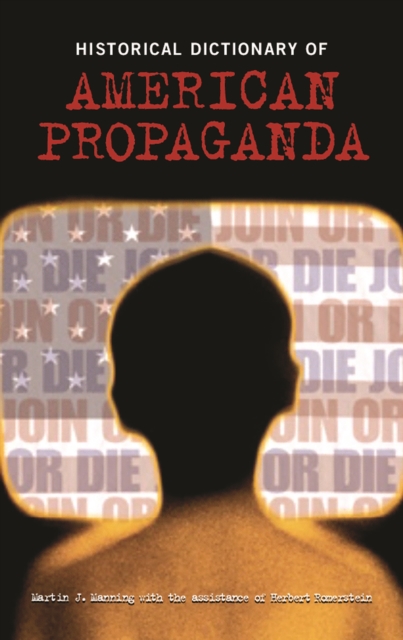
Historical Dictionary of American Propaganda
Presents a comprehensive, authoritative ready-reference guide to official U.S. propaganda, from colonial times to the present. Reviews Upper-division undergraduates; graduate students. Choice A fine acquisition...Recommended. Library Journal
eBook


Faith in Freedom
In Faith in Freedom
, Andrew R. Polk argues that the American civil religion so
many have identified as indigenous to the founding ideology was, in
fact, the result of a strategic campaign of religious
propaganda. Far from being the natural result of the
nation's religious underpinning or the later spiritual machinations
of conservative Protestants, American civil religion and the
resultant \"Christian nationalism\" of today were crafted by secular
elites in the middle of the twentieth century. Polk's genealogy of
the national motto, \"In God We Trust,\" revises the very meaning of
the contemporary American nation.
Polk shows how Presidents Franklin D. Roosevelt, Harry S Truman,
and Dwight D. Eisenhower, working with politicians, advertising
executives, and military public relations experts, exploited
denominational religious affiliations and beliefs in order to unite
Americans during the Second World War and, then, the early Cold
War. Armed opposition to the Soviet Union was coupled with militant
support for free economic markets, local control of education and
housing, and liberties of speech and worship. These preferences
were cultivated by state actors so as to support a set of
right-wing positions including anti-communism, the Jim Crow status
quo, and limited taxation and regulation.
Faith in Freedom is a pioneering work of American
religious history. By assessing the ideas, policies, and actions of
three US Presidents and their White House staff, Polk sheds light
on the origins of the ideological, religious, and partisan divides
that describe the American polity today.
eBook