
Catalogue Search | MBRL


Are you sure you want to remove the book from the shelf?

{{itemTitle}}
361
result(s) for
"Propaganda by Monuments"
Sort by:

Ivan Vladislavić's Aesthetics of Detritus in \Autopsy\ and \Propaganda by Monuments\
In this article, I examine detritus as a central trope for post-transitional South African society, an idea that, I argue, has particular relevance for Ivan Vladislavić's second short story collection, Propaganda by Monuments. As a point of departure, I use Leon de Kock's idea of the \"democratic moment\" – the moment of radical globalization coinciding with the fall of the Berlin Wall and the crumbling of apartheid bureaucracy. In this new \"democratic\" age, cultural detritus - remnants, fragments and addenda - begins to circulate and litter transnational contexts, finding its way into the unlikeliest of spaces, producing cultural resonances, echoes and cross-talk. In Propaganda by Monuments, detritus carries exotic charges of meaning, and allows for alternative ways of seeing the urban landscape in the new democratic era, in which the nation state has begun its process of dissipation. As such, Propaganda by Monuments can perhaps be read as a prelude to Vladislavić's third collection of stories, 101 Detectives, in which the detritus has been swept away, and polished surfaces are angled towards the protagonists, and the reader, narrowing their margins for subjectivity and self-styling.
Journal Article

The False Cause
The Lost Cause ideology that emerged after the Civil War and flourished in the early twentieth century sought to recast a struggle to perpetuate a slaveholding culture as a heroic defense of the South. As Adam Domby reveals in his new book, this was not only an insidious goal; it was founded on falsehoods. The False Cause focuses on North Carolina to examine the role of lies and exaggeration in the creation of the Lost Cause narrative. In the process the book shows how these lies have long obscured the past and been used to buttress white supremacy in ways that resonate to this day.Domby explores how fabricated narratives about the war's cause, Reconstruction, and slavery-as expounded at monument dedications and political rallies-were crucial to Jim Crow. He questions the persistent myth of the Confederacy as one of history's greatest armies, revealing a convenient disregard of deserters, dissent, and Unionism, and exposes how pension fraud facilitated a myth of unwavering support of the Confederacy among nearly all white Southerners. Domby shows how the dubious concept of \"black Confederates\" was spun from a small number of elderly and indigent African American North Carolinians who got pensions by presenting themselves as \"loyal slaves.\" The book concludes with a penetrating examination of how the Lost Cause narrative and the lies on which it is based continue to haunt the country today and still work to maintain racial inequality.
eBook

Ruins of War into Memorials of Reconciliation: Coventry Cathedral and the Dresden Frauenkirche, 1940–2010
Coventry Cathedral and the Dresden Frauenkirche, both destroyed in the Second World War, are often mentioned in the same breath, treated as architectural, commemorative, and religious equivalents. Nothing could be further from the truth. While the ruins of Coventry Cathedral were transformed into a site of—and memorial to—postwar reconciliation, the Frauenkirche was neither a revered shrine nor an unintentional monument, but simply a gutted structure suspended in limbo for some forty years. It was only in the course of the 1980s, and especially in the aftermath of German reunification, that the Frauenkirche ruins became invested with specific meaning. Support from Britain and, above all, Coventry, was crucial in this process. Methodologically, the article fuses memory studies with church/architectural history and comparative/transnational research.
Journal Article
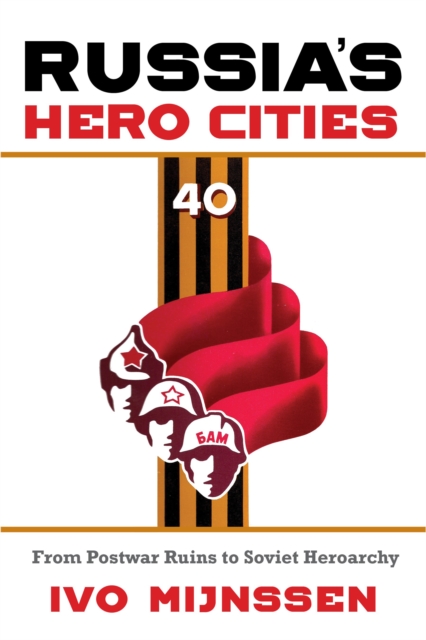
Russia's Hero Cities
By exploring the significance of Hero Cities in Soviet identity and the enduring but conflicted importance they hold for Russians today, Russia's Hero Cities exposes how the Great Patriotic War no longer has the power to mask the deep rifts still present in Russian society.
eBook

Russia’s Iconoclasms
Two iconoclasms took place in twentieth-century Russian history: the iconoclasm after the October revolution, and the iconoclasm after the breakdown of the Soviet Union. These two (ideologically opposite) phases of iconoclastic actions (dismantling, destruction) were incited by programmes concerning the abolition of tsarist monuments of 1918 and met by controversial reactions to the removal of the statues of the former Soviet politicians in the 1990s. The revolutionary demolition of the symbols of the imperial past was executed in accordance with a clear-cut plan and included the erection of new monuments for outstanding communist activists. The official aim of the post-soviet removal of these monuments, to delete traces of a problematic past, was confronted with a revitalized communist ideology on the one hand and with the reaction of the Human Rights Organization Memorial on the other, which criticized the insufficient demolition of soviet symbols. This multifaceted situation is complicated by the reconstruction of destroyed pre-revolutionary monuments of Russian (predominantly religious) history.
Journal Article

The Ideological Past and Present of Bratislava’s Slavín
The article presents an object of public area and also a national cultural monument and a cemetery – the Slavín monument. The author primarily analyses period documents and thus presents the historical-artistic and ideological (propagandist) side of the monument. Subsequently, the author works with the monument from the point of view of historical memory, forgetting and bending of history, while identifies the most significant shortcomings of the monument. In the last part of the article, the author analyses the legal regulation of the monument and offers options that would anchor Slavín as an urban dominant in the 21st century, both ideologically and artistically.
Journal Article

Asianics in Relief: Making Sense of Bronze and Iron Age Monuments in Classical Anatolia
This article argues that Bronze and Iron Age monuments in Anatolia were of intense interest to Greek historians and to the communities and individuals who lived in their vicinity. It focuses on two ancient historians’ discussions of pre-classical rock-cut reliefs to highlight the debates among ancient interpreters about the origins of such remains and their significance in local and universal history. Our analysis challenges Arnaldo Momigliano's clear-cut distinction between antiquarianism and history, as well as Elias Bickerman's influential notion that the only “prehistory” available to the Greeks and their neighbors was that imagined by the Greeks.
Journal Article

Monuments for Posterity
Monuments for Posterity
challenges the common assumption that Stalinist monuments
were constructed with an immediate, propagandistic function,
arguing instead that they were designed to memorialize the present
for an imagined posterity. In this respect, even while
pursuing its monument-building program with a singular ruthlessness
and on an unprecedented scale, the Stalinist regime was broadly in
step with transnational monument-building trends of the era and
their undergirding cultural dynamics.
By integrating approaches from cultural history, art criticism,
and memory studies, along with previously unexplored archival
material, Antony Kalashnikov examines the origin and implementation
of the Stalinist monument-building program from the perspective of
its goal to \"immortalize the memory\" of the era. He analyzes how
this objective affected the design and composition of Stalinist
monuments, what cultural factors prompted the sudden and powerful
yearning to be remembered, and most importantly, what the culture
of self-commemoration revealed about changing outlooks on the
future-both in the Soviet Union and beyond its borders.
Monuments for Posterity shifts the perspective from
monuments' political-ideological content to the desire to be
remembered and prompts a much-needed reconsideration of the
supposed uniqueness of both Stalinist aesthetics and the temporal
culture that they expressed. Many Stalinist monuments still stand
prominently in postsocialist cityscapes and remain the subject of
continual heated political controversy. Kalashnikov makes manifest
monuments' intentional attempts to seduce us-the \"posterity\" for
whom they were built.
eBook

Artifacts of Glory and Pain: Evolving Cultural Narratives on Confederate Symbolism and Commemoration in a New Era of Social Justice
The American Civil War has been commemorated with a great variety of monuments, memorials, and markers. These monuments were erected for a variety of reasons, beginning with memorialization of the fallen and later to honor aging veterans, commemoration of significant anniversaries associated with the conflict, memorialization of sites of conflict, and celebration of the actions of military leaders. Sources reveal that during both the Jim Crow and Civil Rights eras, many monuments were erected as part of an organized propaganda campaign to terrorize African American communities and distort the past by promoting a “Lost Cause” narrative. Through subsequent decades, to this day, complex and emotional narratives have surrounded interpretive legacies of the Civil War. Instruments of commemoration, through both physical and digital intervention approaches, can be provocative and instructive, as the country deals with a slavery legacy and the commemorated objects and spaces surrounding Confederate inheritances. Today, all of these potential factors and outcomes, with internationally relevance, are surrounded by swirls of social and political contention and controversy, including the remembering/forgetting dichotomies of cultural heritage. In this article, drawing from the testimony of scholars and artists, I address the conceptual landscape of approaches to the presentation and evolving participatory narratives of Confederate monuments that range from absolute expungement and removal to more restrained ideas such as in situ re-contextualization, removal to museums, and preservation-in-place. I stress not so much the academic debate but how the American public is informed about and reacts to the various issues related to Confederate memorialization. My main point, where my premise stands out in the literature, is that, for the sake of posterity, and our ability to connect and engage with a tangible in situ artifact, not all Confederate statues should be taken down. Some of them, or remnants of them, should be preserved as sites of conscience and reflection, with their social and political meanings ongoing and yet to be determined in the future. The modern dilemma turns on the question: In today’s new era of social justice, are these monuments primarily symbols of oppression, or can we see them, in select cases, alternatively as sites of conscience and reflection encompassing more inclusive conversations about commemoration? What we conserve and assign as the ultimate public value of these monuments rests with how we answer this question.
Journal Article

Principia of the legionary fortress in Novae: digital rendering as a tool for analysing Roman army religion and imperial propaganda
A 3D reconstruction of the principia at Novae (Bulgaria) allows modelling of the inscribed statues, altars and building stones as they used to look. By restoring the inscribed monuments to their original contexts, the model means that Roman military religiosity and its messages can be analysed in the legionary headquarters.
Journal Article