
Catalogue Search | MBRL


Are you sure you want to remove the book from the shelf?

{{itemTitle}}
2,383
result(s) for
"Prophecy Christianity."
Sort by:

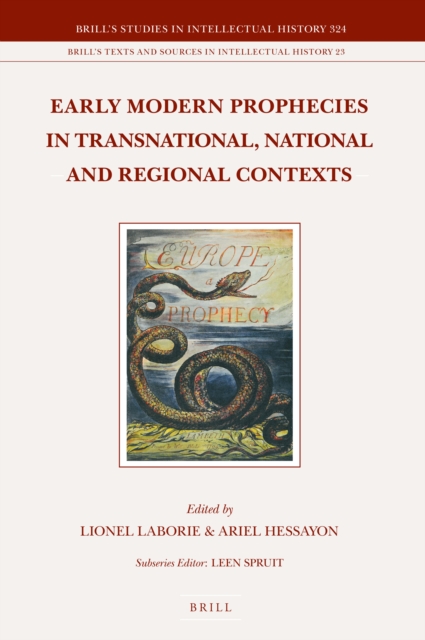
Early Modern Prophecies in Transnational, National and Regional Contexts (3 Vols. )
Laborie and Hessayon bring rare prophetic and millenarian texts to an international audience by presenting sources from all over Europe (broadly defined), and across the early modern period in English for the first time.
eBook

Amos and the Cosmic Imagination
Said to contain the words of the earliest of the biblical prophets (8th century BCE), the book of Amos is reinterpreted by James Linville in light of new and sometimes controversial historical approaches to the Bible. Amos is read as the literary product of the Persian-era community in Judah. Its representations of divine-human communication are investigated in the context of the ancient writers' own role as transmitters and shapers of religious traditions. Amos's extraordinary poetry expresses mythical conceptions of divine manifestation and a process of destruction and recreation of the cosmos which reveals that behind the appearances of the natural world is a heavenly, cosmic temple.
eBook

Al-Radd al-jamil : a fitting refutation of the divinity of Jesus
\"Al-Radd al-jamīl attributed to al-Ghazālī (d. 1111) is the most extensive and detailed refutation of the divinity of Jesus by a Muslim author in the classical period of Islam. Since the discovery of the manuscript in the 1930's scholars have debated whether the great Muslim theologian al-Ghazālī was really the author. This is a new critical edition of the Arabic text and the first complete English translation. The introduction situates this work in the history of Muslim anti-Christian polemical writing. Mark Beaumont and Maha El Kaisy-Friemuth argue that this refutation comes from an admirer of al-Ghazālī who sought to advance some of his key ideas for an Egyptian audience.\"-- Back cover.
BOOK

Doomsayers
The age of revolution, in which kings were dethroned, radical ideals of human equality embraced, and new constitutions written, was also the age of prophecy. Neither an archaic remnant nor a novel practice, prophecy in the eighteenth century was rooted both in the primitive worldview of the Old Testament and in the vibrant intellectual environment of the philosophers and their political allies, the republicans. In Doomsayers: Anglo-American Prophecy in the Age of Revolution, Susan Juster examines the culture of prophecy in Great Britain and the United States from 1765 to 1815 side by side with the intellectual and political transformations that gave the period its historical distinction as the era of enlightened rationalism and democratic revolution.Although sometimes viewed as madmen or fools, prophets of the 1790s and early 1800s were very much products of a liberal commercial society, even while they registered their disapproval of the values and practices of that society and fought a determined campaign to return Protestant Anglo-America to its biblical moorings. They enjoyed greater visibility than their counterparts of earlier eras, thanks to the creation of a vigorous new public sphere of coffeehouses, newspapers, corresponding societies, voluntary associations, and penny pamphlets. Prophecy was no longer just the art of applying biblical passages to contemporary events; it was now the business of selling both terror and reassurance to eager buyers. Tracking the careers of several hundred men and women in Britain and North America, most of ordinary background, who preached a message of primitive justice that jarred against the cosmopolitan sensibilities of their audiences, Doomsayers explores how prophetic claims were formulated, challenged, tested, advanced, and abandoned. The stories of these doomsayers, whose colorful careers entertained and annoyed readers across the political spectrum, challenge the notion that religious faith and the Enlightenment represented fundamentally alien ways of living in and with the world.From the debates over religious enthusiasm staged by churchmen and the literati to the earnest offerings of ordinary men and women to speak to and for God, Doomsayers shows that the contest between prophets and their critics for the allegiance of the Anglo-American reading public was part of a broader recalibration of the norms and values of civic discourse in the age of revolution.
eBook
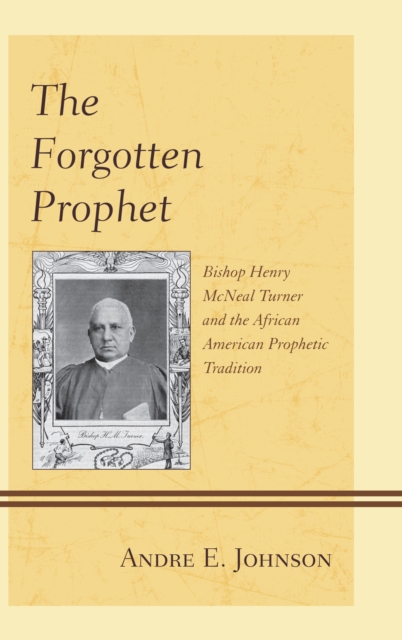
The Forgotten Prophet
The Forgotten Prophet: Bishop Henry McNeal Turner and the African American Prophetic Tradition, by Andre E. Johnson, is a study of the prophetic rhetoric of nineteenth century African Methodist Episcopal Church bishop Henry McNeal Turner. By locating Turner within the African American prophetic tradition, Johnson examines how Bishop Turner adopted a prophetic persona. As one of America's earliest black activists and social reformers, Bishop Turner made an indelible mark in American history and left behind an enduring social influence through his speeches, writings, and prophetic addresses. This text offers a definition of prophetic rhetoric and examines the existing genres of prophetic discourse, suggesting that there are other types of prophetic rhetorics, especially within the African American prophetic tradition. In examining these modes of discourses from 1866-1895, this study further examines how Turner's rhetoric shifted over time. It examines how Turner found a voice to article not only his views and positions, but also in the prophetic tradition, the views of people he claimed to represent. The Forgotten Prophet is a significant contribution to the study of Bishop Turner and the African American prophetic tradition.
eBook
Is Paul also among the prophets? : an examination of the relationship between Paul and the Old Testament prophetic tradition in 2 Corinthians
Aernie examines the prophetic material in the Old Testament and its relationship with the prophetic material in Second Temple Judaism, Hellenism, and the early Christian movement. The subsequent analysis of 1 Corinthians constitutes an investigation of the effect of the Old Testament prophetic tradition on Paul's self-presentation in 1 Cor 9.15-18, and the rhetorical framework in 1 Cor 14.20-25 as a methodological foundation for the exegetical analysis of 2 Corinthians. Aernie explores the influence of the Old Testament prophetic tradition on Paul's apostolic self-presentation and rhetoric in 2 Corinthians. The analysis of Paul's self-presentation examines the apostle's relationship with Moses, the Isaianic servant, and Jeremiah in order to define Paul's position with regard to the preceding prophetic tradition. Aernie analyses Paul's argument in 2 Cor 2.14-16; 4.1-6; 6.14-7.1; 12.1-10, and then seeks to examine the influence of the Old Testament prophetic tradition on the formation of Paul's rhetorical framework. Aernie's intention is to provide support for the notion that the particularly prophetic nature of Paul's apostolic persona affects both his self-presentation and rhetorical agenda in 2 Corinthians.
eBook
Regulations concerning tongues and prophecy in 1 Corinthians 14.26-40 : relevance beyond the Corinthian Church
This is an examination of the background to the gift of tongues in the light of Old Testament prophecy. In this book, Hiu firstly examines the background to the gifts of tongues and prophecy with a comprehensive assessment of the historical evidence, both primary and secondary, finding that tongues is a uniquely Christian phenomenon. Hiu then demonstrates that 'New Testament prophecy' is best considered as a direct extension of Old Testament prophecy. Hiu moves on to define and describe the functions of both tongues and prophecy in the New Testament which subsequently provides a clear base from which to seek a coherent understanding of the context and intent of Paul's regulations in 1 Cor 14.26-40. Attention is then focused on the socio-religious context of the known New Testament churches to determine if these regulations are applicable in non-Corinthian congregations. This ties in with a wider debate in Pauline scholarship surrounding whether Paul's intent was for Corinthians to be only addressed to the church at Corinth or whether he intended it to have a secondary audience also. Finally, Hiu draws the conclusion that Paul's regulations in 1 Corinthians are aptly applicable in all known New Testament churches and that the Corinthian situation is not unique. The natural inference is thereby that these regulations may be considered further in application to Christian churches in a contemporary setting.
eBook
The Spirit of Prophecy Defended
The Spirit of Prophecy Defended (originally published in 1713 as The General Delusion of Christians) defends the miracles, signs, and wonders of the Christian past and of the French Prophets. This retypeset edition incorporates previously unknown marginalia added by the original author, John Lacy.
eBook