
Catalogue Search | MBRL


Are you sure you want to remove the book from the shelf?

{{itemTitle}}
12,689
result(s) for
"Prophecy."
Sort by:

The land you never leave
Newly and uneasily allied, two tribes from different worlds set off across the Ocean of Grass. Their mission is to fulfill a prophecy and take Ottar the Moaner west of west, to save mankind. In their way are the denizens of the Badlands, the most terrifying and powerful collection of murderers and monsters the world has ever seen.
Book

PROPHECY AND AMBIGUITY: THE ORACULAR ART OF SYBILL TRELAWNEY IN HARRY POTTER IN LIGHT OF ANCIENT GREEK ORACLE TRADITIONS/ Profecia e Ambiguidade: A arte oracular de Sibila Trelawney em 'Harry Potter' a luz das tradicoes dos antigos oraculos gregos
This article examines the role of oracles in Greek mythology and how the concept is explored in the literary work \"Harry Potter.\" Greek oracles, such as the famous Oracle of Delphi, served as human intermediaries between gods and mortals, offering divine predictions and guidance. The figure of Sybill Trelawney in \"Harry Potter\" reflects that oracular tradition. Initially discredited due to her eccentric nature, her prophecies prove essential to the plot, especially the one concerning the birth of Harry Potter and his confrontation with Voldemort. Trelawney's narrative highlights the ambiguity of prophecies, a trait shared with Greek oracles, which often provide enigmatic responses. This study analyzes the influence of Greek mythology on the representation of the oracle in \"Harry Potter,\" emphasizing the importance of free will and the characters' choices in the face of destiny.
Journal Article

Prophecy in Clay: The Construction of Prophetic Identities in the Royal Archives of Mari
The prophetic texts from Mari represent the earliest written testimony of the prophetic phenomenon in the Ancient Near East. Approximately sixty-five clay tablets—out of the more than eighteen thousand unearthed at Tell Hariri (Syria)—attest to the prophetic activity of various men and women who received divine revelations primarily intended for the king. However, a detailed reading of the texts reveals that there is no single term used to identify prophetic agents, inviting reflection on the diversity of roles and functions within this phenomenon. Why, then, do scholars refer to them collectively as “prophetic agents” (a term that, moreover, carries a strong biblical resonance)? Can we discern in their actions the counterpart or the very essence of the prophets of Israel? This article explores, based on the original Akkadian texts, the multiple identities of the prophets of Mari through an analysis of the terms employed, their etymology, and their occurrence in Old Babylonian sources. Furthermore, since these individuals are recipients of divine revelation, the study also includes those men and women who bear witness to revelatory dreams. Finally, it raises the question of whether these prophets and their practices can be regarded as precursors to the biblical prophets, given the striking similarities in their behavior and message. This study thus provides grounds to speak of a continuum of prophetic phenomena throughout the biblical Near East.
Journal Article
Contours of the Holy Jerusalem on Earth: Elements of Montanist Ecclesiology
The paper presents the ecclesiological convictions of the so-called New Prophecy or ‘Montanist’ movement, a prophetic movement that rapidly gained prominence throughout the Empire from the middle of the second century CE. By regarding themselves as the mouthpieces of the Johannine Paraclete-Spirit, the founding prophets conveyed primarily ethical messages to the contemporary church. It is argued that their ascetic imperatives can be regarded as the practical implementation of a more complex ecclesiological and eschatological conviction. In the Montanists’ understanding, their prophetic communities were the earthly realisation of the heavenly Jerusalem, to which the Apocalypse of John attached concrete ethical contours (Rev 21:7–8). Such ‘realistic’ eschatology prevented the prophets and their adherents from seeing the reality of the church in a dualistic way or upholding the sanctification of the individual believer as a futuristic fulfilment. They believed that the coming of the Paraclete had instituted a new era for the church, and the ‘spiritual’ believers must prove to be ready to achieve moral perfection. Such pneumatic-prophetic and ascetic-perfectionist convictions give the contours of Montanist ecclesiology, one that proved to be widespread in the second century and influential on later Christian ecclesiological trajectories as well.
Journal Article

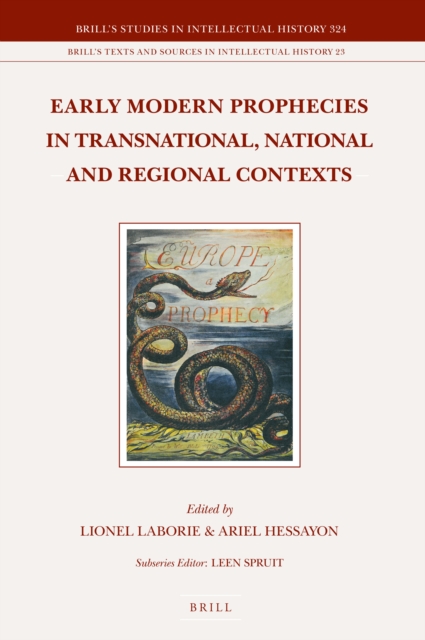
Early Modern Prophecies in Transnational, National and Regional Contexts (3 Vols. )
Laborie and Hessayon bring rare prophetic and millenarian texts to an international audience by presenting sources from all over Europe (broadly defined), and across the early modern period in English for the first time.
eBook

You die when you die
\"When his settlement is massacred by a hostile empire, Finn and his clan make their escape across an unforgiving land, battling animals and monsters, determined assassins, powerful tribes, and each other to fulfill a prophecy that is their only hope.\"--Page 4 of cover.
Book

Lying and self-defeating prophecies
The paper disputes the common view which holds that to lie is, essentially, to assert a disbelieved proposition. It shows by reference to self-defeating prophecies that one can lie by asserting a believed proposition, and by reference to self-fulfilling prophecies that one can be truthful by asserting a disbelieved proposition. It concludes that lying is, essentially, asserting a proposition believed to be false conditionally on the occurrence of the assertion.
Journal Article