
Catalogue Search | MBRL


Are you sure you want to remove the book from the shelf?

{{itemTitle}}
1,383
result(s) for
"Prosecution United States."
Sort by:


American terrorism trials : prosecutorial and defense strategies
Since 1980, prosecutors and defense attorneys handling federal terrorism trials have developed politicized strategies and counter strategies unique to terrorism trials, and those strategies have had a significant impact on case outcomes. Moreover, case outcomes were positively impacted by proactive policy changes implemented in the wake of 9/11. Building on structural contextual theory and the hydraulic effect, Shields finds that when prosecutors rely less heavily on highly politicized prosecution strategies, conviction rates increased. In fact, his findings indicate that the more prosecutors politicize a case, the more likely the case goes to trial, increasing the odds of acquittal.
eBook


Arbitrary Justice
In this eye-opening work, Angela J. Davis shines a much-needed light on the power of American prosecutors, revealing how the day-to-day practice of even the most well-intentioned prosecutors can result in unequal treatment of defendants and victims and gross inequities in criminal justice. For the paperback edition, Davis provides a new Afterword which covers such recent incidents of prosecutorial abuse as the Jena Six case, the Duke lacrosse case, the Department of Justice firings, and more.
eBook
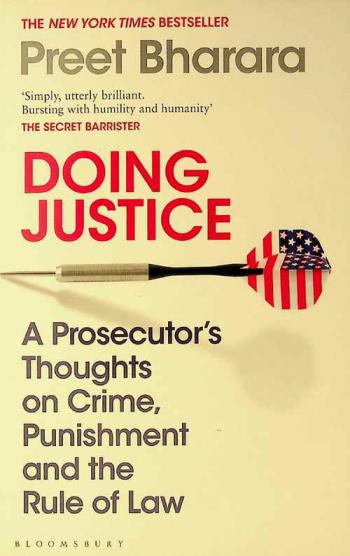
Doing justice : a prosecutor's thoughts on crime, punishment and the rule of law
In Doing Justice Bharara takes us into the gritty, tactically complex, often sensational world of America's criminal justice system. We meet the wrongly accused and those who have escaped scrutiny for too long, the fraudsters and mobsters, investigators and interrogators, snitches and witnesses. We learn what justice is and the basics of building a case, and how judgement must be delivered not only with toughness, but with calmness, care and compassion. This is not just a book about the law. This is a book about integrity, leadership, decision-making and moral reasoning - and one that teaches us how to think and act justly in our own lives.
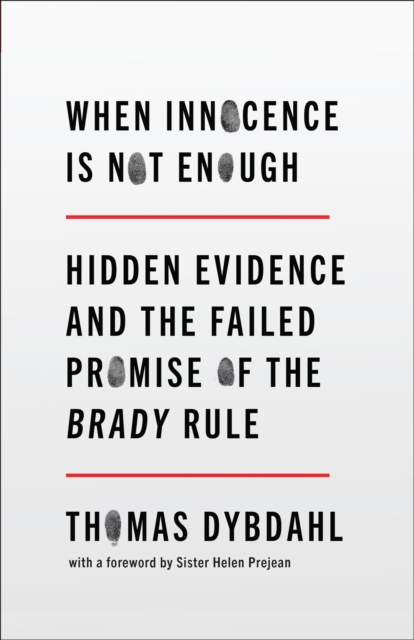
When Innocence Is Not Enough
Finalist, Colorado Book Award
A gripping work of narrative nonfiction, told across
time, that exposes what’s at stake when prosecutors
conceal evidence—and what we can do about it The
Brady rule was meant to transform the U.S. justice
system. In soaring language, the Supreme Court decreed in 1963
that prosecutors must share favorable evidence with the
defense—part of a suite of decisions of that
reform-minded era designed to promote fairness for those
accused of crimes. But reality intervened. The opinion faced
many challenges, ranging from poor legal reasoning and shaky
precedent to its clashes with the very foundations of the
American criminal legal system and some of its most powerful
enforcers: prosecutors.
In this beautifully wrought work of narrative nonfiction,
Thomas L. Dybdahl illustrates the promise and shortcomings of
the
Brady rule through deft storytelling and attention to
crucial cases, including the infamous 1984 murder of Catherine
Fuller in Washington, DC. This case led to eight young Black
men being sent to prison for life after the prosecutor, afraid
of losing the biggest case of his career, hid information that
would have proven their innocence.
With a seasoned defense lawyer’s unsparing eye for
detail, Thomas L. Dybdahl chronicles the evolution of the
Brady rule—from its unexpected birth to the
series of legal decisions that left it defanged and
ineffective. Yet Dybdahl shows us a path forward by
highlighting promising reform efforts across the country that
offer a blueprint for a legislative revival of
Brady ’s true spirit.
eBook

Rumor, repression, and racial politics : how the harassment of Black elected officials shaped post-civil rights America
\"Historians have exhaustively documented how African Americans gained access to electoral politics in the mid-1960s, but few have scrutinized what happened next, and the small body of work that does consider the aftermath of the civil rights movement is almost entirely limited to the Black Power era. In Rumor, Repression, and Racial Politics, George Derek Musgrove pushes much further, examining black elected officials' allegations of state and news media repression--what they called \"harassment\"--to gain new insight into the role of race in U.S. politics between 1965 and 1995.Drawing from untapped sources, including interviews he conducted with twenty-five sitting and former black members of Congress, Musgrove tells new stories and reinterprets familiar events. His cast of characters includes Julian Bond, Adam Clayton Powell Jr., Alcee Hastings, Ronald Dellums, Richard Arrington, and Marion Barry, as well as white political figures like Newt Gingrich and Jefferson Sessions. Throughout, Musgrove connects patterns of surveillance, counterintelligence, and disproportionate investigation of black elected officials to the broader political culture. In so doing, he reveals new aspects of the surveillance state of the late 1960s, the rise of adversary journalism and good government reforms in the wake of Watergate, the official corruption crackdown of the 1980s, and the allure of conspiracy theory to African Americans seeking to understand the harassment of their elected leadership. Moving past the old debate about whether there was a conscious conspiracy against black officials, Musgrove explores how the perception of harassment shaped black political thought in the post-civil rights era. The result is a field-defining work by a major new intellectual voice\"--Provided by publisher.
Book

Effigy
Effigy examines the images of a capital defendant portrayed, by the defense attorneys and the prosecutor, during the guilt and penalty phases of capital trial, the trial tactics used to impart these images, and the consequences that result from the jury's attempt to reconcile contradictory images to place one in permanent record as a verdict.
eBook

Allen Dulles, the OSS, and Nazi war criminals : the dynamics of selective prosecution
\"This book examines the circumstances surrounding SS-Obergruppenfuhrer Karl Wolff's escape from prosecution for war crimes in 1945. Wolff avoided prosecution because of his role in 'Operation Sunrise', negotiations conducted by high-ranking American, Swiss and British officials - in violation of the Casablanca agreements with the Soviet Union - for the surrender of German forces in Italy that enabled the Anglo-American forces to take Trieste. After 1945, Allied officials, amongst them Allen Dulles, in a move that later helped him ascend to the head of the CIA, shielded Wolff from prosecution to maintain secrecy about the negotiations. 'Operation Sunrise' thus relates to the early origins of the Cold War in Europe and had wide-ranging implications, even in the field of justice: new evidence suggests that the Western Allies not only failed to ensure cooperation between their respective national war crimes prosecution organizations, but in certain cases even obstructed justice by withholding evidence from the prosecution\"-- Provided by publisher.
Book

White Collar Criminal Prosecutions in the U. S. and U. K
Table of Contents: The Fundamentals of White Collar Practice Law Enforcement's Evidence Gathering Tools Charging Decisions, Charging Instruments, and Bail The Main Financial Crimes Pre-Trial Discovery and Disclosure Resolving and Challenging a Case Before Trial Trial Procedure and Evidentiary Rules Post-Verdict Motions and Appeals Sentencing &.
eBook