
Catalogue Search | MBRL


Are you sure you want to remove the book from the shelf?

{{itemTitle}}
5,532
result(s) for
"Protection de l"
Sort by:
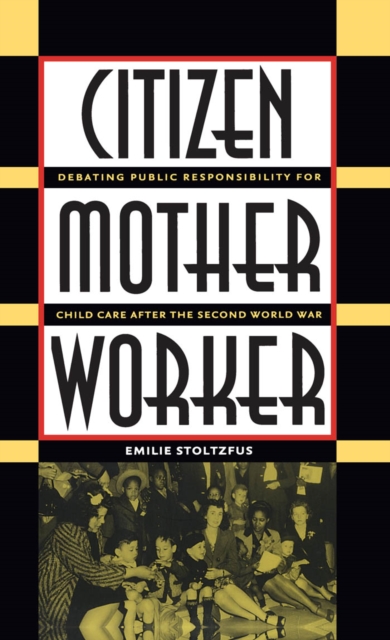
Citizen mother worker : debating public responsibility for child care after the Second World War
During World War II, American women entered the workforce in unprecedented numbers, and many of them relied on federally funded child care programs. At the end of the war, working mothers vigorously protested the termination of child care subsidies. In Citizen, Mother, Worker , Emilie Stoltzfus traces grassroots activism and national and local policy debates concerning public funding of children's day care in the two decades after the end of World War II. Using events in Cleveland, Ohio; Washington, D.C.; and the state of California, Stoltzfus identifies a prevailing belief among postwar policymakers that women could best serve the nation as homemakers. Although federal funding was briefly extended after the end of the war, grassroots campaigns for subsidized day care in Cleveland and Washington met with only limited success. In California, however, mothers asserted their importance to the state's economy as \"\"productive citizens\"\" and won a permanent, state-funded child care program. In addition, by the 1960s, federal child care funding gained new life as an alternative to cash aid for poor single mothers. These debates about the public's stake in what many viewed as a private matter help illuminate America's changing social, political, and fiscal priorities, as well as the meaning of female citizenship in the postwar period. |Stoltzfus traces grassroots activism and national and local policy debates surrounding public funding of childcare services for working parents in the two decades after the end of World War II. Using case studies from Cleveland, Washington, D.C., and the state of California, she explains why we still don't have adequate child care in America. The book helps illuminate America's changing social, political, and fiscal priorities, as well as the meaning of female citizenship in the postwar period.
eBook

Using integrated coastal management and economics to conserve coastal tourism resources in Sri Lanka
Coastal areas in the tropics are increasingly being developed for tourism. The combined natural features of beaches, coral reefs, warm marine waters and often a friendly culture of people, offer desirable destinations for many travelers. Although coastal tourism generates substantial economic benefits to local and national economies, the trade-off of such development is usually degradation of coastal environment. Poor environmental planning and lack of consideration of social-cultural issues are usual causes. This article examines the case of Hikkaduwa town and marine sanctuary, Sri Lanka, where tourism development has nearly ruined the coastal environment. Integrated coastal management in Sri Lanka through a community-based \"Special Area Management\" (SAM) plan for Hikkaduwa is examined. The ongoing and proposed management actions required to solve the environmental and social problems are analyzed in a cost-benefit framework. Financial, socialeconomic and environmental economic analyses for a 20-year project life all strongly support investment in SAM plan implementation. Untapped consumer surplus of visitors to Hikkaduwa has a large potential to contribute to costs. To ensure sustainability of tourism and resources, policies on how to finance plan implementation through profit sharing and locally collected fees are suggested.
Journal Article


Factors affecting farmers' use and rejection of banded pesticide applications
This article addresses farmers' decisions to try using banded herbicide applications as well as factors that affect whether
or not trial attempts are then extended to regular usage. The data is drawn from a total of 722 person-to-person interviews
held in 16 Missouri counties, including 75 longer semi-structured interviews within three watersheds. The group of farmers
who have tried banding operate significantly larger corn and soybean acreages, and have statistically higher levels of gross
sales, education, knowledge of pesticides, and ability to apply their own chemicals. Logistic regression analysis suggests
college education, certification as a private applicator, and gross sales as the three variables most likely to predict experimentation.
Maintenance of the practice following initial use, however, is negatively related to farm size, and positively related only
to gross sales and certification. Logistic regression analysis suggests only gross sales as significantly increasing the odds
of adoption. The qualitative research reveals that obstacles with adoption for trial users center largely around difficulties
of locating custom applicators for banding, the time and labor required for cultivation, and the ripple effects of banding-related
tasks on other aspects of operator farming systems. In essence, banding satisfies farmers' desires to reduce pesticide use
and protect water quality, but as a practice it is very difficult to incorporate into individual farming systems.
Journal Article
Evaluating soil properties of CRP land using remote sensing and GIS in Finney County, Kansas
The Conservation Reserve Program (CRP) began in 1986 with the primary purpose of reducing soil erosion. It also was intended
to help the development of sustainable agriculture and associated environmental harmony. However, its effectiveness has been
questioned because of the large costs and extensive staff required to conduct the program. The objectives of our study were
to test procedures for integrating remote sensing and geographic information systems (GIS) techniques to evaluate the present
CRP in terms of its main goal, and to give recommendations for the future of the program in Finney County, Kansas. Three seasonal
Landsat Thematic Mapper (TM) images were used to derive the land-use/land cover (LULC) map. This information was incorporated
with spatial dimensions of soil surface horizon thickness, surface horizon texture, soil family, soil subgroup, and soil erodibility
index (EI), all of which were extracted or calculated from the Natural Resources Conservation Service (NRCS) soil survey geographic
(SSURGO) data base. With GIS techniques, calculation of EI was more efficient and the value was more accurate than that calculated
by hand. We found the average EI of the county to be 20, with the highest EI of 77 in the southwest portion of the study area.
CRP land had higher soil fertility and a lower EI than land currently used for farming; therefore, the CRP for this county
did not necessarily include the lands most susceptible to erosion. We suggest continuing the CRP program in Finney County,
because the soils are generally at serious risk of erosion. We also suggest modifying the eligibility rules of the program
in order to target the most environmentally sensitive lands.
Journal Article

Criteria used for protection of natural areas in Sweden 1909-1986
We examined 15 criteria used for selection of 1175 natural areas protected by the Swedish Nature Conservation Act. We categorized criteria as \"scientific,\" having botanical, ornithological, and geological values, or \"political,\" having human-oriented recreational, landscape, and cultural values. On average, 2.3 criteria were used per protected area, and number of criteria increased with size of area. The six major criteria in order of use were: recreational, botanical, landscape, geological, ornithological, and cultural values. Political criteria were as important as scientific ones for protection of Swedish nature. There were only minor historical changes in use of different criteria, except that recreational values increased strongly from 1965 to 1975. The average and median size of protected areas increased from 1960 onwards. Areas of recreational value were more common close to the three largest cities and were often large; areas of botanical value were often small. Areas of recreational or ornithological value were associated with lakes and the coast; areas of botanical and landscape value were associated with mountains and farmland. An ordination of areas with two or more criteria showed associations within the group of political and within the group of scientific criteria. Political criteria may be important in or close to populated areas during periods when urbanization and leisure increase; nationally, we plead for emphasis on biological criteria in future selection of protected areas.
Journal Article
Using geographic information systems for watershed classification and rating in developing countries
Sheng et al provide an overview of how Geographic Information Systems (GIS) can support watershed classification and management priority ratings and suggest practical methodology and procedures for such an undertaking at a national or regional level. These suggestions are presented in context of a watershed classification and priority rating system suitable for use in developing countries.
Journal Article

Green reason: communicative ethics for the biosphere
Exclusively instrumental notions of rationality not only reinforce attitudes conducive to the destruction of the natural world, but also undermine attempts to construct environmental ethics that involve more harmonious relationships between humans and nature. Deep ecologists and other ecological critics of instrumental rationality generally prefer some kind of spiritual orientation to nature. In this paper I argue against both instrumental rationalists and ecological spiritualists in favor of a communicative rationality which encompasses the natural world. I draw upon both critical theory and recent scientific intimations of agency in nature.
Journal Article