
Catalogue Search | MBRL


Are you sure you want to remove the book from the shelf?

{{itemTitle}}
8,458
result(s) for
"Protectorates."
Sort by:


Topologically protected states in one-dimensional continuous systems and Dirac points
We study a class of periodic Schrödinger operators on ℝ that have Dirac points. The introduction of an “edge” via adiabatic modulation of a periodic potential by a domain wall results in the bifurcation of spatially localized “edge states,” associated with the topologically protected zero-energy mode of an asymptotic one-dimensional Dirac operator. The bound states we construct can be realized as highly robust transverse-magnetic electromagnetic modes for a class of photonic waveguides with a phase defect. Our model captures many aspects of the phenomenon of topologically protected edge states for 2D bulk structures such as the honeycomb structure of graphene.
Journal Article

Without glory in Arabia : the British retreat from Aden
\"'So we left without glory but without disaster,' Sir Humphrey Trevelyan, the last High Commissioner of the Federation of South Arabia. In 1967, 139 years after their arrival in Aden, the British withdrew from the southern tip of the Arabian Peninsula. Their departure was abrupt, messy and controversial. Using important, previously unpublished material and original interviews with a range of individuals, both British and Yemeni, who lived through this defining period of colonial history, Without Glory in Arabia tells the story of the final few years of British rule in Aden and the neighbouring Eastern and Western Aden Protectorates. While some view British rule, on the whole, as beneficial to the local population, others insist that very little was achieved. Worse, Britain did not provide a structure of government constitution which met the conflicting needs of Aden and the Protectorate. This illuminating book brilliantly sets the scuttle--as the episode came to be known--in context, with a thorough re-examination of the background against which the events of the 1960s unfolded in this obscure backwater of the British Empire\"--Back cover.
Book

The New Model Army
The definitive account of the superior fighting force that powered the English Revolution The New Model Army was one of the most formidable fighting forces ever assembled. Formed in 1645, it was crucial in overthrowing the monarchy and propelling one of its most brilliant generals, Oliver Cromwell, to power during the English Revolution. Paradoxically, it was also instrumental in restoring the king in 1660. But the true nature of this army has long been debated. In this authoritative history, Ian Gentles examines the full scope of the New Model Army. As a fighting force it engineered regicide, pioneered innovative military tactics, and helped to keep Cromwell in power as Lord Protector until his death. All the while, those within its ranks promoted radical political ideas inspired by the Levellers and held dissenting religious beliefs. Gentles explores how brilliant battlefield maneuvering and logistical prowess contributed to its victories-and...
eBook

Kenya's Engagement with China
In recent decades, Kenya has witnessed profound changes in its
economic, cultural, and environmental landscapes resulting from its
interactions with China. University students are competing for
scholarships to study in China, coastal artisanal fishers are
increasingly worried about Chinese-owned trawlers depleting fish
stocks, fishers on Lake Victoria are grappling with the impact of
frozen tilapia from China, and unemployed youth are seeking a fair
shot at working on one of Kenya's multimillion-dollar
Chinese-funded infrastructure projects. Anita Plummer's Kenya's
Engagement with China investigates the tension between
official Kenyan and Chinese state narratives and individual
Kenyans' reactions to China's presence to provide insight into how
everyday Kenyans exercise their political agency. The competing
discourses Plummer uncovers in person, in the news, and online
reveal how Kenyans use China to question local power structures,
demand policy change, and articulate different visions for their
country's future. This critical text represents the next step in
research on Sino-African relations.
eBook
Ripples of Hope
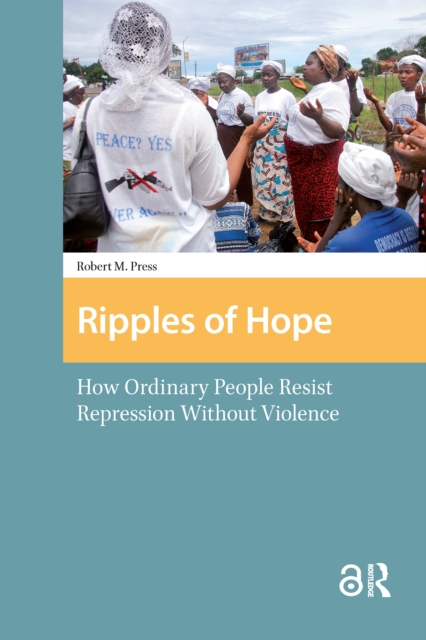
In Ripples of Hope, Robert M. Press tells the stories of mothers, students, teachers, journalists, attorneys, and many others who courageously stood up for freedom and human rights against repressive rulers and who helped bring about change through primarily nonviolent means. Global in application and focusing on Kenya, Liberia and Sierra Leone, this tribute to the strength of the human spirit also breaks new ground in social movement theories, showing how people on their own or in small groups can make a difference.
eBook


Making Morocco
How did four and a half decades of European colonial intervention transform Moroccan identity? As elsewhere in North Africa and in the wider developing world, the colonial period in Morocco (1912-1956) established a new type of political field in which notions about and relationships among politics and identity formation were fundamentally transformed. Instead of privileging top-down processes of colonial state formation or bottom-up processes of local resistance, the analysis in Making Morocco focuses on interactions between state and society.
Jonathan Wyrtzen demonstrates how, during the Protectorate period, interactions among a wide range of European and local actors indelibly politicized four key dimensions of Moroccan identity: religion, ethnicity, territory, and the role of the Alawid monarchy. This colonial inheritance is reflected today in ongoing debates over the public role of Islam, religious tolerance, and the memory of Morocco's Jews; recent reforms regarding women's legal status; the monarchy's multiculturalist recognition of Tamazight (Berber) as a national language alongside Arabic; the still-unresolved territorial dispute over the Western Sahara; and the monarchy's continued symbolic and practical dominance of the Moroccan political field.
eBook