
Catalogue Search | MBRL


Are you sure you want to remove the book from the shelf?

{{itemTitle}}
1,143
result(s) for
"Protest song"
Sort by:

The tide is rising so are we! : a climate movement anthem
\"Inspired by the climate movement anthem \"The Tide Is Rising,\" this story is full of hope and determination for rising up to meet the climate change challenges of our day\"-- Provided by publisher.
CHILDBOOK

The Routledge History of Social Protest in Popular Music
The major objective of this collection of 28 essays is to analyze the trends, musical formats, and rhetorical devices used in popular music to illuminate the human condition. By comparing and contrasting musical offerings in a number of countries and in different contexts from the 19th century until today, The Routledge History of Social Protest in Popular Music aims to be a probing introduction to the history of social protest music, ideal for popular music studies and history and sociology of music courses.
eBook

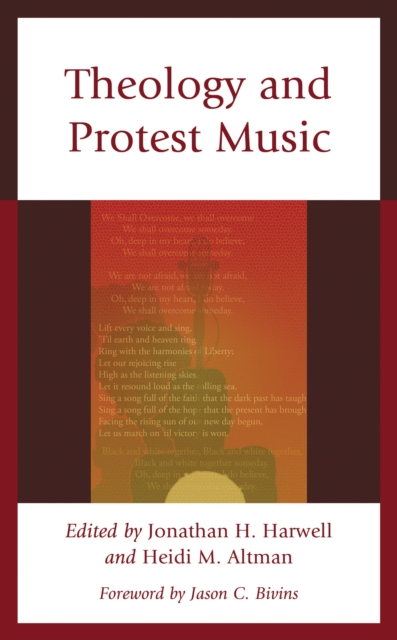
Theology and Protest Music
Songs of protest have been inspiring activists for millennia, and continue to be created, shared, and reworked across musical genres. From the prophet Habakkuk as proto-protest singer, through a broad spectrum of twentieth and twenty-first century artists and diverse faith traditions, Theology and Protest Music gathers compelling contributions that examine Brazilian eschatology, Black liberation and womanism, esoteric Islam in Five Percenter rap, heavy metal as anti-theology, Howard Thurman's relevance to jazz, Cuban Santería priest Pedrito Martinez' sacred Batá drumming, as well as theological reflections on Jay-Z, Funkadelic, Marvin Gaye, Sweet Honey in the Rock, and the social justice chorale movement. Those interested in theology and popular culture, as well as scholars of music, social justice, racial identity, LGBTQ+ studies, and gender studies will find new aspects of the broad spectrum of protest music and its diverse spiritual connections. Theology and Protest Music also features invited contributions by pioneering choral activist Catherine Roma and world-renowned performer, composer, and educator Dr. Ysaye Maria Barnwell.
eBook

Music Is Power
Honorable Mention, 2019 Foreword INDIES Awards - Performing Arts & Music Honorable Mention, Graphis 2021 Design Annual Competitionâ Popular music has long been a powerful force for social change.Protest songs have served as anthems regarding war, racism, sexism, ecological destruction, and so many other crucial issues.
eBook

The battle hymn of the republic : a biography of the song that marches on
It was sung at Ronald Reagan's funeral, and adopted with new lyrics by labor radicals. John Updike quoted it in the title of one of his novels, and George W. Bush had it performed at the memorial service in the National Cathedral for victims of September 11, 2001. Perhaps no other song has held such a profoundly significant--and contradictory--place in America's history and cultural memory than \"The Battle Hymn of the Republic.\" In this sweeping study, John Stauffer and Benjamin Soskis show how this Civil War tune has become an anthem for cause after radically different cause in our nation's history.
eBook
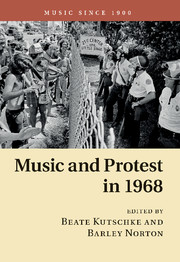
Music and Protest in 1968
Music was integral to the profound cultural, social and political changes that swept the globe in 1968. This collection of essays offers new perspectives on the role that music played in the events of that year, which included protests against the ongoing Vietnam War, the May riots in France and the assassination of Martin Luther King, Jr. From underground folk music in Japan to antiauthoritarian music in Scandinavia and Germany, Music and Protest in 1968 explores music's key role as a means of socio-political dissent not just in the US and the UK but in Asia, North and South America, Europe and Africa. Contributors extend the understanding of musical protest far beyond a narrow view of the 'protest song' to explore how politics and social protest played out in many genres, including experimental and avant-garde music, free jazz, rock, popular song, and film and theatre music.
eBook

Protest Song in East and West Germany since the 1960s
The modern German political song is a hybrid of high and low culture. With its roots in the birth of mass culture in the 1920s, it employs communicative strategies of popular song. Yet its tendencies toward philosophical, poetic, and musical sophistication reveal intellectual aspirations. This volume looks at the influence of revolutionary artistic traditions in the lyrics and music of the 'Liedermacher' of east and west Germany: the rediscovery of the revolutionary songs of 1848 by the 1960s West German folk revival, the use of the profane \"carnivalesque\" street-ballad tradition by Wolf Biermann and the GDR duo Wenzel & Mensching, the influence of 1920s artistic experimentation on 'Liedermacher' such as Konstantin Wecker, and the legacy of Hanns Eisler's revolutionary song theory. The book also provides an insider perspective on the countercultural scenes of the two Germanys, examining the conditions in which political songs were written and performed. In view of the decline of the political song form since the fall of communism, the book ends with a look at German avant-garde techno's attempt to create a music that challenges conventional cultural perceptions and attitudes. CONTRIBUTORS: DAVID ROBB, ECKARD HOLLER, ANNETTE BLÜHDORN, PETER THOMPSON. David Robb is Senior Lecturer in German Studies at the Queen's University of Belfast.
eBook

Crisis music
Marching to the beat of punk rock and reggae, Rock Against Racism was a mass movement built in opposition to racism and fascism in 1970s Britain. At a time of severe economic and social crises, RAR, alongside the Anti-Nazi League, organised one of the biggest and most effective political and cultural mobilisations of the post-war period. Expressing itself through spectacular carnivals, concerts, marches and innovative forms of design and communication, RAR combined hard-headed political organisation with the optimism and energy of radical youth culture. Drawing on interviews with activists, supporters and critics, and based on the latest research, Crisis music explores the nature of this ground-breaking politico-cultural phenomenon. The author explains why RAR seized upon the power and passion of punk and reggae, and how this has helped to shape the boundaries of modern popular music. He also offers, for the first time, a clear picture of the relationship between RAR and its main political sponsor, the Socialist Workers Party. Crisis music discusses RAR's place within the left's often-troubled encounters with popular culture, and draws comparisons with other music-based movements and campaigns, such as the post-war folk revival and Live 8. This book casts light on numerous current debates: about 'celebrity politics' and the role of musicians as political spokespeople, for instance, and the links between ethnicity, popular culture and politics. It will be of value to students and researchers in cultural studies, politics and labour history, and to anyone interested in the role of culture in political activity.
eBook

Choreographies of Protest Performance as Recruitment to Activism
This article seeks to understand why some bystanders to protest transcended to become actors in protests during the re-emergence of wide-spread student activism in an institution of higher education in South Africa during 2015. For this purpose, a performance ethnography is employed in the observation and analysis of protest performances. The article shows that in encountering an atmosphere of protest, there emerged a relation of feeling, referred to as 'feeling the vibe or atmosphere', which those who became protest performers resolved in ways which increased their capacity to act in favour of co-constituting that atmosphere. In the encounter between the body of bystanders and the atmosphere of protest, non-linear somatic communication, characterised by active and passive gestures and postures,occurred through which protest performers developed contact and connection with other bodies as a result of the displacement of space. Therefore, this article suggests that participation in activism can be about going with the flow of movement in an uncertain and ambiguous moment and is not limited to an identification with the pre-existing organisation of preferences and interests as the creativity of movement produces a social space - a performed becoming in space.
Journal Article