
Catalogue Search | MBRL


Are you sure you want to remove the book from the shelf?

{{itemTitle}}
5,793
result(s) for
"Proust, Marcel"
Sort by:

Marcel Proust
This is a concise critical biography of Marcel Proust, one of the most important writers of the 20th century. The book considers Proust's early years of personal and aesthetic experiment, the growth of his masterwork 'A la recherche du temps perdu', and his personal decline due to ill-health.
BOOK

The Growth of A la recherche du temps perdu
For forty years, scholars have had access to a vast array of documents that reveal the stages by which a few modest episodes grew into the vast and complex structure the world reveres as Marcel Proust's unique novel,A la recherche du temps perdu. Although many soundings have been made in this corpus, which comprises manuscript pages, exercise books, typescripts, and publisher's proofs, Anthony Pugh's study is the first attempt to provide a comprehensive view of the story that the documents reveal, at least in the years before the outbreak of war in 1914.
A crucial feature of the research is the rigorous establishment of the chronological sequence of the documents, a task complicated by Proust's habit of returning to sketches already written, amplifying them with extensive additions in the margins and on the facing pages, often reorganizing them, and finally reworking them in another form, sometimes physically intercalating pages of the first version into the new one. Anthony Pugh analyses with scrupulous care every document, facing all the multi-faceted problems they present, and showing why many solutions, some of them widely accepted by Proust scholars, have to be questioned.
It emerges from this investigation that however unsystematic Proust was in his method of composing, there is an inner logic in the way he oscillates between writing new incidents and editing texts already extant. Now, for the first time, the whole story of the way in whichA la recherche du temps perdugrew during the first six years of its gestation is told in full, both in its general thrust and in its fine details.
eBook

The Cambridge Introduction to Marcel Proust
\"Proust's A la recherche du temps perdu (In Search of Lost Time, 1913-27) changed the course of modern narrative fiction. This Introduction provides an account of Proust's life, the socio-historical and cultural contexts of his work and an assessment of his early works. At its core is a volume-by-volume study of In Search of Lost Time, which attends to its remarkable superstructure, as well as to individual images and the intricacies of Proust's finely-stitched prose. The book reaches beyond stale commonplaces of madeleines and memory, alerting readers to Proust's verbal virtuosity, his preoccupations with the fleeting and the unforeseeable, with desire, jealousy and the nature of reality. Lively, informative chapters on Proust criticism and the work's afterlives in contemporary culture provide a multitude of paths to follow. The book charges readers with the energy and confidence to move beyond anecdote and hearsay and to read Proust's novel for themselves\"-- Provided by publisher.
BOOK
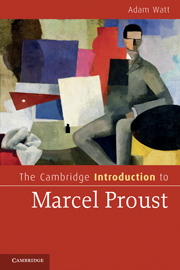
The Cambridge Introduction to Marcel Proust
Proust's A la recherche du temps perdu (In Search of Lost Time, 1913–27) changed the course of modern narrative fiction. This Introduction provides an account of Proust's life, the socio-historical and cultural contexts of his work and an assessment of his early works. At its core is a volume-by-volume study of In Search of Lost Time, which attends to its remarkable superstructure, as well as to individual images and the intricacies of Proust's finely-stitched prose. The book reaches beyond stale commonplaces of madeleines and memory, alerting readers to Proust's verbal virtuosity, his preoccupations with the fleeting and the unforeseeable, with desire, jealousy and the nature of reality. Lively, informative chapters on Proust criticism and the work's afterlives in contemporary culture provide a multitude of paths to follow. The book charges readers with the energy and confidence to move beyond anecdote and hearsay and to read Proust's novel for themselves.
eBook
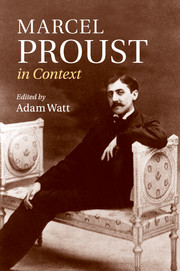
Marcel Proust in Context
This volume sets Marcel Proust's masterwork, Á la recherche du temps perdu (In Search of Lost Time, 1913–27), in its cultural and socio-historical contexts. Essays by the leading scholars in the field attend to Proust's biography, his huge correspondence, and the genesis and protracted evolution of his masterpiece. Light is cast on Proust's relation to thinkers and artists of his time, and to those of the great French and European traditions of which he is now so centrally a part. There is vivid exploration of Proust's reading; his attitudes towards contemporary social and political issues; his relation to journalism, religion, sexuality, science and travel, and how these figure in the Recherche. The volume closes with a comprehensive survey of Proust's critical reception, from reviews during his lifetime to the present day, including assessments of Proust in translation and the broader assimilation of his work into twentieth- and twenty-first-century culture.
eBook


A reader's guide to Proust's In search of lost time
\"Proust's 'A la recherche du temps perdu' (In search of lost time) is many things at once: a novel of education, a portrait of French society during the Third Republic, a masterful psychological analysis of love, a reflection on homosexuality, an essay in moral and aesthetic theory, and, above all, one of the great literary achievements of the twentieth century. This Reader's Guide analyses each volume of the 'Recherche' in order and in detail. Without jargon or technical language, David Ellison leads the reader through the work, clarifying but not oversimplifying the intricate beauty of Proust's imaginary universe. Focused both on large themes and on narrative and stylistic particularities, Ellison's readings expand our understanding and appreciation of the work and provide tools for the further study of Proust. All French quotations are translated, making this an ideal guide for students of comparative literature as well as of French\"--Provided by publisher.
BOOK

Proust and Emotion
InProust and Emotion, Inge Crosman Wimmers proposes a new approach toA la recherche du temps perduthat centres on the role of affect. Through close reading of the hero-narrator's personal history, the author shows how emotional paradigms (especially separation anxiety), involuntary memory, and other compelling impressions give focus and structure to Proust's novel. Drawing on reader-oriented and emotion theories, she shows how affect commands the attention of the 'motivated reader' and is crucial to the process of self-understanding for both the narrator and the reader.
This is the first extensive study in English to take fully into consideration the drafts (esquisses) published in the new Pléiade edition of the novel, the Mauriac edition ofAlbertine disparue, and material from the unpublished Proust manuscripts - all of which shed further light on the importance of affect inA la recherche.Proust and Emotionwill appeal to readers interested in an approach to Proust that combines insights from philosophy, psychology, and literary aesthetics and in a poetics of reading that pays particular attention to emotion.
eBook