
Catalogue Search | MBRL


Are you sure you want to remove the book from the shelf?

{{itemTitle}}
10
result(s) for
"Prudentius, 348-"
Sort by:

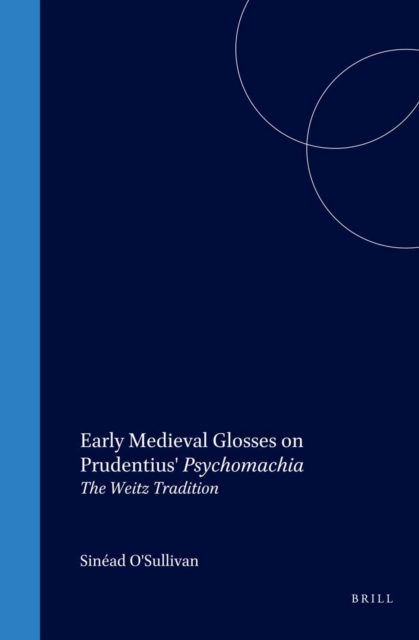
Early medieval glosses on Prudentius' Psychomachia : the Weitz tradition
This book elucidates the significance of glosses on Prudentius' Psychomachia in the German or Weitz manuscript tradition. It redirects attention away from the philological concerns of conventional scholarship toward those of mainstream Carolingian and Ottonian intellectual history.
eBook

Prudentius
Prudentius (born 348 CE) used allegory and classical Latin verse forms in the service of Christianity. His works include the Psychomachia, an allegorical description of the struggle between (Christian) virtues and (pagan) vices; lyric poetry; and--a valuable source on Christian iconography--poetic inscriptions for biblical scenes on the walls of a church. Prudentius (Aurelius Prudentius Clemens) was born in 348 CE probably at Caesaraugusta (Saragossa) and lived mostly in northeastern Spain, but visited Rome between 400 and 405. His parents, presumably Christian, had him educated in literature and rhetoric. He became a barrister and at least once later on an administrator; he afterwards received some high honour from Emperor Theodosius. Prudentius was a strong Christian who admired the old pagan literature and art, especially the great Latin poets whose forms he used. He looked on the Roman achievement in history as a preparation for the coming of Christ and the triumph of a spiritual empire. The Loeb Classical Library edition of the poems of Prudentius is in two volumes. Volume I presents: Preface (Praefatio); The Daily Round (Liber Cathemerinon); 12 literary and attractive hymns, parts of which have been included in the Breviary and in modern hymnals; The Divinity of Christ (Apotheosis), which maintains the Trinity and attacks those who denied the distinct personal being of Christ; The Origin of Sin (Hamartigenia) attacking the separation of the \"strict\" God of the Old Testament from the \"good\" God revealed by Christ; Fight for Mansoul (Psychomachia), which describes the struggle between (Christian) Virtues and (Pagan) Vices; and the first book of Against the Address of Symmachus (Contra Orationem Symmachi), in which pagan gods are assailed. The second volume contains the second book of Against the Address of Symmachus, opposing a petition for the replacement of an altar and statue of Victory; Crowns of Martyrdom (Peristephanon Liber), 14 hymns to martyrs mostly of Spain; Lines To Be Inscribed under Scenes from History (Tituli Historiarum), 49 four-line stanzas which are inscriptions for scenes from the Bible depicted on the walls of a church; and an Epilogue.
Book

The Roman self in late antiquity : Prudentius and the poetics of the soul
The Roman Self in Late Antiquity for the first time situates Prudentius within a broad intellectual, political, and literary context of fourth-century Rome. As Marc Mastrangelo convincingly demonstrates, the late-fourth-century poet drew on both pagan and Christian intellectual traditions—especially Platonism, Vergilian epic poetics, and biblical exegesis—to define a new vision of the self for the newly Christian Roman Empire.
Mastrangelo proposes an original theory of Prudentius's allegorical poetry and establishes Prudentius as a successor to Vergil. Employing recent approaches to typology and biblical exegesis as well as the most current theories of allusion and intertextuality in Latin poetry, he interprets the meaning and influence of Prudentius's work and positions the poet as a vital author for the transmission of the classical tradition to the early modern period.
This provocative study challenges the view that poetry in the fourth century played a subordinate role to patristic prose in forging Christian Roman identity. It seeks to restore poetry to its rightful place as a crucial source for interpreting the rich cultural and intellectual life of the era.
eBook


Bridal Songs: Catullan Epithalamia and Prudentius Peristephanon 3
Prudentius' account of the martyrdom of the young Spanish girl Eulalia in Peristephanon 3 is particularly interesting because not only does it consist of her defiance of an order to pay homage to the pagan gods but also a rejection of pressures to get married. If martyrdom constituted an act of rebellion against the conventions of pagan society, then female martyrdom was doubly so and the ways in which it was presented to a community in which Christianity was still struggling to establish its reputation is worthy of detailed examination. Prudentius was arguably the Christian poet most influenced by his pagan predecessors, making an active effort to compose poetry worthy of the great Latin poetic tradition. When examining the classical antecedents of Peristephanon 3, scholars have largely concentrated upon its Virgilian echoes, emphasising the heroic dimensions of Eulalia's conduct by comparing her to Virgilian ‘heroines’ (the Sibyl, Camilla and Dido) who challenge conventional female roles. Some critics have pointed to elements of an epithalamium within the poem but they have related this imagery to late antique epithalamia or to the Song of Songs rather than looking for antecedents within classical poetry.
Journal Article

Typology and Agency in Prudentius’s Treatment of the Judith Story
In the late fourth century, the Christian poet Prudentius wrote thePsychomachia(The Battle within the Soul), which depicts a series of single combats between personified virtues and vices. Immensely popular in the Middle Ages and Renaissance, thePsychomachia’s allegorical battles were depicted in a variety of relief sculptures and paintings throughout churches in Europe.¹ In his poem, Prudentius frequently uses a character or story from the Old Testament that prefigures a character or event from the New Testament, Roman Christian history, and a personified virtue or vice. These typologies form the backbone of Prudentius’s poem; so, for instance, the
Book Chapter
