
Catalogue Search | MBRL


Are you sure you want to remove the book from the shelf?

{{itemTitle}}
26,193
result(s) for
"Pruitt, Scott"
Sort by:
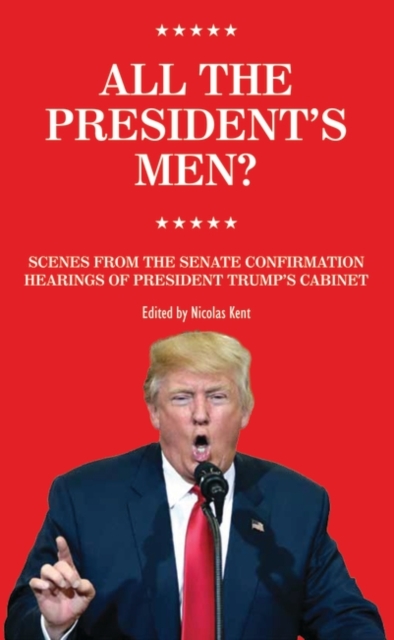
All the President's men?: scenes from the Senate confimation hearings of President Trump's cabinet
The U.S. Senate's 2017 confirmation process for President Trump's Cabinet. It forensically reveals the ethics, beliefs and philosophy behind four key Cabinet figures: Rex Tillerson, the former CEO of Exxon, now Secretary of State responsible for America's foreign policy; Attorney-General Jeff Sessions, a leading campaigner for the President and now his chief law officer; Dr Tom Price, a strident critic of Obamacare now Health Secretary and Scott Pruitt, a climate change sceptic confirmed as Director of the Environmental Protection Agency.The appointment of these men will have huge implications. They will lead the administration's policy on Russia, the Middle East, Iran and North Korea, on human rights worldwide, on the Paris Climate control agreement, as well as on the civil rights and the health of millions of Americans.
eBook

The Environmental Protection Agency in the Early Trump Administration: Prelude to Regulatory Capture
We explore and contextualize changes at the Environmental Protection Agency (EPA) over the first 6 months of the Trump administration, arguing that its pro-business direction is enabling a form of regulatory capture. We draw on news articles, public documents, and a rapid response, multisited interview study of current and retired EPA employees to (1) document changes associated with the new administration, (2) contextualize and compare the current pro-business makeover with previous ones, and (3) publicly convey findings in a timely manner. The lengthy, combined experience of interviewees with previous Republican and Democratic administrations made them valuable analysts for assessing recent shifts at the Scott Pruitt–led EPA and the extent to which these shifts steer the EPA away from its stated mission to “protect human and environmental health.” Considering the extent of its pro-business leanings in the absence of mitigating power from the legislative branch, we conclude that its regulatory capture has become likely—more so than at similar moments in the agency’s 47-year history. The public and environmental health consequences of regulatory capture of the EPA will probably be severe and far-reaching.
Journal Article

Pollution, health, and the planet: time for decisive action
Pollution is the largest environmental cause of disease and death in the world today, responsible for an estimated 9 million premature deaths in 2015.1 92% of all pollution-related mortality is seen in low-income and middle-income countries.1 A new Lancet Commission on pollution and health aims to confront and overturn this urgent predicament.1 The substantial health and economic costs of pollution globally can no longer be ignored. Pollution is a major theme within planetary health because the drivers of climate change, such as the combustion of fossil fuels or land use change, are also important contributors to pollution. Pollution itself has effects, which are still incompletely understood, on a range of natural systems—for example, toxic chemicals can cause reduced ecosystem function that can indirectly affect human health.2 In 2006, the Stern review commissioned by the UK Government was influential in reframing climate change as an economic issue, and not merely an environmental challenge.3 The Stern review improved our understanding of the economic costs of climate change, and inspired a huge amount of subsequent work.
Journal Article


US rule would strip science from environmental policies and increase premature deaths, warn scientists
Decades of landmark public health studies on matters such as air pollution and water quality could be eliminated from consideration in future decision from the US Environmental Protection Agency (EPA), health experts have warned. Since allowing access to such data would breach confidentiality agreements between researchers and study participants, many studies would be excluded from consideration when drawing up new rules on problems like lead contamination or vehicle emissions, said the scientists. “Transparency, reproducibility, and application of current scientific knowledge are paramount to providing the foundation required for sound regulations,” said a statement from the American Chemistry Council, which is the principal industry group of the US chemical industry, whose members include companies such as Dow, DuPont, and Eli Lilly.
Journal Article
EPA data rule questioned
[...]critics say, such a rule would prevent the agency from considering some of the best health research, ultimately making it harder to create new environmental regulations. EMISSIONS FIGHT The science-advisory board also voted to assess the research underlying a series of proposed regulations to limit greenhouse-gas emissions from power plants, vehicles, and oil and gas operations. The plan sought to reduce carbon emissions from existing power plants and was former president Barack Obama's signature climate-change policy.
Journal Article
Pollution rules under siege at US environment agency
After controlling for factors such as income, the scientists found that death rates increased in areas with more fine-particulate pollution and higher levels of ozone, a major component of smog - even if those regions met air-quality standards. Cory Zigler, a biostatistician at the University of Texas at Austin, says that Cox has effectively declared his own statistical methods king, writing off a variety of studies demonstrating the link between air pollution and public health. [...]researchers including Christopher Frey, an environmental engineer at North Carolina State University in Raleigh, have pointed out that the current CASAC lacks the scientific expertise to properly evaluate the EPA's work on air-quality standards.
Journal Article
Fears rise over US climate report
A sweeping US government report on the state of climate-change science is nearing the finish line, but researchers who wrote it aren't ready to relax just yet. Federal scientists have twice reviewed the roughly 600-page document--which examines everything from shifting weather patterns to rising sea levels--as have the US National Academies of Sciences, Engineering, and Medicine. Just one hurdle remains, but it may be the highest: final sign-off by top officials in President Donald Trump's administration, many of whom are sceptical of climate science.
Journal Article
Outrage over changes to EPA chemical assessments
The latest push includes changes to chemicalsafety guidelines that place greater weight on industry-sponsored research, among other things, and is a part of efforts by US President Donald Trump's administration to reshape how the agency uses science to make decisions. Jennifer Sass, a senior scientist at the Natural Resources Defense Council, an advocacy group based in New York City, suspects that the goals are to promote science from industry and change the calculations that the EPA uses to develop regulations and estimate safe exposure limits for chemicals. MEETING THE REQUIREMENTS The guidelines introduce many data reporting requirements - including statistical analyses that measure whether a study correctly identifies the presence of an effect - that are standard for industry-funded research.
Journal Article