
Catalogue Search | MBRL


Are you sure you want to remove the book from the shelf?

{{itemTitle}}
216
result(s) for
"Pseudodifferential operators"
Sort by:

Singular integrals in quantum Euclidean spaces
We shall establish the core of singular integral theory and pseudodifferential calculus over the archetypal algebras of
noncommutative geometry: quantum forms of Euclidean spaces and tori. Our results go beyond Connes’ pseudodifferential calculus for
rotation algebras, thanks to a new form of Calderón-Zygmund theory over these spaces which crucially incorporates nonconvolution
kernels. We deduce
eBook

Quasi-Periodic Standing Wave Solutions of Gravity-Capillary Water Waves
The authors prove the existence and the linear stability of small amplitude time quasi-periodic standing wave solutions (i.e. periodic and even in the space variable x) of a 2-dimensional ocean with infinite depth under the action of gravity and surface tension. Such an existence result is obtained for all the values of the surface tension belonging to a Borel set of asymptotically full Lebesgue measure.
eBook

Positive Gaussian Kernels also Have Gaussian Minimizers
We study lower bounds on multilinear operators with Gaussian kernels acting on Lebesgue spaces, with exponents below one. We put
forward natural conditions when the optimal constant can be computed by inspecting centered Gaussian functions only, and we give
necessary and sufficient conditions for this constant to be positive. Our work provides a counterpart to Lieb’s results on maximizers of
multilinear operators with real Gaussian kernels, also known as the multidimensional Brascamp-Lieb inequality. It unifies and extends
several inverse inequalities.
eBook

Adiabatic Evolution and Shape Resonances
Motivated by a problem of one mode approximation for a non-linear evolution with charge accumulation in potential wells, we consider
a general linear adiabatic evolution problem for a semi-classical Schrödinger operator with a time dependent potential with a well in an
island. In particular, we show that we can choose the adiabatic parameter
\\center
Motivés par un
problème d’approximation à un mode pour une évolution avec accumulation de charge dans des puits de potentiel, nous considérons un
problème d’évolution linéaire pour un opérateur de Schrödinger avec un potentiel dépendant du temps avec un puits dans une île. En
particular, nous montrons que nous pouvons choisir le paramètre adiabatique
eBook

Pseudo-differential operators with discontinuous symbols: Widom’s Conjecture
Relying on the known two-term quasiclassical asymptotic formula for the trace of the function f(A) of a Wiener-Hopf type operator A in dimension one, in 1982 H. Widom conjectured a multi-dimensional generalisation of that formula for a pseudo-differential operator A with a symbol a(x,ξ) having jump discontinuities in both variables. In 1990 he proved the conjecture for the special case when the jump in any of the two variables occurs on a hyperplane. The present paper provides a proof of Widom's Conjecture under the assumption that the symbol has jumps in both variables on arbitrary smooth bounded surfaces.
eBook
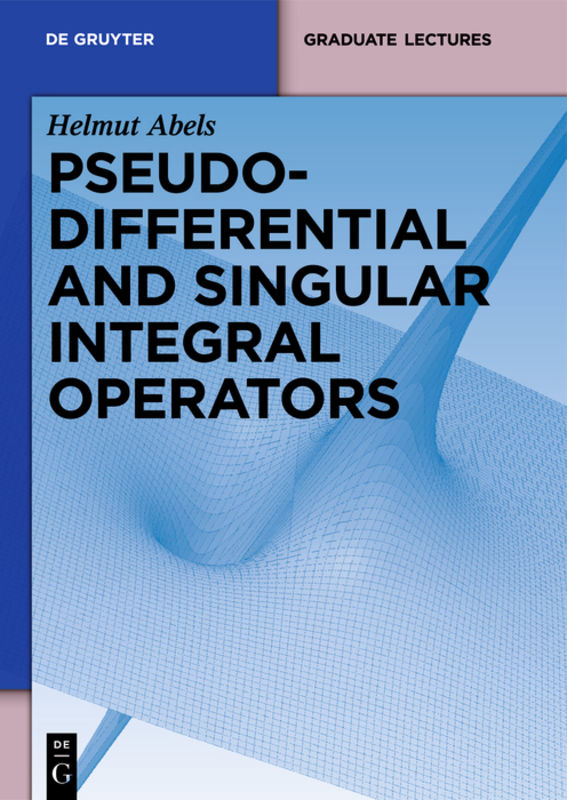
Pseudodifferential and Singular Integral Operators
This textbook provides a self-contained and elementary introduction to the modern theory of pseudodifferential operators and their applications to partial differential equations.In the first chapters, the necessary material on Fourier transformation and distribution theory is presented.
eBook


Analysis of Hyper-Singular, Fractional, and Order-Zero Singular Integral Operators
In this article, we conduct a study of integral operators defined in terms of non-convolution type kernels with singularities of various degrees. The operators that fall within our scope of research include fractional integrals, fractional derivatives, pseudodifferential operators, Calderón-Zygmund operators, and many others. The main results of this article are built around the notion of an operator calculus that connects operators with different kernel singularities via vanishing moment conditions and composition with fractional derivative operators. We also provide several boundedness results on weighted and unweighted distribution spaces, including homogeneous Sobolev, Besov, and Triebel-Lizorkin spaces, that are necessary and sufficient for the operator’s vanishing moment properties, as well as certain behaviors for the operator under composition with fractional derivative and integral operators. As applications, we prove T1-type theorems for singular integral operators with different singularities, boundedness results for pseudodifferential operators belonging to the forbidden class
S
1
,
1
0
, fractional order and hyper-singular paraproduct boundedness, a smooth-oscillating decomposition for singular integrals, sparse domination estimates that quantify regularity and oscillation, and several operator calculus results. It is of particular interest that many of these results do not require L²-boundedness of the operator, and furthermore, we apply our results to some operators that are known not to be L²-bounded.
Journal Article

Spectral theory and geometric analysis : international conference in honor of Mikhail Shubin's 65th birthday, Spectral Theory and Geometric Analysis, July 29-August 2, 2009, Northeastern University, Boston, MA
This volume contains the proceedings of the conference on Spectral Theory and Geometric Analysis, held at Northeastern University, Boston, MA, from July 29-August 2, 2009. The papers cover important topics in spectral theory and geometric analysis, such as resolutions of smooth group actions, spectral asymptotics, solutions of the Ginzburg-Landau equation, scattering theory, Riemann surfaces of infinite genus, tropical mathematics and geometric methods in the analysis of flows in porous media.
eBook

Partial Compactification of Monopoles and Metric Asymptotics
We construct a partial compactification of the moduli space,
eBook