
Catalogue Search | MBRL


Are you sure you want to remove the book from the shelf?

{{itemTitle}}
26
result(s) for
"Psychologists Great Britain Biography."
Sort by:


No Ordinary Psychoanalyst
The author had a deep impact on psychoanalysis, combining a deep knowledge thereof with an avid interest in social psychology, to the benefit of both. He was a fresh thinker, always innovative, with an extensive range of interests. This is an affectionate, incisive, intelligent paean to one of the greats of psychoanalysis.
eBook

Stuart Hall
James Procter's introduction places Hall's work within its historical contexts, providing a clear guide to his key ideas and influences, as well as to his critics and his intellectual legacy.
Stuart Hall has been pivotal to the development of cultural studies during the past forty years. Whether as director of the Centre for Contemporary Cultural Studies, or as one of the leading public intellectuals of the postwar period, he has helped transform our understanding of culture as both a theoretical catagory and a political practice.
Topics include:
*
popular culture and youth subcultures
*
the CCCS and cultural studies
*
media and communication
*
racism and resistance
*
postmodernism and the postcolonial
*
Thatcherism
*
identity, ethnicity, diasporaStuart Hall is the ideal gateway to the work of a critic described by Terry Eagleton as 'a walking chronicle of everything from the New Left to New Times, Leavis to Lyotard, Aldermaston to ethnicity'
eBook


The Public Lives of Charlotte and Marie Stopes
Charlotte Stopes was the first woman in Scotland to get a university qualification. She devoted her life to studying Shakespeare and the promotion of women in public life. Though Charlotte is largely forgotten, her daughter Marie is well known. Green asserts that Marie's success can only be understood in relation to the achievements of her mother.
eBook


Settler Feminism and Race Making in Canada
Settler Feminism and Race Making in Canadaengages in a discursive analysis of three 'texts' - the narratives of Anna Jameson (Winter Studies and Summer Rambles in Canada), Theresa Gowanlock and Theresa Delaney (Two Months in the Camp of Big Bear), and the 'Janey Canuck' books of Emily Murphy - in order to examine how, in the context of a settler colony, white women have been part of the project of its governance, its racial constitution, and its role in British imperialism. Using Foucauldian theories of governmentality to connect these first-person narratives to wider strategies of race making, Jennifer Henderson develops a feminist critique of the ostensible freedom that Anglo-Protestant women found within nineteenth-century liberal projects of rule.
Henderson's interdisciplinary approach - including critical studies in law, literature, and political history - offers a new perspective on these women that detaches them from the dominant colony-to-nation narrative and shows their importance in a tradition of moral regulation. This project not only redresses problems in Canadian literary history, it also responds to the limits of postcolonial, nationalist, and feminist projects that search for authentic voices and resistant agency without sufficient attention to the layers of historical sedimentation through which these voices speak.
eBook

Before Victoria
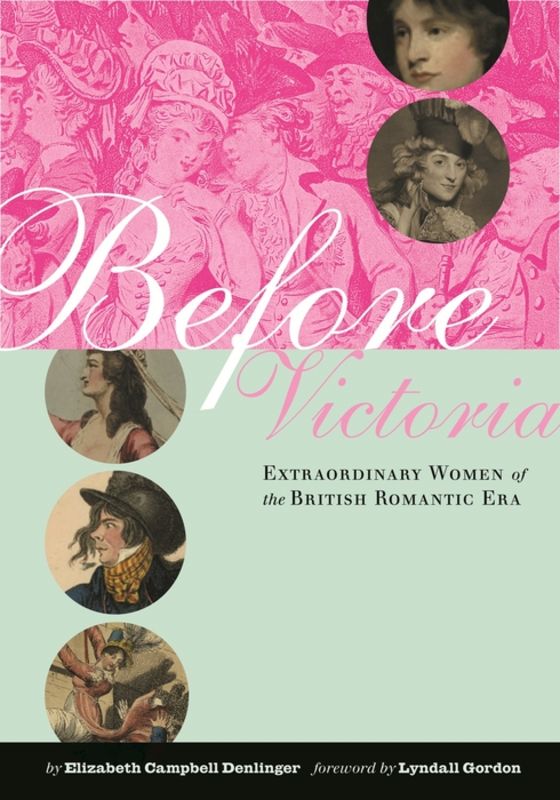
It might not have the been the revolution that Mary Wollstonecraft called for in A Vindication of the Rights of Woman (1792), but the Romantic era did witness a dramatic change in women's lives. Combining literary and cultural history, this richly illustrated volume brings back to life a remarkable, though frequently overlooked, group of women who transformed British culture and inspired new ways of understanding feminine roles and female sexuality. What was this revolution like? Women were expected to be more moral, more constrained, and more private than in the eighteenth century, when women such as Georgiana Cavendish, Duchess of Devonshire crafted bold public personas. Genteel women no longer laughed aloud at bawdy jokes and noblewomen ran charity bazaars instead of private casinos. By 1800, motherhood had become a sacred calling and women who could afford to do so devoted themselves to the home. While this idealization of domesticity kept some women off the streets, it afforded others new opportunities. Often working from home, women wrote novels and poetry, sculpted busts, painted portraits, and conducted scientific research. They also seized the chance to do good, and crafted new public roles for themselves as philanthropists and reformers. Now-obscure female astronomers, photographers, sculptors, and mathematicians share these pages with celebrated writers such as Mary Shelley, her mother Mary Wollstonecraft, and Mary Robinson, who in addition to being a novelist and actress was also the mistress of the Prince of Wales. This book also makes full use of The New York Public Library's extensive collections, including graphic works and caricatures from the late eighteenth and early nineteenth centuries, manuscripts, hand-colored illustrations, broadsides, drawings, oil paintings, notebooks, albums and early photographs. These vivid, beautiful, and often humorous images depict these women, their works, and their social and domestic worlds.
eBook