
Catalogue Search | MBRL


Are you sure you want to remove the book from the shelf?

{{itemTitle}}
247
result(s) for
"Psychology-Research-Methodology"
Sort by:

The seven deadly sins of psychology : a manifesto for reforming the culture of scientific practice
Chris Chambers draws on his own experiences as a working scientist to reveal a dark side to psychology that few of us ever see. Using the seven deadly sins as a metaphor, he shows how practitioners are vulnerable to powerful biases that undercut the scientific method, how they routinely torture data until it produces outcomes that can be published in prestigious journals, and how studies are much less reliable than advertised. He reveals how a culture of secrecy denies the public and other researchers access to the results of psychology experiments, how fraudulent academics can operate with impunity, and how an obsession with bean counting creates perverse incentives for academics ... Outlining a core set of best practices that can be applied across the sciences, Chambers demonstrates how all these sins can be corrected by embracing open science, an emerging philosophy that seeks to make research and its outcomes as transparent as possible. Provided by publisher.
Book

Qualitative data : an introduction to coding and analysis
Qualitative Data is meant for the novice researcher who needs guidance on what specifically to do when faced with a sea of information. It takes readers through the qualitative research process, beginning with an examination of the basic philosophy of qualitative research, and ending with planning and carrying out a qualitative research study. It provides an explicit, step-by-step procedure that will take the researcher from the raw text of interview data through data analysis and theory construction to the creation of a publishable work.
The volume provides actual examples based on the authors' own work, including two published pieces in the appendix, so that readers can follow examples for each step of the process, from the project's inception to its finished product. The volume also includes an appendix explaining how to implement these data analysis procedures using NVIVO, a qualitative data analysis program.
eBook


Social science methods for psychodynamic inquiry : the unconscious on the world scene
\"This book explains, with case examples, a variety of social science research methods suitable for studying the unconscious components of irrational social and political actions in world affairs, which can be defined as those that are intensely destructive, self-destructive, or extremely bizarre. The book argues that they are driven in part by feelings and fantasies that are outside of conscious awareness. Meyers explores the role empathy in clinical understanding, as well as the value of exposing assertions to empirical disconfirmation. With a variety of research methods such as survey research, content analysis, and narrative analysis, and case examples such as studies of 'irreal' statements by authoritarian leaders, fabricated newspaper articles and climate change denial, this book sheds light on how to conduct research on psychodynamic matters in a scientifically valid and credible way\"-- Provided by publisher.
Book

Applying the Rasch Model
Recognised as the most influential publication in the field, ARM facilitates deep understanding of the Rasch model and its practical applications. The authors review the crucial properties of the model and demonstrate its use with examples across the human sciences. Readers will be able to understand and critically evaluate Rasch measurement research, perform their own Rasch analyses and interpret their results. The glossary and illustrations support that understanding, and the accessible approach means that it is ideal for readers without a mathematical background.
Intended as a text for graduate courses in measurement, item response theory, (advanced) research methods or quantitative analysis taught in psychology, education, human development, business and other social and health sciences. Professionals in these areas will also appreciate the book’s accessible introduction.
Highlights of the new edition include:
More learning tools to strengthen readers’ understanding including chapter introductions, boldfaced key terms, chapter summaries, activities and suggested readings.
Greater emphasis on the use of R packages; readers can download the R code from the Routledge website.
Explores the distinction between numerical values, quantity and units, to understand the measurement and the role of the Rasch logit scale (Chapter 4).
A new four-option data set from the IASQ (Instrumental Attitude toward Self-assessment Questionnaire) for the Rating Scale Model (RSM) analysis exemplar (Chapter 6).
Clarifies the relationship between Rasch measurement, path analysis and SEM, with a host of new examples of Rasch measurement applied across health sciences, education and psychology (Chapter 10).
eBook

Looking ahead : the new science of the predictive mind
\"An introduction to predictive processing. Ideal for graduate students in cognitive and brain sciences, researchers, and anyone seeking an introduction to the new science of the predictive mind\"-- Provided by publisher.
BOOK

Cognitive interviewing methodology
\"Providing a comprehensive approach to cognitive interviewing in the field of survey methodology, Cognitive Interviewing Methodology delivers a clear guide that draws upon modern, cutting-edge research from a variety of fields. Each chapter begins by summarizing the prevailing paradigms that currently dominate the field of cognitive interviewing. Then underlying theoretical foundations are presented, which supplies readers with the necessary background to understand newly-evolving techniques in the field. The theories lead into developed and practiced methods by leading practitioners, researchers, and/or academics. Finally, the edited guide lays out the limitations of cognitive interviewing studies and explores the benefits of cognitive interviewing with other methodological approaches.\"--
eBook

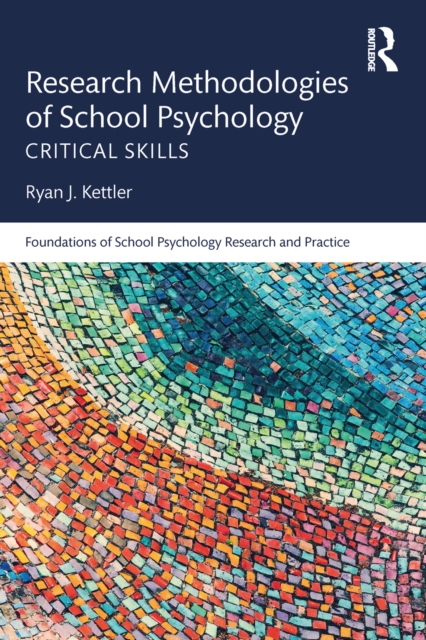
Research Methodologies of School Psychology
Research Methodologies of School Psychology is a comprehensive, actionable resource that offers graduate students and school psychologists the knowledge and skills to apply key scientific techniques in practice.
A volume in the Foundations of School Psychology Research and Practice Series, this book directly addresses the need for definitive resources on mastering research methodologies in the field. Covering topics such as development and evaluation of measures, application of various designs, and drawing inferences from data, Ryan J. Kettler provides rigorous yet accessible methodological guidance. Each chapter includes illustrative examples, summaries of essential learnings, and reflective concluding questions.
Using these engaging and invaluable strategies, graduate students and school psychologists will be effectively prepared to apply the scientific method in their own professional contexts.
eBook