
Catalogue Search | MBRL


Are you sure you want to remove the book from the shelf?

{{itemTitle}}
320,032
result(s) for
"Public Libraries"
Sort by:


Equity and Excellence in the Public Library
This important volume by one of the leading scholars in the field examines and discusses how library professionals can meet the demands of policy makers to open up the public library system without destroying its values. Based on a critical literature review, a survey of library professionals and consultations with other stakeholders, the book discusses the challenges involved in providing a service that prioritizes equity and social inclusion while at the same time attempting to promote and maintain quality, excellence and ethical standards. In assessing how those responsible for public libraries around the world go about this task the author advocates a service that is sensitive to difference and seeks to provide access to the best.
eBook

The public library : a photographic essay
\"Many of us have vivid recollections of childhood visits to the public library: the unmistakable, slightly musty scent, the excitement of checking out a stack of newly-discovered books. Today's libraries also function as de facto community centers, and offer free access to the Internet, job-hunting assistance, or a warm place to take shelter along with the endless possibilities that spark your imagination the moment you open the cover of a book. There are more than 17,000 public libraries in America. Over the last eighteen years, photographer Robert Dawson has traveled the nation, documenting hundreds of these institutions--from Alaska to Florida, New England to the West Coast. The Public Library presents a wide selection of Dawson's photographs, revealing a vibrant, essential, yet seriously threatened system. Essays, letters, and poetry by a collection of America's most celebrated writers--including E. B. White, Isaac Asimov, Anne Lamott, Amy Tan, Charles Simic, Dr. Seuss, and Philip Levine, as well as the voices of dedicated librarians working today--are woven with photographs of the majestic reading room at the New York Public Library; the one-room Tulare County Free Library built by former slaves, in Allensworth, California; the architectural wonder of Seattle's glass and steel Central Library; and the Berkeley, California tool lending library; among many others. A foreword by Bill Moyers and an afterword by Ann Patchett bookend this important survey of a treasured American institution\"-- Provided by publisher.
Book

Reading Publics: New York City's Public Libraries, 1754-1911
This lively, nuanced history of New York City's early public libraries traces their evolution within the political, social, and cultural worlds that supported them. On May 11, 1911, the New York Public Library opened its \"marble palace for book lovers\" on Fifth Avenue and 42nd Street. This was the city's first public library in the modern sense, a tax-supported, circulating collection free to every citizen. Since before the Revolution, however, New York's reading publics had access to a range of \"public libraries\" as the term was understood by contemporaries. In its most basic sense a public library in the eighteenth and most of the nineteenth centuries simply meant a shared collection of books that was available to the general public and promoted the public good. From the founding in 1754 of the New York Society Library up to 1911, public libraries took a variety of forms. Some of them were free, charitable institutions, while others required a membership or an annual subscription. Some, such as the Biblical Library of the American Bible Society, were highly specialized; others, like the Astor Library, developed extensive, inclusive collections. What all the public libraries of this period had in common, at least ostensibly, was the conviction that good books helped ensure a productive, virtuous, orderly republic-that good reading promoted the public good. Tom Glynn's vivid, deeply researched history of New York City's public libraries over the course of more than a century and a half illuminates how the public and private functions of reading changed over time and how shared collections of books could serve both public and private ends. Reading Publics examines how books and reading helped construct social identities and how print functioned within and across groups, including but not limited to socioeconomic classes. The author offers an accessible while scholarly exploration of how republican and liberal values, shifting understandings of \"public\" and \"private,\" and the debate over fiction influenced the development and character of New York City's public libraries in the eighteenth and nineteenth centuries. Reading Publics is an important contribution to the social and cultural history of New York City that firmly places the city's early public libraries within the history of reading and print culture in the United States.
eBook


Pivoting during the Pandemic : ideas for serving your community anytime, anywhere
Sharing lessons learned and barriers overcome, this book will spur you towards new ways of serving your patrons during unprecedented times.
eBook
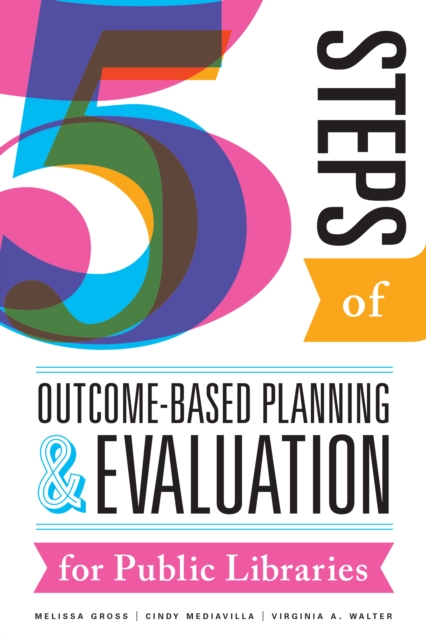
Five steps of outcome-based planning and evaluation for public libraries
Featuring plentiful examples of how to proceed through each phase of the OBPE model, this book boils down planning and evaluation into an approachable, easy to understand process for public librarians, library managers, and grant writers.
eBook

Public library administration transformed : developing the organization and empowering users
\"As society struggles with issues related to the scope and effectiveness of government, librarians must ask, 'How and why will communities support public libraries in the future?' This book covers public library administration [in an effort to answer that question]\"-- Provided by publisher.
Book

Part of our lives : a people's history of the American public library
Despite dire predictions in the late twentieth century that public libraries would not survive the turn of the millennium, their numbers have only increased. Two of three Americans frequent a public library at least once a year, and nearly that many are registered borrowers. Although library authorities have argued that the public library functions primarily as a civic institution necessary for maintaining democracy, generations of library patrons tell a different story. In Part of Our Lives, Wayne A. Wiegand delves into the heart of why Americans love their libraries. The book traces the history of the public library, featuring records and testimonies from as early as 1850. Rather than analyzing the words of library founders and managers, Wiegand listens to the voices of everyday patrons who cherished libraries. Drawing on newspaper articles, memoirs, and biographies, Part of Our Lives paints a clear and engaging picture of Americans who value libraries not only as civic institutions, but also as social spaces for promoting and maintaining community. Whether as a public space, a place for accessing information, or a home for reading material that helps patrons make sense of the world around them, the public library has a rich history of meaning for millions of Americans. From colonial times through the recent technological revolution, libraries have continuously adapted to better serve the needs of their communities. Wiegand goes on to demonstrate that, although cultural authorities (including some librarians) have often disparaged reading books considered not \"serious\" the commonplace reading materials users obtained from public libraries have had a transformative effect for many, including people like Ronald Reagan, Sonia Sotomayor, and Oprah Winfrey. A bold challenge to conventional thinking about the American public library, Part of Our
Lives is an insightful look into one of America's most beloved cultural institutions.
eBook