
Catalogue Search | MBRL


Are you sure you want to remove the book from the shelf?

{{itemTitle}}
1,078
result(s) for
"Public art spaces New York (State) New York."
Sort by:


The Accidental Playground: Brooklyn Waterfront Narratives of the Undesigned and Unplanned
The Accidental Playground explores the remarkable landscape created by individuals and small groups who occupied and rebuilt an abandoned Brooklyn waterfront in Williamsburg. Without formal authority, capital, professional assistance, grand vision, consensus, or coordination with each other, these \"vernacular\" builders transformed a vacated waterfront railroad yard into a unique setting for recreation and creative endeavor. With the Manhattan skyline as its backdrop, the collapsing piers, eroded bulkhead, and remaining building foundations of the former Brooklyn Eastern District Terminal (BEDT) became the raw materials for various forms of waterside leisure and social spaces. Lacking predetermined rules governing its use, this waterfront evolved into the home turf for unusual and sometimes spectacular recreational, social, and creative subcultures. These included skateboarders who built a short-lived, but nationally renowned skatepark; a twenty-five-piece \"public\" marching band, fire performance troupes, and a variety of artists, photographers, and filmmakers. At the same time the site also served basic recreational needs of local residents. Collapsing piers became great places to catch fish, sunbathe, or take in the Manhattan skyline; the foundation of a demolished warehouse became an ideal place to practice music or skateboard; rubble-strewn earth became a compelling setting for film and fashion shoots; broken bulkhead became a beach; and thick patches of weeds dotted by ailanthus trees became a jungle. Drawing on a rich mix of documentary strategies including observation, ethnography, photography, and first-person narrative, Daniel Campo probes this accidental playground, allowing those who created it to share and examine their own narratives, perspectives, and conflicts. The multiple constituencies of this Williamsburg waterfront were surprisingly diverse, their stories colorful and provocative. When taken together, Campo argues, they suggest a radical reimagining of urban public space, the waterfront, and the practices by which they are created and maintained. The Accidental Playground, which treats readers to an utterly compelling story, is an exciting and distinctive contribution to the growing literature on the unplanned and the undesigned spaces and activities in cities today.
eBook
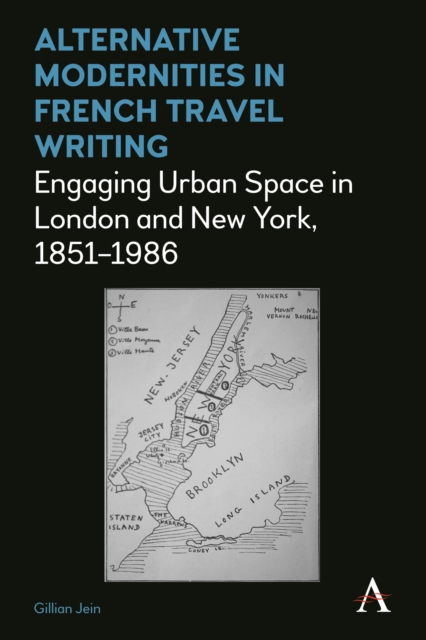
Alternative modernities in French travel writing
Ever since human beings first travelled, cities have constituted important material and literary destinations. While the city has formed a key theme for scholars of literary fiction, travellers' writings on the western city have been somewhat neglected by travel studies. However, travel writing with its attention to difference provides a rich source for the study of representational strategies and tactics in modern urban space. Beginning at the Crystal Palace in 1851 and ending up in the skyscrapers of NYC, this book analyses the writings of lesser-known as well as canonical French travel writers, including Paul Morand, Jean-Paul Sartre, Georges Perec and Jean Baudrillard. Tracing the work of these writers in London and New York from 1851 to the 1980s, it contributes to a body of work that analyses travel and travel writing beyond the Anglophone context, and engages in questions pertaining to the French imagination of possible meanings for life in the modern city. One of the central tenets of the book is that, in the way its spaces are planned, encountered and represented, the city is active in formulating identities, while the book's guiding question is how analysis of French travel writing allows us to explore the multiplicity of urban modernities by engaging with the historical and cultural differences internal to 'the West'. Bringing together the strands of theory, context and poetic analysis, the book treats of travel writing as a spatial practice, one that engages representations of urban space in questions of nationality, power and legibility. In this way, it opens avenues for the exploration of urban modernity from a position of alterity, whereby alternative imaginative geographies of the city come into view.
eBook

Money Jungle
Description: For more than a century, Times Square has mesmerized the world with the spectacle of its dazzling supersigns, its theaters, and its often-seedy nightlife. New York City's iconic crossroads has drawn crowds of revelers, thrill-seekers, and other urban denizens, not to mention lavish outpourings of advertising and development money.
eBook

Urban Fear, Criminality and the Erosion of Intangible Cultural Access in Machala: A Critical Qualitative Content Analysis of Ecuadorian National Digital Press
This article examines how the Ecuadorian national digital press has represented the relationship between criminal violence, declining mobility, tourism contraction, and the erosion of intangible cultural access in Machala, Puerto Bolívar, and the route to Jambelí during 2025. This study aims to explain how mediated representations of insecurity can contribute to the symbolic narrowing of culturally meaningful urban–coastal spaces, even when those spaces remain materially present and formally open. The article responds to a gap in the literature at the intersection of critical heritage studies, media framing, urban fear, and Latin American security studies. The existing research has examined heritage as social practice, media representation of crime, and urban securitization, but has rarely connected these fields to explain how criminal violence erodes lived access to intangible cultural environments in secondary port cities of the Global South. Methodologically, this study applies qualitative content analysis to a purposive corpus of eight focal journalistic texts published in Ecuadorian digital outlets, such as El Universo, El Comercio, Expreso, El Mercurio, Extra, Primicias, GK, and La Hora. Deductive–inductive coding was complemented by descriptive article-level indicators of themes, keyword clusters, and temporal distribution. The findings show that the press did not merely report violent events; it progressively reorganized the symbolic meaning of Machala by re-signifying Puerto Bolívar, the marine environment, the cabotage pier, and the maritime route to Jambelí as spaces of risk, interruption, and conditional access. This study contributes conceptually by defining intangible cultural access and symbolic enclosure, empirically by documenting the mediated erosion of coastal public–cultural life, and practically by proposing integrated policy actions for security governance, cultural reactivation, local commerce, maritime mobility, and responsible public communication.
Journal Article

Designs on the Public
Kristine F. Miller delves into six of New York’s public spaces, including Times Square, Trump Tower, and Sony Plaza, to trace how design influences their complicated existence. Design is, in Miller’s view, complicit in regulation of public spaces in New York City to exclude undesirables and privilege commercial interests, and in this work she shows how design can reactivate public space and public life.
eBook

Streets and Stages: Urban Renewal and the Arts after World War II
Lincoln Center for the Performing Arts in Manhattan and the revitalization of the Brooklyn Academy of Music in Brooklyn offer insights into the intersection of arts and urbanization after World War II. This intra-city comparison shows the aggrandizing pull of the international arena in the shaping of Lincoln Center and the arts it featured in contrast to the local focus and debate that transformed how BAM fit into its Brooklyn neighborhood. The performing arts, bound as they are to a moment fused in space and time, reveal the making of place within grandiose formal buildings as well as outside on the streets that surround them—and it is, perhaps, that tensile connection between stages and streets that informs the relevancy of both the institution and the arts it features. At a time when the suburbs pulled more and more people, the arts provided a counterforce in cities, as magnet and stimulus. The arts were used as compensation for the demolition and re-building of a neighborhood in urban renewal, but they also exposed the more complex social dynamics that underpinned the transformation of the mid-20th century American city from a segregated to a multi-faceted place.
Journal Article

Non-Preaching Activism in New York. The Theatrical Militancy of Billionaires for Bush and Reverend Billy
This article, grounded on a fieldwork conducted in 2007 and 2008 in New York City, aims at analyzing the social usages and effects of artistic and ironic actions led by two activist collectives: Reverend Billy and the Church of Stop Shopping and the Billionaires for Bush. The first organization is opposed to excessive consumerism and denounces actors, like multinational corporations, involved in the privatization of public spaces in New York City. The second collective—by using forms of action and ironic slogans pretending to endorse US government decisions regarding tax cuts and, more generally, any law favouring privileged groups—condemns policies which widen social inequalities. The resort to artistic and ironic actions assumes denouncing and non-preaching characteristics. First, these actions target elected people or institutions perceived as responsible for the social, economic, and political problems identified by the collectives. Then, the activists tend to criticize and disassociate from connotations which to them are associated with certain forms of religious ceremonies and political activism, delivering sermons and preaching to the choir. A major interest of the non-preaching nature of these artistic and ironic actions would precisely lie in their capacity to sensitize outside the social circles of converted activists. The article first examines formal transfers between art and activism—narratives, costumes, musical repertoires—drawing on US cultural and religious references while taunting them. The analytical description of these actions will lead to a critical insight into their political and social effects. To which extent do these musical and theatrical forms of protest have the capacity to call political beliefs into question, to arm convinced activists, to convert the undecided, or even the opponents to the causes championed by these protest groups?
Journal Article
MoneyWatch Report
Meanwhile, stocks closed mixed yesterday led by gains in tech and industrial companies. The Dow did decline twenty-six points. The NASDAQ closed up eighteen, hitting a new record. The S&P 500 gained three points.
Transcript