
Catalogue Search | MBRL


Are you sure you want to remove the book from the shelf?

{{itemTitle}}
718
result(s) for
"Public health -- Moral and ethical aspects"
Sort by:


Power, Suffering, and the Struggle for Dignity
Directed at a diverse audience of students, legal and public health practitioners, and anyone interested in understanding what human rights-based approaches (HRBAs) to health and development mean and why they matter, Power, Suffering, and the Struggle for Dignity provides a solid foundation for comprehending what a human rights framework implies and the potential for social transformation it entails. Applying a human rights framework to health demands that we think about our own suffering and that of others, as well as the fundamental causes of that suffering. What is our agency as human subjects with rights and dignity, and what prevents us from acting in certain circumstances? What roles are played by others in decisions that affect our health? How do we determine whether what we may see as \"natural\" is actually the result of mutable, human policies and practices?Alicia Ely Yamin couples theory with personal examples of HRBAs at work and shows the impact they have had on people's lives and health outcomes. Analyzing the successes of and challenges to using human rights frameworks for health, Yamin charts what can be learned from these experiences, from conceptualization to implementation, setting out explicit assumptions about how we can create social transformation. The ultimate concern of Power, Suffering, and the Struggle for Dignity is to promote movement from analysis to action, so that we can begin to use human rights frameworks to effect meaningful social change in global health, and beyond.
eBook

Ethics and governance of public health information
\" Holland provides a deft philosophical guide to a wide range of complex issues in the collection, storage and use of public health data. His overarching argument, that concerns about informational privacy have gone too far, is well-developed; researchers, regulators and ethicists should all reflect on it\"--Back cover.
Book
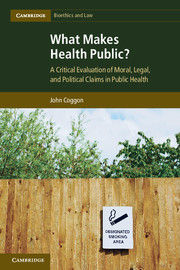
What Makes Health Public?
John Coggon argues that the important question for analysts in the fields of public health law and ethics is 'what makes health public?' He offers a conceptual and analytic scrutiny of the salient issues raised by this question, outlines the concepts entailed in, or denoted by, the term 'public health' and argues why and how normative analyses in public health are inquiries in political theory. The arguments expose and explain the political claims inherent in key works in public health ethics. Coggon then develops and defends a particular understanding of political liberalism, describing its implications for critical study of public health policies and practices. Covering important works from legal, moral, and political theory, public health, public health law and ethics, and bioethics, this is a foundational text for scholars, practitioners and policy bodies interested in freedoms, rights and responsibilities relating to health.
eBook

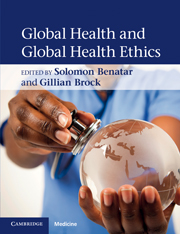
Global Health and Global Health Ethics
What can be done about the poor state of global health? How are global health challenges intimately linked to the global political economy and to issues of social justice? What are our responsibilities and how can we improve global health? Global Health and Global Health Ethics addresses these questions from the perspective of a range of disciplines, including medicine, philosophy and the social sciences. Topics covered range from infectious diseases, climate change and the environment to trade, foreign aid, food security and biotechnology. Each chapter identifies the ways in which we exacerbate poor global health and discusses what we should do to remedy the factors identified. Together, they contribute to a deeper understanding of the challenges we face, and propose new national and global policies. Offering a wealth of empirical data and both practical and theoretical guidance, this is a key resource for bioethicists, public health practitioners and philosophers.
eBook

Public Health Ethics : Key Concepts and Issues in Policy and Practice
\"Public health ethics is a discipline concerned with the health of the public or a population as a whole, rather than focusing on the individual. This book introduces a number of this new field's central concepts and explores the key and controversial issues arising. Topics covered include the nature of public health ethics, the concepts of disease and prevention, risk and precaution, health inequalities and justice, screening, vaccination and disease control, smoking and issues relating to the environment and public health. With insightful contributions from leading experts, Public Health Ethics presents thought-provoking reviews of these topics, at the same time as encouraging and identifying areas for future discussion in this emerging discipline. This is a valuable addition to the library of anyone working in the fields of public health, health policy, ethics, philosophy and social science\"-- Provided by publisher.
Book

To Fix or To Heal
Do doctors fix patients? Or do they heal them? For all of modern medicine's many successes, discontent with the quality of patient care has combined with a host of new developments, from aging populations to the resurgence of infectious diseases, which challenge medicine's overreliance on narrowly mechanistic and technical methods of explanation and intervention, or \"fixing' patients. The need for a better balance, for more humane \"healing\" rationales and practices that attend to the social and environmental aspects of health and illness and the experiencing person, is more urgent than ever. Yet, in public health and bioethics, the fields best positioned to offer countervailing values and orientations, the dominant approaches largely extend and reinforce the reductionism and individualism of biomedicine.
The collected essays inTo Fix or To Healdo more than document the persistence of reductionist approaches and the attendant extension of medicalization to more and more aspects of our lives. The contributors also shed valuable light on why reductionism has persisted and why more holistic models, incorporating social and environmental factors, have gained so little traction. The contributors examine the moral appeal of reductionism, the larger rationalist dream of technological mastery, the growing valuation of health, and the enshrining of individual responsibility as the seemingly non-coercive means of intervention and control. This paradigm-challenging volume advances new lines of criticism of our dominant medical regime, even while proposing ways of bringing medical practice, bioethics, and public health more closely into line with their original goals. Precisely because of the centrality of the biomedical approach to our society, the contributors argue, challenging the reductionist model and its ever-widening effects is perhaps the best way to press for a much-needed renewal of our ethical and political discourse.
eBook

What makes health public? : a critical evaluation of moral, legal, and political claims in public health
\"John Coggon argues that the important question for analysts in the fields of public health law and ethics is 'what makes health public?' He offers a conceptual and analytic scrutiny of the salient issues raised by this question, outlines the concepts entailed in, or denoted by, the term 'public health' and argues why and how normative analyses in public health are inquiries in political theory. The arguments expose and explain the political claims inherent in key works in public health ethics. Coggon then develops and defends a particular understanding of political liberalism, describing its implications for critical study of public health policies and practices. Covering important works from legal, moral, and political theory, public health, public health law and ethics, and bioethics, this is a foundational text for scholars, practitioners and policy bodies interested in freedoms, rights and responsibilities relating to health\"-- Provided by publisher.
Book
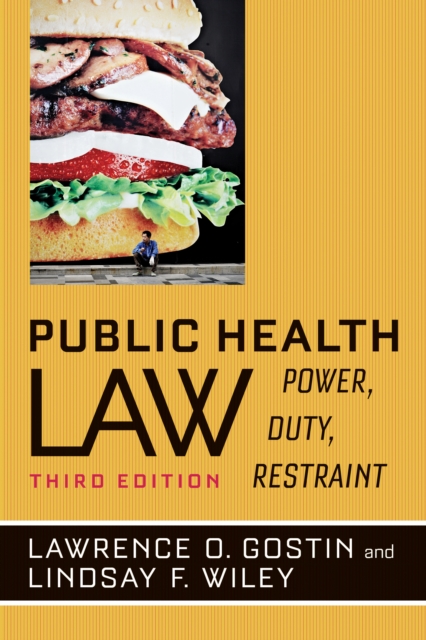
Public health law
Lawrence O. Gostin's seminal Public Health Law is widely acclaimed as the definitive statement on public health law at the turn of the twenty-first century. In this bold third edition, Gostin is joined by Lindsay F. Wiley to analyze major health threats of our time such as chronic diseases, emerging infectious diseases, antimicrobial resistance, bioterrorism, natural disasters, opiod overdose, and gun violence. The authors draw on constitutional law, administrative law, local government law, and tort law to develop their conception of law as a tool for protecting the public's health. The book creates an intellectual framework for modern public health law and supports that framework with illustrations of the scientific, political, and ethical issues involved. In proposing innovative solutions for the future of the public's health, Gostin and Wiley's essential study provides a blueprint for public and political debates to come. New issues covered in this edition: • Corporate personhood rights raised in response to regulations of tobacco, food and beverages, alcohol, firearms, prescription drugs, and marijuana. • Local government authority to protect the public's health. • Deregulation and harm reduction as modes of public health law intervention. • Taxation, spending, and alteration of the socioeconomic environment as modes of public health law intervention. • Access to health care as a strategy for protecting the public's health. • Taxation, spending, licensing, zoning, and shared-use strategies for chronic disease prevention. • The public health law perspective on violence and injury prevention. • Health justice as a framework for reducing health disparities and protecting the public's health.
eBook