
Catalogue Search | MBRL


Are you sure you want to remove the book from the shelf?

{{itemTitle}}
89
result(s) for
"Public health laws Criminal provisions."
Sort by:

Criminal law, philosophy and public health practice
\"The goal of improving public health involves the use of different tools, with the law being one way to influence the activities of institutions and individuals. Of the regulatory mechanisms afforded by law to achieve this end, criminal law remains a perennial mechanism to delimit the scope of individual and group conduct. Utilising criminal law may promote or hinder public health goals, and its use raises a number of complex questions that merit exploration. This examination of the interface between criminal law and public health brings together international experts from a variety of disciplines, including law, criminology, public health, philosophy and health policy, in order to examine the theoretical and practical implications of using criminal law to improve public health\"-- Provided by publisher.
Book
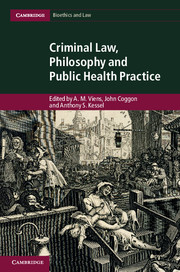
Criminal Law, Philosophy and Public Health Practice
The goal of improving public health involves the use of different tools, with the law being one way to influence the activities of institutions and individuals. Of the regulatory mechanisms afforded by law to achieve this end, criminal law remains a perennial mechanism to delimit the scope of individual and group conduct. Utilising criminal law may promote or hinder public health goals, and its use raises a number of complex questions that merit exploration. This examination of the interface between criminal law and public health brings together international experts from a variety of disciplines, including law, criminology, public health, philosophy and health policy, in order to examine the theoretical and practical implications of using criminal law to improve public health.
eBook

Does Public Assistance Reduce Recidivism?
Under the Personal Responsibility and Work Opportunity Reconciliation Act (PRWORA) of 1996, individuals convicted of drug-related felonies were permanently banned from receiving welfare and food stamps. Since then, over 30 states have opted out of the federal ban. In this paper, I estimate the impact of public assistance eligibility on recidivism by exploiting both the adoption of the federal ban and subsequent passage of state laws that lifted the ban. Using administrative prison records on five million offenders and a triple-differences research design, I find that public assistance eligibility for drug offenders reduces one-year recidivism rates by 10 percent.
Journal Article

The Scope, Nature, and Causes of Child Abuse and Neglect
Child maltreatment is a complex problem affecting millions of children in the United States every year. This article examines existing knowledge on the scope, nature, and causes of child abuse and neglect. First, we review the discordant definitions and conceptualizations of child maltreatment and consider the implications of broad and narrow definitions for the size and scope of the child welfare system and for child safety. Second, we provide an assessment of the quality and comprehensiveness of existing data for understanding the incidence rates and trends in child abuse and neglect. Third, we review theory and evidence on the causes of child maltreatment, with particular attention to whether and how social policy can reduce its prevalence. Last, we provide recommendations for improving the use of data and scientific evidence in child welfare policy and systems.
Journal Article

Blood on Their Hands
A few short years after HIV first entered the world blood supply in the late 1970s and early 1980s, over half the hemophiliacs in the United States were infected with the virus. But this was far more than just an unforeseeable public health disaster. Negligent doctors, government regulators, and Big Pharma all had a hand in this devastating epidemic.Blood on Their Handsis an inspiring, firsthand account of the legal battles fought on behalf of hemophiliacs who were unwittingly infected with tainted blood. As part of the team behind the key class action litigation filed by the infected, young New Jersey lawyer Eric Weinberg was faced with a daunting task: to prove the negligence of a powerful, well-connected global industry worth billions. Weinberg and journalist Donna Shaw tell the dramatic story of how idealistic attorneys and their heroic, mortally-ill clients fought to achieve justice and prevent further infections. A stunning exposé of one of the American medical system's most shameful debacles,Blood on Their Handsis a rousing reminder that, through perseverance, the victims of corporate greed can sometimes achieve great victory.
eBook

Newly enacted mental health law in Bangladesh
Mental health problems are almost ignored in Bangladesh, one of the most densely populated countries in the world. The lack of overall health literacy and human resources due to an ineffectively updated legal and regulatory framework, coupled with very limited but misused budget allocation, are some of the factors responsible for this. The country's Constitution recognises the importance of public health and stipulates the improvement of public health as an important primary duty of the state. Nevertheless, it is often compromised or neglected in favour of other socioeconomic development priorities. The Lunacy Act 1912 was recently repealed and substituted by the Mental Health Act 2018 to fill in various gaps in mental health law. This is a welcome development, but there remain limitations and scope for further improvement. We highlight some important provisions of this newly enacted law, identify some limitations and propose some issues for consideration in future policy reform.
Journal Article

Transmission of HIV and the criminal law: Examining the impact of pre-exposure prophylaxis and treatment- as- prevention
In its engagement with HIV, the criminal law has long attracted controversy, prompting protest, critique and calls for law reform. This article examines the impact of two major advances in the prevention of HIV transmission on criminal offences that apply to HIV transmission-related events: namely, treatment-as-prevention ('TasP') and pre-exposure prophylaxis ('PrEP'). The use of these two biomedical technologies and their associated practices has the potential to radically reduce, even eliminate, the incidence of HIV transmission. If these benefits are made widely available, these advances will - by reframing current understandings of causation, risk and the seriousness of harm at the foundation of HIV transmission-related criminal offences - potentially bring about shifts in the ways that HIV has been received by the criminal law. This article examines the likely impacts of these new practices and technologies. It argues that, where used, these new forms of HIV transmission prevention should radically reduce, and potentially eliminate, the incidence of HIV transmission-related criminal prosecutions for unintentional transmission. However, it also concludes that these effects will likely be uneven due to the misalignment between those populations who are taking up these new prevention options and those who have been historically prosecuted for HIV transmission-related criminal offences.
Journal Article
Transmission of HIV and the criminal law: Examining the impact of pre-exposure prophylaxis and treatment-asprevention
In its engagement with HIV, the criminal law has long attracted controversy, prompting protest, critique and calls for law reform. This article examines the impact of two major advances in the prevention of HIV transmission on criminal offences that apply to HIV transmission-related events: namely, treatment-as-prevention ('TasP') and pre-exposure prophylaxis ('PrEP'). The use of these two biomedical technologies and their associated practices has the potential to radically reduce, even eliminate, the incidence of HIV transmission. If these benefits are made widely available, these advances will - by reframing current understandings of causation, risk and the seriousness of harm at the foundation of HIV transmission-related criminal offences - potentially bring about shifts in the ways that HIV has been received by the criminal law. This article examines the likely impacts of these new practices and technologies. It argues that, where used, these new forms of HIV transmission prevention should radically reduce, and potentially eliminate, the incidence of HIV transmission-related criminal prosecutions for unintentional transmission. However, it also concludes that these effects will likely be uneven due to the misalignment between those populations who are taking up these new prevention options and those who have been historically prosecuted for HIV transmission-related criminal offences.
Journal Article
Transmission of HIV and the criminal law: Examining the impact of pre-exposure prophylaxis and treatment- as- prevention
In its engagement with HIV, the criminal law has long attracted controversy, prompting protest, critique and calls for law reform. This article examines the impact of two major advances in the prevention of HIV transmission on criminal offences that apply to HIV transmission-related events: namely, treatment-as-prevention ('TasP') and pre-exposure prophylaxis ('PrEP'). The use of these two biomedical technologies and their associated practices has the potential to radically reduce, even eliminate, the incidence of HIV transmission. If these benefits are made widely available, these advances will - by reframing current understandings of causation, risk and the seriousness of harm at the foundation of HIV transmission-related criminal offences - potentially bring about shifts in the ways that HIV has been received by the criminal law. This article examines the likely impacts of these new practices and technologies. It argues that, where used, these new forms of HIV transmission prevention should radically reduce, and potentially eliminate, the incidence of HIV transmission-related criminal prosecutions for unintentional transmission. However, it also concludes that these effects will likely be uneven due to the misalignment between those populations who are taking up these new prevention options and those who have been historically prosecuted for HIV transmission-related criminal offences.
Journal Article

Medicaid Expansion's Spillover to the Criminal Justice System: Evidence from Six Urban Counties
Spillovers from the Affordable Care Act Medicaid expansion to other social-sector
outcomes have received little attention. One that may be especially salient for
public policy is the impact of expanded eligibility on jail-related outcomes.
This study compares recidivism outcomes in three non-expansion counties to
nearby expansion counties before and after Medicaid expansion. Using forty-eight
months of arrest data from six urban county jails, we conduct comparative
interrupted time series analyses to describe changes in the probability of
rearrest and the number of arrests before and after Medicaid expansion.
Consistent with previous literature, we find mixed results. In two case studies,
Medicaid expansion is associated with decreased rates of recidivism. In the
other, we find differential increases in jail-based recidivism after Medicaid
expansion. We use contextual information from site visits and stakeholder
interviews to understand the factors that may mediate and moderate the
relationship between Medicaid expansion and return to jail.
Journal Article