
Catalogue Search | MBRL


Are you sure you want to remove the book from the shelf?

{{itemTitle}}
12
result(s) for
"Public spaces -- Italy -- Rome -- History"
Sort by:

Rome : an urban history from antiquity to the present
\"Spanning the entire history of the city of Rome from Iron Age village to modern metropolis, this is the first book to take the long view of the Eternal City as an urban organism. Three thousand years old and counting, Rome has thrived almost from the start on self-reference, supplementing the everyday concerns of urban management and planning by projecting its own past onto the city of the moment. This is a study of the urban processes by which Rome's people and leaders, both as custodians of its illustrious past and as agents of its expansive power, have shaped and conditioned its urban fabric by manipulating geography and organizing space; planning infrastructure; designing and presiding over mythmaking, ritual, and stagecraft; controlling resident and transient populations; and exploiting Rome's standing as a seat of global power and a religious capital\"-- Provided by publisher.
Book
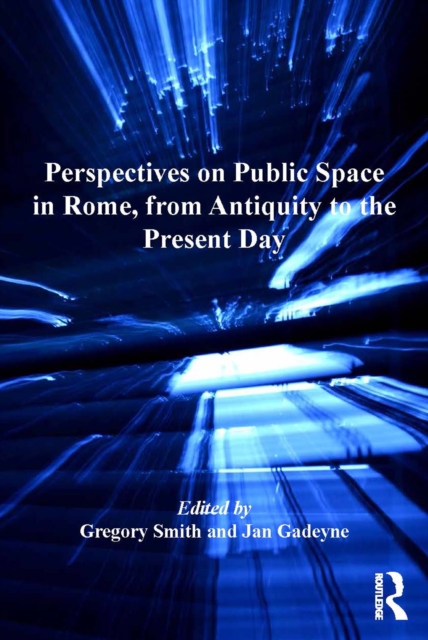
Perspectives on Public Space in Rome, from Antiquity to the Present Day
This volume provides readers interested in urban history with a collection of essays on the evolution of public space in that paradigmatic western city which is Rome. Scholars specialized in different historical periods contributed chapters, in order to find common themes which weave their way through one of the most complex urban histories of western civilization. Divided into five chronological sections (Antiquity, Middle Ages, Renaissance, Baroque, Modern and Contemporary) the volume opens with the issue of how public space was defined in classical Roman law and how ancient city managers organized the maintenance of these spaces, before moving on to explore how this legacy was redefined and reinterpreted during the Middle Ages. The third group of essays examines how the imposition of papal order on feuding families during the Renaissance helped introduce a new urban plan which could satisfy both functional and symbolic needs. The fourth section shows how modern Rome continued to express strong interest in the control and management of public space, the definition of which was necessarily selective in this vastly extensive city. The collection ends with an essay on the contemporary debate for revitalizing Rome's eastern periphery. Through this long-term chronological approach the volume offers a truly unique insight into the urban development of one of Europe's most important cities, and concludes with a discuss of the challenges public space faces today after having served for so many centuries as a driving force in urban history.
eBook

The politics of public space in Republican Rome
\"Taking public space as her starting point, Amy Russell offers a fresh analysis of the ever-fluid public/private divide in Republican Rome. Built on the 'spatial turn' in Roman studies and incorporating textual and archaeological evidence, this book uncovers a rich variety of urban spaces. No space in Rome was solely or fully public. Some spaces were public but also political, sacred, or foreign; many apparently public spaces were saturated by the private, leaving grey areas and room for manipulation. Women, slaves, and non-citizens were broadly excluded from politics: how did they experience and help to shape its spaces? How did the building projects of Republican dynasts relate to the communal realm? From the Forum to the victory temples of the Campus Martius, culminating in Pompey's great theatre-portico-temple-garden-house complex, The Politics of Public Space in Republican Rome explores how space was marked, experienced, and defined by multiple actors and audiences\"-- Provided by publisher.
Book

Roman Urban Street Networks
The streets of Roman cities have received surprisingly little attention until recently. Traditionally the main interest archaeologists and classicists had in streets was in tracing the origins and development of the orthogonal layout used in Roman colonial cities. Roman Urban Street Networks is the first volume to sift through the ancient literature to determine how authors used the Latin vocabulary for streets, and determine what that tells us about how the Romans perceived their streets. Author Alan Kaiser offers a methodology for describing the role of a street within the broader urban transportation network in such a way that one can compare both individual streets and street networks from one site to another.
This work is more than simply an exploration of Roman urban streets, however. It addresses one of the central problems in current scholarship on Roman urbanism: Kaiser suggests that streets provided the organizing principle for ancient Roman cities, offering an exciting new way of describing and comparing Roman street networks. This book will certainly lead to an expanded discussion of approaches to and understandings of Roman streetscapes and urbanism.
eBook

The Roman street : urban life and society in Pompeii, Herculaneum, and Rome
\"Every day Roman urbanites took to the street for myriad tasks, from hawking vegetables and worshipping local deities to simply loitering and socializing. Hartnett takes readers into this thicket of activity as he repopulates Roman streets with their full range of sensations, participants, and events that stretched far beyond simple movement. As everyone from slave to senator met in this communal space, city dwellers found unparalleled opportunities for self-aggrandizing display and the negotiation of social and political tensions. Hartnett charts how Romans preened and paraded in the street, and how they exploited the street's collective space to lob insults and respond to personal rebukes. Combining textual evidence, comparative historical material, and contemporary urban theory with architectural and art historical analysis, The Roman Street offers a social and cultural history of urban spaces that restores them to their rightful place as primary venues for social performance in the ancient world\"-- Provided by publisher.
Book

Triumphal Arches in the Public Sphere in Israel—Between Temporary Reality and Fantasy
An examination of the place of triumphal arches in the Israeli public sphere leads to an unequivocal conclusion: on the one hand, quite a few triumphal (or honorary) arches were intentionally constructed as temporary structures. On the other hand, over the years the State of Israel witnessed several proposals to build permanent arches, but time and again, these were not realized. It seems that even if the word “triumph” was not officially uttered, the association to triumphal arches is clear, not to say deliberate. Moreover, most of the arches (whatever their title was) sought to evoke (whether explicitly or implicitly) the Arch of Titus as a blatant symbol of defeat and exile, all of which need to be cured. The article investigates the various functional and symbolic facets of both the temporary arches and the not-realized ones. They will be studied as part of a worldwide phenomenon, but at the same time as a local manifestation of the national consciousness and collective memory/ies. Necessarily the discussion will touch different aspects of the Israeli glorification and commemoration discourse as they are represented in the urban public sphere.
Journal Article

Exhibiting the New Mussolinian City: Memories of empire in the World Exhibition of Rome (EUR)
The aim of this paper is to show how fascist imperialist discourses were articulated in a new urban space, just on the outskirts of Rome, and how they affected its design, use and representation. This new city, which should have been the spatial expression of the regime's political, cultural and economical achievements, since its beginning was conceived almost as a mirror image of classical Rome. As her fascist alter-ego, it was imagined as the modern realisation of the ancient dream of reconnecting Rome to the Mediterranean, of 'bringing Rome to the sea and the sea to Rome', as Mussolini used to say. This was a city that had to represent a strong political desire and ended up as an image of mere representation, a city that was founded to contain a world exhibition and became in itself merely an exhibit. Here I am interested not only in the story the EUR (Esposizione Universale di Roma) buildings tell, but also in what they do, according to a performative view of cultural production. In other words, they are not simply new monuments to be added to Fascism's already powerful iconography, but an integral part of those processes of incorporation and rule at work in the construction of Italy's national/imperial identity.
Journal Article