
Catalogue Search | MBRL


Are you sure you want to remove the book from the shelf?

{{itemTitle}}
15,718
result(s) for
"Public spaces Planning."
Sort by:

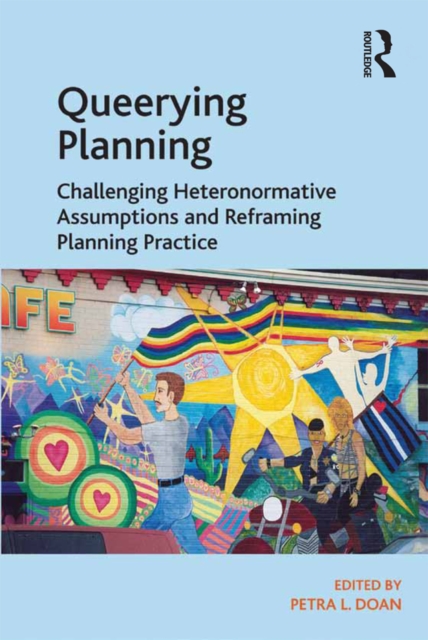
Queerying Planning
Current planning practices have largely neglected the needs of the Lesbian, Gay, Bisexual, and Transgender (LGBT) community for safe urban spaces in which to live, work, and play. This volume fills the gap in the literature on the planning and development of queer spaces, and highlights some of the resistance within the planning profession to incorporate gay and lesbian concerns into the planning mainstream. Planning lags behind other disciplines concerned with queer urban issues. In contrast, the field of geography has developed a rich sub-specialty in the geographies of sex and gender that examines spaces and the variety of non-heteronormative populations that inhabit them. This volume brings together both planners and geographers with experience in planning to examine some of the fundamental assumptions of urban planning as they relate to the LGBT community. The first few chapters are substantial revisions and expansions of earlier influential work on planning for non-conformist populations and the preservation of LGBT neighborhoods. Subsequent chapters comprise original contributions that draw on the rich literature from queer theory, planning theory and the geography of sexualities to explore the ways that nonconformist populations struggle with heteronormative expectations embedded in planning theory and procedures. These chapters consider the intersection of planning and a range of populations including transgendered and gender variant individuals. Subsequent chapters examine the ways that variations in the scale of urban and regional governance influence local politics around the implementation of more equitable policies at the city level. In addition, several chapters critically examine the implications of using the tolerance component of Richard Florida's \"creative cities\" arguments. The final section consists of two chapters that explore the ways that urban planning regimes have been used to regulate sexually-oriented businesses and the way this regulat
eBook


Safe and Sound: Governance for Planning Public Space in a Security-by-Design Paradigm
Security in public spaces has long been the subject of debate and extensive experimentation. With the exponential growth in risks (both expected and unexpected) that public spaces are exposed to, further exacerbated by the pandemic crisis, urban security management increasingly conflicts with the right to social interaction in space. To avoid creating overly controlled spaces that are unsuitable for generating sociality and spontaneous interactions, and which often reproduce discriminatory social dynamics, while at the same time ensuring users’ awareness of being in a safe environment, it is necessary for all three dimensions of public space security—policy, design, and governance—to converge. This study focuses on governance, exploring how security management shapes public life and how it can align with planning that supports vibrant, spontaneous interaction. Using a multi-method qualitative approach, including a critical literature review, EU policy analysis, and empirical research from the Horizon Europe SAFE CITIES project, the study introduces two tools: the Security and Vulnerability Assessment (SVA) framework and the Atlas for Safe Public Spaces Design. These were tested in pilot sites, including the Gorizia-Nova Gorica cross-border square. Results support a governance model integrating “security by design,” which aligns with Foucault’s view of governance as adaptable to uncertainty and flow. This mixed-method approach allowed for a comprehensive examination of the governance dynamics shaping urban security, ensuring that the study’s conclusions are grounded in theoretical insights and practical implementation, though necessarily limited in generalizability. By framing security as a process of negotiated governance rather than a set of technical constraints, the study offers a conceptual contribution to urban security discourse and practical guidance for planning secure, inclusive public spaces.
Journal Article


Contemporary Spatial Publicness: Its New Characteristics and Democratic Possibilities
In this study, we explore the recognition of publicness as understood by everyday users of public space. By analyzing news articles in South Korea selected from 1 January 2010, to 31 December 2018, this study examines a discourse which is largely missing in the existing studies—the subjective experience and framing of contemporary spatial publicness by its end-users. After analyzing the contents from a total of 583 articles in the KINDS database, we develop a general typology of how contemporary spatial publicness is represented in South Korea. Although the scope and background of questions surrounding South Korea’s recognition of contemporary spatial publicness are different from that of Western countries, a similar debate has emerged about what publicness means in the context of the architecture and urban space around the globe. By developing different thematic dimensions in the representations of contemporary spatial publicness, we further discuss the implications for future research to examine the pragmatic sensibilities of individuals and utility of semi-public/private space.
Journal Article

Public space in urban Asia
\"The world faces two absolute imperatives. One is to eradicate global poverty and reduce the income gap. The other is to ensure social and environmental sustainability. There is currently an increasing convergence of views among the majority, particularly the younger generation, that to achieve these goals we need to redefine key concepts such as inclusiveness and bottom up participation. Over the last few decades the rise of many cities, especially in emerging economies, has threatened to erode much of public space. It is in this context that William SW Lim, Chairperson of the Asian Urban Lab has edited Public Space in Urban Asia, to discuss the issue of Public Space in selected Asian cities\"-- Provided by publisher.
Book

Urban Planning in Al-Madinah Al-Munawarah using New Green Spaces Modelling through GIS Application
The present study investigated the new green spaces modelling in Al-Madinah Al-Munawarah using GIS application. It adopted the mental health theory as a theoretical framework. The data of the study was collected through two data collection instruments, namely, questionnaire as well as interview. The quantitative data was analysed through SPSS software while the qualitative data collected from the interviews was qualitatively analysed using thematic content analysis. The findings of the study revealed the most suitable model for potential new green spaces using GIS analysis (descriptive summaries) for urban planning in Al-Madinah Al-Munawarah is Quba (25.5%). Moreover, the most prominent challenge facing the design of a new green space in Al-Medinah Al-Munawarah, Saudi Arabia, is the weakness of the budget allocated to designing green spaces (86.7%). It is also shown that the most prominent benefits of designing new green spaces for the residents of Al-Madinah Al-Munawarah are the provision of seats and seating areas. Therefore, the participants stress the importance of taking into account the provision of seats and seating places when designing green spaces (93.3%). In terms of the potential of developing urban green spaces in Al-Madinah Al-Munawarah, the majority of the respondents believe that urban green spaces can be developed, to a large degree, in Al-Madinah Al-Munawarah in the future. Therefore, the study recommends that urban green spaces should be developed in Al-Madinah Al-Munawarah and the budget allocated to designing green spaces in Al-Madinah Al-Munawarah should be also increased. This study could be considered as a guideline for future development that can be used by government in Saudi Arabia.
Journal Article

Designing London's public spaces : post-war and now
Those involved in the creation of public spaces think a great deal about the users of those spaces. Users think little, if at all, about those who create them. In 'super-diverse' cities like London, a successful public realm, where people can be together in trust and tolerance, is essential. A city's commitment to design quality indicates a commitment to civic health. In the interests of such commitment, the book asks: What should public space 'design intentions' be today?; Who is 'the public' of public spaces?; What can/should designers do to protect the 'publicness' of public spaces?; Was state financed public space mid-20th century of any higher quality than privately financed public space today?; How significant is the shift from commissioning architects to design public spaces mid-20th century to commissioning landscape architects and public realm architects today?.
Book

Community Public Open Space Planning Based on Green Infrastructure with the Priority of Biodiversity
Maintaining and restoring urban biodiversity is one of the basic functions of green infrastructure. Starting from the ecological problems of community public open space and the insufficiency of traditional planning methods, the biodiversity of green infrastructure attempts to be integrated into public open space planning in community-scale. After discussing the research on the combination of community public open space and green infrastructure based on biodiversity, ‘the interconnections between green infrastructures’ is the key to achieving both benefits at the same time. Finally, taking Nanjing Xinjiekou Street in China as an example, the renewal planning method of community public open space on the priority of biodiversity is elaborated and corresponding suggestions are put forward. In a word, the reasonable planning and layout of community green infrastructure based on biodiversity can make up for the disadvantages of traditional planning and renewal methods of public open space to a certain extent, solve the ecological and social problems of public open space, and realize the symbiosis of people and nature in community.
Journal Article