
Catalogue Search | MBRL


Are you sure you want to remove the book from the shelf?

{{itemTitle}}
29
result(s) for
"Public spaces Singapore Planning."
Sort by:


Towards a “City in Nature”: Evaluating the Cultural Ecosystem Services Approach Using Online Public Participation GIS to Support Urban Green Space Management
The concept of cultural ecosystem services has been increasingly influential in both environmental research and policy decision making, such as for urban green spaces. However, its popular definitions tend to conflate “services” with “benefits”, making it challenging for planners to employ them directly to manage urban green spaces. Thus, attempts have been made to redefine cultural ecosystem services as the function of cultural activities in environmental spaces which result in people’s enjoyment of cultural ecosystem benefits. The operability of such a redefinition needs to be evaluated, which this study seeks to achieve with Bishan-Ang Mo Kio Park in Singapore presenting itself as a prime case study research area. Transdisciplinary mixed methods of a public participation geographic information system, which leverages on spatial data from public park users, and social media text mining analysis via Google reviews were used. A wealth of cultural ecosystem services and benefits were reported in the park, especially the recreational and aesthetic services and experiential benefits. Policy and methodological implications for future research and urban park developments were considered. Overall, this paper would recommend the employment of the redefined cultural ecosystem services approach to generate relational, data-driven and actionable insights to better support future urban green space management.
Journal Article

Spatial Cognition and Three-Dimensional Vertical Urban Design Guidelines—Cognitive Measurement and Modelling for Human Centre Design
Numerous studies have shown that the emotional wellbeing of urban populations is influenced by various aspects of urban development, such as social factors and the presence of walkable areas and green spaces. However, there is a lack of research that closely integrates urban design and cognition, particularly in the context of vertical and volumetric urbanism. This disconnect between design and science disciplines is evident when reviewing the limited research on emotional and spatial cognition in this specific urban context. This paper seeks to address that disconnect by proposing a comprehensive framework for the cognitive measurement and modelling of the built environment. This will involve exploring and measuring neural mechanisms, employing electroencephalogram (EEG) equipment to measure user responses in vertical and volumetric public spaces. The aim is to create a foundation for further studies in this field that is consistent and rigorous and can facilitate collaboration with cognitive neuroscientists by establishing a shared conceptual basis. The goal of this research is to develop a human-centric approach for urban design that is scientific and measurable, producing a set of urban design guidelines that incorporate cognitive measurement and modelling, with the broader intention to prioritize human needs and wellbeing within urban environments to make them more liveable.
Journal Article

The green open space development model and associated use behaviors in dense urban settings: Lessons from Hong Kong and Singapore
Green open space is addressed as an important urban planning strategy to ameliorate the negative environmental impacts of high density. The article presents a comparative study of green open space development models and associated use behaviors between Hong Kong and Singapore. The two cities represent two distinct models: “Concrete Jungle” where green open spaces are separated from built-up areas and “Garden City” where green open spaces are integrated in buildings. The research argues that the two distinct urban development models are shaping two types of use behaviors. The detached green open space in Hong Kong engendered active visits with high intentions and sensations; the integrated green open spaces in Singapore, on the other hand, caused passive visits with low intentions and sensations. This research draws attention to the overwhelming greenery in urban development that might attenuate the therapeutic function for healing and restoration. The spatial arrangement of green space distribution should encourage people’s intentions and aspirations for an active visit with social or physical activities. The planning and design of open space should also optimize microclimate conditions (such as shading, cross-ventilation and thermal comfort) to facilitate longer stays.
Journal Article

Making cities more walkable for tourists: a view from Singapore’s streets
PurposeThe purpose of this paper is to explore the meanings of walkability and relevance for tourism in modern Asian cities, including barriers to its implementation. Particular reference is made to conditions in the city state of Singapore and the manner in which urban planning and transport policies are influencing the tourist walking experience.Design/methodology/approachA case study methodology was selected as most suitable for the exercise accompanied by a literature review. Findings are derived from material in the public arena collected from a range of sources.FindingsThe government is shown to be actively pursuing policies to encourage both walking and cycling by residents as components of wider strategies directed at improving liveability. Several initiatives which positively affect the comfort and enjoyment of city walking by tourists are identified, but so too are Singapore’s shortcomings as a destination in which to walk. Balancing the demands on public space is a critical challenge for authorities.Originality/valueThe subject has been neglected within both an urban tourism and Asian city context and this paper illuminates aspects of significance pertaining to the concept and practice of walkability. Insights are afforded into factors which facilitate walkability and impediments to overcome.
Journal Article

Public Perceptions of Nature and Landscape Preference in Singapore
Widespread urbanization has led to urban areas becoming increasingly seen as sites for biodiversity conservation. Urban and landscape planners are required to concurrently tackle environmental and social issues, such as facilitating public acceptance towards naturalistic habitats and its associated biodiversity in urban areas. The research presented here quantifies public perception of nature in relation to landscape choices in Singapore, a highly urbanized city in which sustainable landscape planning movements have recently begun to take root. Results indicate that landscape preference tended towards manicured landscapes despite an overall tendency towards nature conservation, which is best achieved in naturalistic habitats. Reasons driving landscape choice were found to be aesthetic, with a focus on visual hues present in a landscape. Specific education in ecology/conservation as well as increased opportunities to experience first-hand natural areas abroad were factors that may influence landscape choice to encompass more naturalistic habitats.
Journal Article

Social Production of Space in Johor Bahru
Debates on the social production of urban spaces have been embedded in human geography and urban sociology since the 1970s. This paper analyses and interprets how different social perceptions, constructions and 'lived' experiences of space contribute to urban studies in the fast-growing city of Johor Bahru, under Iskandar Malaysia, that is regarded as the dual city of Singapore. This is addressed through the investigation of urban transformation in the city centre, field observations and interviews with developers in Iskandar Malaysia and inhabitants in an urbankampong(village) located in the expanded metropolitan area. The paper also discusses the Malaysian capitalist modernisation manifested in urban redevelopment that drives socio-spatial transformation and results in the decline of the old centre and massive suburban sprawl, while reinforcing the cultural hegemony of spaces by the dominant socioeconomic class and ethnic groups.
Journal Article
Comparative analysis of utilisation of open space at neighbourhood level in three Asian cities: Singapore, Delhi and Kuala Lumpur
Planners and urban designers place high value on public open spaces, because of the latter's contribution to the quality of life and social interaction of residents in an urban development. Many urban theorists consider open space as an important component of a healthy urban environment. It is well established in the literature that the utilisation of public space varies from context to context. This article investigates whether the utilisation of open space at the neighbourhood level is more associated with the physical and functional properties of open space or if it varies across different cultures and contexts of cities. This research adopts the method of comparative analysis, involving three case studies from different cultures, and climatic and geographical contexts. In each of these three cities, the opinions of residents and visitors about public open space were obtained and observation surveys were conducted to measure the utilisation of these spaces. The research found that the utilisation of public space at various levels of neighbourhood significantly differs between cities because of the local context, such as culture, social values and climate, instead of just being due to the physical and functional properties of open space.
Journal Article
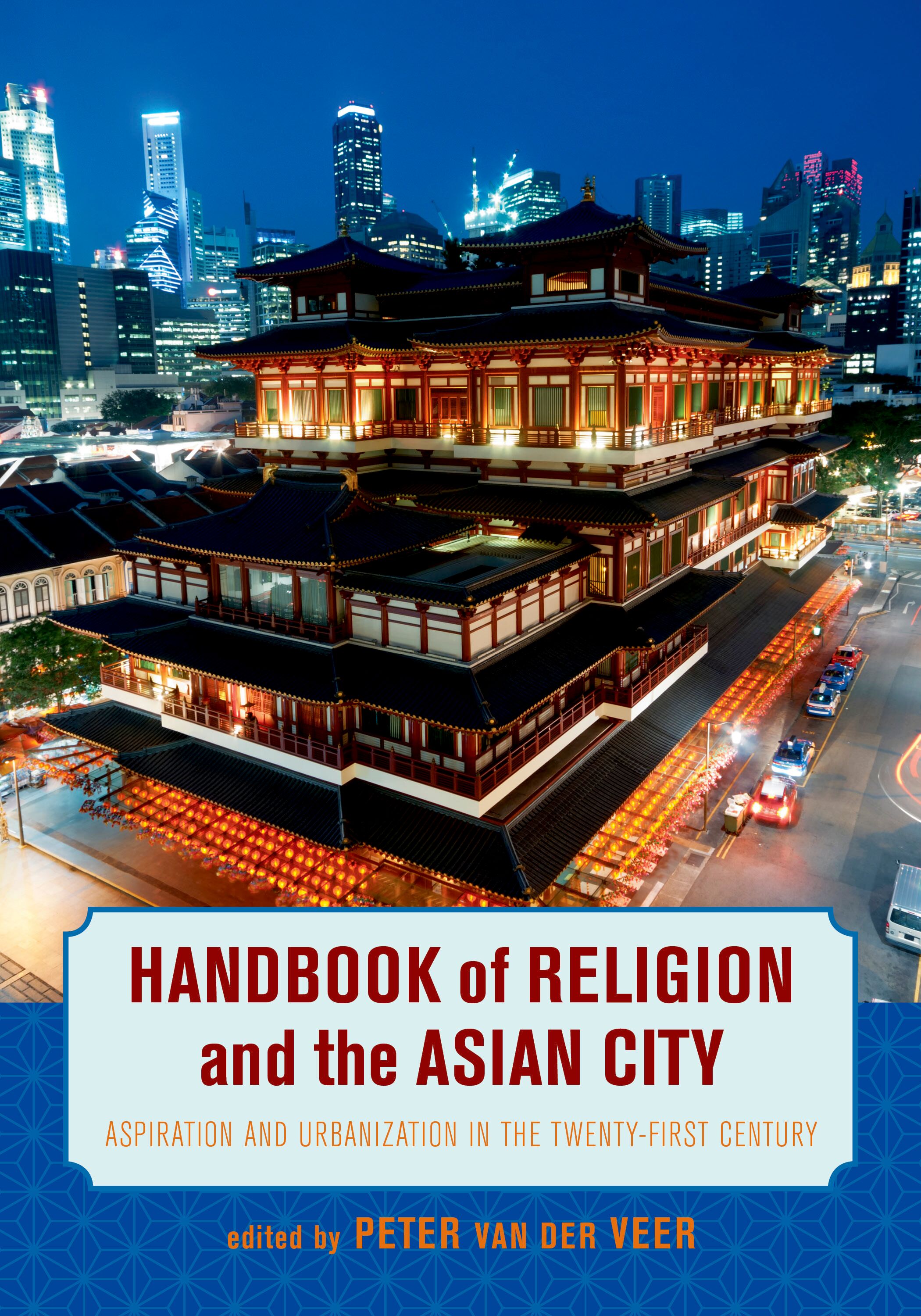
Handbook of religion and the Asian city
Handbook of Religion and the Asian Cityhighlights the creative and innovative role of urban aspirations in Asian world cities. It does not assume that religion is of the past and that the urban is secular, but instead points out that urban politics and governance often manifest religious boundaries and sensibilities-in short, that public religion is politics. The essays in this book show how projects of secularism come up against projects and ambitions of a religious nature, a particular form of contestation that takes the city as its public arena.Questioning the limits of cities like Mumbai, Singapore, Seoul, Beijing, Bangkok, and Shanghai, the authors assert that Asian cities have to be understood not as global models of futuristic city planning but as larger landscapes of spatial imagination that have specific cultural and political trajectories. Religion plays a central role in the politics of heritage that is emerging from the debris of modernist city planning.Megacities are arenas for the assertion of national and transnational aspirations as Asia confronts modernity. Cities are also sites of speculation, not only for those who invest in real estate but also for those who look for housing, employment, and salvation. In its potential and actual mobility, the sacred creates social space in which they all can meet.Handbook of Religion and the Asian Citymakes the comparative case that one cannot study the historical patterns of urbanization in Asia without paying attention to the role of religion in urban aspirations.
eBook

Singapore's Balancing Act, from the Perspective of the Linguistic Landscape
Messages displayed or exposed in public spaces have begun to receive attention from scholars, as they turn to the study of what has been referred to as the linguistic landscape or as geosemiotics — if we consider how the text interacts with the social and physical world. Like traditional media, these messages are also public communication, in that the designated audience is the general passer-by rather than specific individuals. In multilingual and multicultural areas of the world, the extent to which different languages are represented in these displays is of particular interest. A distinction is made between official signs, in which the specific languages to be used and even their order might be dictated by by-laws, and unofficial signs erected by individuals or private companies, who have a free hand in deciding what goes on a sign. Singapore has struggled to be even-handed with its official languages (English, Malay, Mandarin Chinese and Tamil), and its linguistic landscape can be seen as evidence of some tension in the balancing act between the official languages. Evidence is drawn from a sampling of data from various key locations in Singapore.
Journal Article