
Catalogue Search | MBRL


Are you sure you want to remove the book from the shelf?

{{itemTitle}}
98
result(s) for
"Public spaces-Design"
Sort by:

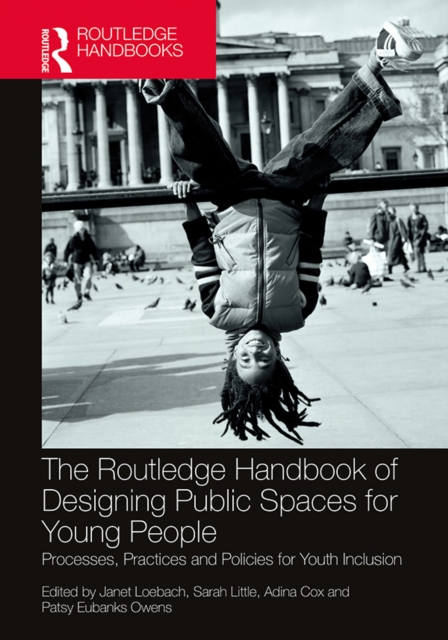
The Routledge Handbook of Designing Public Spaces for Young People
The Routledge Handbook of Designing Public Spaces for Young People is a thorough and practical resource for all who wish to influence policy and design decisions in order to increase young people's access to and use of public spaces, as well as their role in design and decision-making processes.
The ability of youth to freely enjoy public spaces, and to develop a sense of belonging and attachment to these environments, is critical for their physical, social, cognitive, and emotional development. Young people represent a vital citizen group with legitimate rights to occupy and shape their public environments, yet they are often driven out of public places by adult users, restrictive bylaws, or hostile designs. It is also important that children and youth have the opportunity to genuinely participate in the planning of public spaces, and to have their needs considered in the design of the public realm.
This book provides both evidence and tools to help effectively advocate for more youth-inclusive public environments, as well as integrate youth directly into both research and design processes related to the public realm. It is essential reading for researchers, design and planning professionals, community leaders, and youth advocates.
eBook


Empathic design : perspectives on creating inclusive spaces
How do you experience a public space? Do you feel safe? Seen? Represented? The response to these questions may differ based on factors including your race, age, ethnicity, or gender identity. In the architecture and design professions, decisions about the articulation of public spaces and who may be honored in them have often been made by white men. How do designers rethink design processes to produce works that hold space for the diversity of people using them?
In Empathic Design , designer and architecture professor Elgin Cleckley brings together leaders and visionary practitioners in architecture, urban design, planning, and design activism to help explore these questions. Cleckley explains that empathic designers need to approach design as iterative, changing, and shifting to say, “we see you”, “we hear you”. Part of an emerging design framework, empathic designers work with and in the communities affected. They acknowledge the full history of a place and approach the lived experience and memories of those in the community with respect.
Early chapters explore broader conceptual approaches, proposing definitions of empathy in the context of design, disrupting colonial narratives, and making space for grief. Other chapters highlight specific design projects, including the Harriet Tubman Memorial in Newark, The Camp Barker Memorial in Washington, D.C., the Freedom Center in Oklahoma City, and the Charlottesville Memorial for Peace and Justice.
Empathic Design provides essential approaches and methods from multiple perspectives, meeting the needs of our time and holding space for readers to find themselves.
eBook

Waterfront promenade design : urban revival strategies
\"Waterfronts, the unique places where land and water meet, are a finite resource, embodying the special history and character of each city. The last decades have witnessed profound changes along abandoned or underused waterfronts, bringing in new pedestrian areas, new business opportunities, and new vitality. This trend is accelerating in cities around the globe. 'Waterfront Promenade Design' seeks to answer to the question of how we can go about rejuvenating waterfronts by promoting good landscape planning and design. In total, 34 great waterfront design practices were selected from all over the world, each with their own unique way of solving the problems posed by their allocated sites, social conditions, and public policies. All resulted in more vibrant, accessible, resilient, and culturally rich public spaces, attuned to these needs. In order to strengthen the waterfront's coherence and connection, this book pays special attention to the design of traversable space along waterfronts, ensuring that promenades are maintained as pedestrian and cyclists-friendly zones. Based on in-depth analysis, this book provides useful design and planning approaches for professionals, decision-makers, and scholars.\"--Cover page 4.
Book


Designing London's public spaces : post-war and now
Those involved in the creation of public spaces think a great deal about the users of those spaces. Users think little, if at all, about those who create them. In 'super-diverse' cities like London, a successful public realm, where people can be together in trust and tolerance, is essential. A city's commitment to design quality indicates a commitment to civic health. In the interests of such commitment, the book asks: What should public space 'design intentions' be today?; Who is 'the public' of public spaces?; What can/should designers do to protect the 'publicness' of public spaces?; Was state financed public space mid-20th century of any higher quality than privately financed public space today?; How significant is the shift from commissioning architects to design public spaces mid-20th century to commissioning landscape architects and public realm architects today?.
Book

Redesign pedestrian-way in blok m area as a pathway of sustainable urban mobility
This paper presents a study of the redesign of pedestrian-way in the Blok M area as part of the implementation of sustainable urban mobility. The background of this study is to create sustainable transport planning in order to minimize the impact of traveling to the environment. Jakarta is among the most polluted cities in the world with the biggest contributor to pollution in the transportation sector. According to this case, there needs to encourage the public can shift using mass public transportation and leaving private vehicles as a commuter vehicle. Promotion of public transportation mode must be accompanied by the construction of road infrastructure that focuses on pedestrian according to sustainable urban mobility principles. Pedestrian-way had a role of connecting between modes. By consider the criteria that exist in public spaces design, it is necessary to adjust the facilities provided in order to create an attractive and comfortable space for users who pass through it.
Journal Article

Return to the source : new energy landscapes from the Land Art Generator Initiative : Abu Dhabi
\"Prize-winning public art installations demonstrate how renewable energy can become an extension of human culture. The Land Art Generator Initiative is one of the world's most exciting design competitions and for its 2019 challenge, entrants from around the world were asked to create a renewable energy-producing artwork for the UAE's Masdar City in Abu Dhabi. The winning designs are profiled in this generously illustrated volume. Each work demonstrates the aesthetic possibilities of renewable energy infrastructures. Capturing energy from nature and then converting it into power, these designs provide more than clean electricity to the city's residents. They also offer space for recreation and contemplation, while challenging our assumptions about ecological systems, resource generation, consumption, energy storage, and climate change solutions. Best of all, they illustrate the possibilities of living well in a post-carbon future\"--Amazon.com.
Book

Producing ownership through play: everyday public space practices in the Frankenberger neighbourhood
Play is commonly associated with childhood as a creative and productive activity that supports learning and innovation. However, its relevance extends beyond childhood and offers a critical lens for examining the consumption-oriented and rationalised patterns of contemporary urban life. In public space, playful activities often emerge as spontaneous and voluntary practices through which individuals engage with their surroundings, develop a sense of belonging, participate in shaping everyday spatial use, and move beyond purely functional or passive interpretations of space. In this article, owning space is understood not as a legal or formal condition, but as a situational and experiential process enacted through everyday use, interaction, and spatial adaptation by city residents. Such practices demonstrate how public space can be actively produced through use rather than passively consumed, and how everyday activities may resist tendencies toward standardisation and privatisation.
This study investigates the relationship between play theory and urban public space through a case study of the Frankenberger Neighbourhood in Aachen. Moving beyond playground-based and child-centred interpretations of play, the research focuses on playful and social practices embedded in everyday public space use, while critically engaging with processes of privatisation and control. The study draws on systematic observations, behavioural mapping, visual documentation, and questionnaires designed to explore users’ preferences, choices, and expectations regarding public space. Together, these methods illustrate how residents participate in and activate public space through playful practices, how owning space is produced through everyday use, and how such insights can inform public space design. The article argues that urban designers and planners can support more inclusive and playful public spaces not by prescribing specific functions, but by enabling spatial conditions that allow users to shape, reinterpret, and co-produce space through their everyday practices.
Journal Article