
Catalogue Search | MBRL


Are you sure you want to remove the book from the shelf?

{{itemTitle}}
134
result(s) for
"Public welfare -- Europe -- History -- 20th century"
Sort by:

Marginalized groups, inequalities and the post-war welfare state : whose welfare?
\"With its focus on different marginalized groups: migrants and people with disabilities, this volume offers novel perspectives on the national and international dimensions of the post-war welfare state in Western Europe and North America\"-- Provided by publisher.
Book

A long goodbye to bismarck?
This book provides an extensive and comparative account of all welfare reforms that occurred during the last three decades in Continental European countries. It reveals unexpected important structural reforms, to be understood as the culmination of a long reform trajectory, analyzed in detail with the tools of comparative historical institutionalism. With these reforms, Bismarckian welfare systems have lost their encompassing capacities, have partially turned to employment-friendliness and weakened the strongest elements of their male breadwinner bias.
eBook

A Long Goodbye to Bismarck?
This book provides an extensive and comparative account of all welfare reforms that occurred during the last three decades in Continental European countries. It reveals unexpected important structural reforms, to be understood as the culmination of a long reform trajectory, analyzed in detail with the tools of comparative historical institutionalism. With these reforms, Bismarckian welfare systems have lost their encompassing capacities, have partially turned to employment-friendliness and weakened the strongest elements of their male breadwinner bias. \"This volume is the definitive work on the politics of reform in Bismarckian welfare regimes. It is essential reading for any scholar interested in welfare reform - or indeed, in institutional and policy change more generally.\" (Kathleen Thelen, Massachusetts Institute of Technology ) \"The contributors to the volume are all recognized experts on their field and provide strictly comparable analyses in their chapters, making this volume a gold mine for comparative welfare state scholars. Palier's volume is certain to be a benchmark study for the foreseeable future.\" (John D. Stephens, University of North Carolina, Chapel Hill) \"This volume, representing the best available scholarship in comparative socio-economic research, provides important and highly policy-relevant insights. A must-read.\" (Fritz Scharpf, Max Planck Institute for the Studies of Societies) This title is available in the OAPEN Library - http://www.oapen.org.
eBook

The Rise and Fall of the Miraculous Welfare Machine
Sweden is well known for the success of its welfare state. Many believe that success was made possible in part by the country's ethnic homogeneity and that the increased diversity of Sweden's population is putting its welfare state at risk. Few, however, have suggested convincing mechanisms for explaining the precise relationship between relative ethnic homogeneity/heterogeneity and the welfare state. In this book Carly Elizabeth Schall acknowledges the important role of ethnic homogeneity in Sweden's thriving welfare state, but she argues that it mattered primarily because political elites-especially social democrats-made it matter.
Schall shows that diversity and the welfare state are related but that diversity does not undermine the welfare state in a straightforward way. Tracing the development of the Swedish welfare state from the late 1920s until the present day, she focuses on five historical periods of crisis. She argues that the story of Swedish national identity is a story of elite-driven hegemony-building and that the linking of social democracy and national identity colored the integration of immigrants in important ways. Social democracy could have withstood the challenge posed by immigration, but the faltering of social democratic hegemony opened a door for anti-immigrant sentiment. In her deft analysis of the relationship between immigration and the welfare state in Sweden, Schall makes a compelling argument that has relevance for immigration policy in the United States and elsewhere.
eBook

Differential Diagnoses
Although the United States spends 16 percent of its gross domestic product on health care, more than 46 million people have no insurance coverage, while one in four Americans report difficulty paying for medical care. Indeed, the U.S. health care system, despite being the most expensive health care system in the world, ranked thirty-seventh in a comprehensive World Health Organization report. With health care spending only expected to increase, Americans are again debating new ideas for expanding coverage and cutting costs. According to the historian Paul V. Dutton, Americans should look to France, whose health care system captured the World Health Organization's number-one spot.
InDifferential Diagnoses, Dutton debunks a common misconception among Americans that European health care systems are essentially similar to each other and vastly different from U.S. health care. In fact, the Americans and the French both distrust \"socialized medicine.\" Both peoples cherish patient choice, independent physicians, medical practice freedoms, and private insurers in a qualitatively different way than the Canadians, the British, and many others. The United States and France have struggled with the same ideals of liberty and equality, but one country followed a path that led to universal health insurance; the other embraced private insurers and has only guaranteed coverage for the elderly and the very poor.
How has France reconciled the competing ideals of individual liberty and social equality to assure universal coverage while protecting patient and practitioner freedoms? What can Americans learn from the French experience, and what can the French learn from the U.S. example?Differential Diagnosesanswers these questions by comparing how employers, labor unions, insurers, political groups, the state, and medical professionals have shaped their nations' health care systems from the early years of the twentieth century to the present day.
eBook

Integral Europe
Over the past 15 years, the project of advanced European integration has followed a complex secular and cosmopolitan agenda. As that agenda has evolved, however, so have various hard-line populist movements with goals diametrically opposed to the ideals of a harmonious European Union. Spearheaded by figures such as Jean-Marie Le Pen, the controversial leader of France's National Front party, these radical movements have become increasingly influential and, because of their philosophical affinities with fascism and national socialism--politically worrisome.
InIntegral Europe,anthropologist Douglas Holmes posits that such movements are philosophically rooted in integralism, a sensibility that, in its most benign form, enables people to maintain their ethnic identity and solidarity within the context of an increasingly pluralistic society. Taken to irrational extremes by people like Le Pen, integralism is being used to inflame people's feelings of alienation and powerlessness, the by-products of impersonal, transnational \"fast-capitalism.\" The consequences are an invidious politics of exclusion that spawns cultural nationalism, racism, and social disorder.
The analysis moves from northern Italy to Strasbourg and Brussels, the two venues of the European Parliament, and finally to the East End of London. This multi-sited ethnography provides critical perspective on integralism as a form of intimate cultural practice and a violent idiom of estrangement. It combines a wide-ranging review of modern and historical scholarship with two years of field research that included personal interviews with right-wing activists, among them Le Pen and neo-Nazis in inner London. Fascinating, provocative, and sobering,Integral Europeoffers a rare inside look at one of modern Europe's most unsettling political trends.
eBook

Cultivating the Masses
Under Stalin's leadership, the Soviet government carried out a massive number of deportations, incarcerations, and executions. Paradoxically, at the very moment that Soviet authorities were killing thousands of individuals, they were also engaged in an enormous pronatalist campaign to boost the population. Even as the number of repressions grew exponentially, Communist Party leaders enacted sweeping social welfare and public health measures to safeguard people's well-being. Extensive state surveillance of the population went hand in hand with literacy campaigns, political education, and efforts to instill in people an appreciation of high culture.
InCultivating the Masses, David L. Hoffmann examines the Party leadership's pursuit of these seemingly contradictory policies in order to grasp fully the character of the Stalinist regime, a regime intent on transforming the socioeconomic order and the very nature of its citizens. To analyze Soviet social policies, Hoffmann places them in an international comparative context. He explains Soviet technologies of social intervention as one particular constellation of modern state practices. These practices developed in conjunction with the ambitions of nineteenth-century European reformers to refashion society, and they subsequently prompted welfare programs, public health initiatives, and reproductive regulations in countries around the world.
The mobilizational demands of World War I impelled political leaders to expand even further their efforts at population management, via economic controls, surveillance, propaganda, and state violence. Born at this moment of total war, the Soviet system institutionalized these wartime methods as permanent features of governance. Party leaders, whose dictatorship included no checks on state power, in turn attached interventionist practices to their ideological goal of building socialism.
eBook
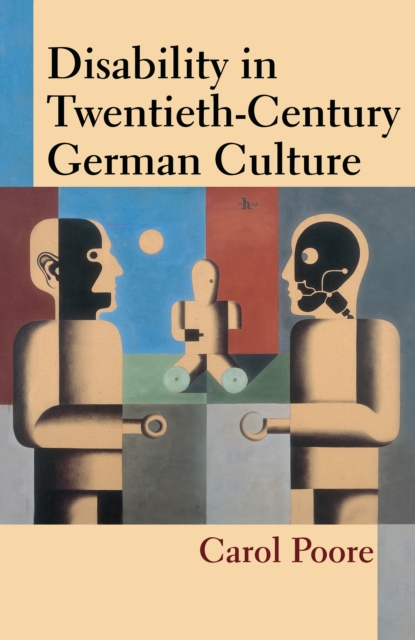
Disability in twentieth-century German culture
Disability in Twentieth-Century German Culture covers the entire scope of Germany's most tragic and tumultuous century—from the Weimar Republic to the current administration—revealing how central the notion of disability is to modern German cultural history. By examining a wide range of literary and visual depictions of disability, Carol Poore explores the contradictions of a nation renowned for its social services programs yet notorious for its history of compulsory sterilization and eugenic dogma. This comprehensive volume focuses particular attention on the horrors of the Nazi era, when those with disabilities were considered \"unworthy of life,\" but also investigates other previously overlooked topics including the exile community's response to disability, socialism and disability in East Germany, current bioethical debates, and the rise and gains of Germany's disability rights movement. Richly illustrated, wide-ranging, and accessible, Disability in Twentieth-Century German Culture gives all those interested in disability studies, German studies, visual culture, Nazi history, and bioethics the opportunity to explore controversial questions of individuality, normalcy, citizenship, and morality. The book concludes with a memoir of the author's experiences in Germany as a person with a disability.
eBook

Berlin Electropolis
Berlin Electropolisties the German discourse on nervousness in the late nineteenth and early twentieth centuries to Berlin's transformation into a capital of the second industrial revolution. Focusing on three key groups-railway personnel, soldiers, and telephone operators-Andreas Killen traces the emergence in the 1880s and then later decline of the belief that modernity caused nervous illness. During this period, Killen explains, Berlin became arguably the most advanced metropolis in Europe. A host of changes, many associated with breakthroughs in technologies of transportation, communication, and leisure, combined to radically alter the shape and tempo of everyday life in Berlin. The resulting consciousness of accelerated social change and the shocks and afflictions that accompanied it found their consummate expression in the discourse about nervousness. Wonderfully researched and clearly written, this book offers a wealth of new insights into the nature of the modern metropolis, the psychological aftermath of World War I, and the operations of the German welfare state. Killen also explores cultural attitudes toward electricity, the evolution of psychiatric thought and practice, and the status of women workers in Germany's rapidly industrializing economy. Ultimately, he argues that the backlash against the welfare state that occurred during the late Weimar Republic brought about the final decoupling of modernity and nervous illness.
eBook

Intergenerational Occupational Mobility in Great Britain and the United States Since 1850
The US tolerates more inequality than Europe and believes its economic mobility is greater than Europe's, though they had roughly equal rates of intergenerational occupational mobility in the late twentieth century. We extend this comparison into the nineteenth century using 10,000 nationally-representative British and US fathers and sons. The US was more mobile than Britain through 1900, so in the experience of those who created the US welfare state in the 1930s, the US had indeed been \"exceptional.\" The US mobility lead over Britain was erased by the 1950s, as US mobility fell from its nineteenth century levels.
Journal Article