
Catalogue Search | MBRL


Are you sure you want to remove the book from the shelf?

{{itemTitle}}
8,589
result(s) for
"Pure Mathematics"
Sort by:
Spectral theory of block operator matrices and applications
This book presents a wide panorama of methods to investigate the spectral properties of block operator matrices. Particular emphasis is placed on classes of block operator matrices to which standard operator theoretical methods do not readily apply: non-self-adjoint block operator matrices, block operator matrices with unbounded entries, non-semibounded block operator matrices, and classes of block operator matrices arising in mathematical physics.
eBook

When Computers Were Human
Before Palm Pilots and iPods, PCs and laptops, the term \"computer\" referred to the people who did scientific calculations by hand. These workers were neither calculating geniuses nor idiot savants but knowledgeable people who, in other circumstances, might have become scientists in their own right. When Computers Were Human represents the first in-depth account of this little-known, 200-year epoch in the history of science and technology. Beginning with the story of his own grandmother, who was trained as a human computer, David Alan Grier provides a poignant introduction to the wider world of women and men who did the hard computational labor of science. His grandmother's casual remark, \"I wish I'd used my calculus,\" hinted at a career deferred and an education forgotten, a secret life unappreciated; like many highly educated women of her generation, she studied to become a human computer because nothing else would offer her a place in the scientific world. The book begins with the return of Halley's comet in 1758 and the effort of three French astronomers to compute its orbit. It ends four cycles later, with a UNIVAC electronic computer projecting the 1986 orbit. In between, Grier tells us about the surveyors of the French Revolution, describes the calculating machines of Charles Babbage, and guides the reader through the Great Depression to marvel at the giant computing room of the Works Progress Administration. When Computers Were Human is the sad but lyrical story of workers who gladly did the hard labor of research calculation in the hope that they might be part of the scientific community. In the end, they were rewarded by a new electronic machine that took the place and the name of those who were, once, the computers.
eBook

Unipotency of Matrix Group Generated by Two Matrices
In this paper, the problem of unipotency for the matrix group generated by two matrices is examined. By employing matrix logarithms as a tool, various combinatorial formulas for matrices were derived by selecting different primitive elements. Key conclusions were then reached through the organization and simplification of these formulas. It was ultimately demonstrated, based on these conclusions, that a matrix group G generated by two matrices, where the Jordan blocks do not exceed third order, must be unipotent if each primitive element of G is unipotent and has an order of six or less.
Journal Article
Homogenization methods for multiscale mechanics
In many physical problems several scales are present in space or time, caused by inhomogeneity of the medium or complexity of the mechanical process. A fundamental approach is to first construct micro-scale models, and then deduce the macro-scale laws and the constitutive relations by properly averaging over the micro-scale. The perturbation method of multiple scales can be used to derive averaged equations for a much larger scale from considerations of the small scales. In the mechanics of multiscale media, the analytical scheme of upscaling is known as the Theory of Homogenization.
eBook
Oblique derivative problems for elliptic equations
This book gives an up-to-date exposition on the theory of oblique derivative problems for elliptic equations. The modern analysis of shock reflection was made possible by the theory of oblique derivative problems developed by the author. Such problems also arise in many other physical situations such as the shape of a capillary surface and problems of optimal transportation. The author begins the book with basic results for linear oblique derivative problems and work through the theory for quasilinear and nonlinear problems. The final chapter discusses some of the applications. In addition, notes to each chapter give a history of the topics in that chapter and suggestions for further reading.
eBook

Advances in the applications of nonstandard finite difference schemes
This volume provides a concise introduction to the methodology of nonstandard finite difference (NSFD) schemes construction and shows how they can be applied to the numerical integration of differential equations occurring in the natural, biomedical, and engineering sciences. These methods had their genesis in the work of Mickens in the 1990's and are now beginning to be widely studied and applied by other researchers. The importance of the book derives from its clear and direct explanation of NSFD in the introductory chapter along with a broad discussion of the future directions needed to advance the topic.
eBook
Differential-algebraic systems
Differential-algebraic equations (DAEs) provide an essential tool for system modeling and analysis within different fields of applied sciences and engineering. This book addresses modeling issues and analytical properties of DAEs, together with some applications in electrical circuit theory.
eBook

Mathematics learning in physics classrooms of Russian schools: a changing landscape from the Soviet period to the present
For a long time, Soviet students learned ‘pure’ mathematics in their mathematics classrooms, while applications of mathematics were introduced in their science (mainly physics) classrooms. This approach was a part of a uniform and rigid national curriculum. Even when in the 1990s the world was moving towards including applications in school mathematics, Russian students continued to engage in pure mathematics learning in their mathematics classrooms. It was physics teachers’ responsibility to teach applications of mathematics; therefore, physics courses were highly mathematics-intensive, making extensive use of mathematics from algebra to calculus in the formulation of scientific laws and the investigation of their consequences. The collapse of the Soviet Union and some liberalization in educational policy led to changes in graduation requirements in mathematics and physics as well as diversity in mathematics and physics curricula in schools. Based on a review of textbooks, standards, curriculum documents, and other resources, in this paper we analyze changes that affected the teaching and learning of mathematics in physics classrooms in Russia from the Soviet period to the present.
Journal Article

Plato's Ghost
Plato's Ghost is the first book to examine the development of mathematics from 1880 to 1920 as a modernist transformation similar to those in art, literature, and music. Jeremy Gray traces the growth of mathematical modernism from its roots in problem solving and theory to its interactions with physics, philosophy, theology, psychology, and ideas about real and artificial languages. He shows how mathematics was popularized, and explains how mathematical modernism not only gave expression to the work of mathematicians and the professional image they sought to create for themselves, but how modernism also introduced deeper and ultimately unanswerable questions.
eBook
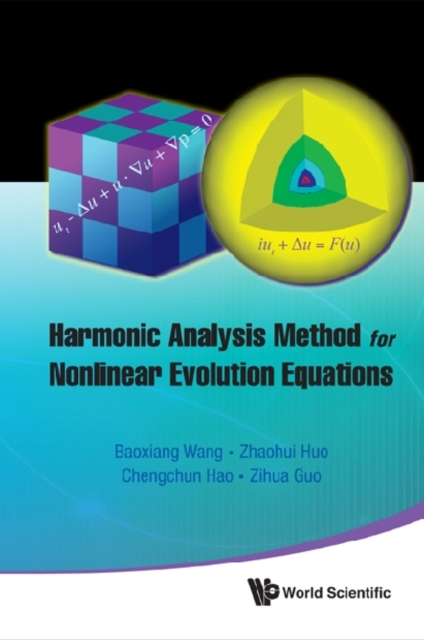
Harmonic analysis method for nonlinear evolution equations, I
This monograph provides a comprehensive overview on a class of nonlinear evolution equations, such as nonlinear Schrödinger equations, nonlinear Klein–Gordon equations, KdV equations as well as Navier–Stokes equations and Boltzmann equations. The global wellposedness to the Cauchy problem for those equations is systematically studied by using the harmonic analysis methods.
eBook