
Catalogue Search | MBRL


Are you sure you want to remove the book from the shelf?

{{itemTitle}}
4,168
result(s) for
"Pynchon, Thomas."
Sort by:

Terrorism and Temporality in the Works of Thomas Pynchon and Don DeLillo
Terrorism and Temporality in the Works of Thomas Pynchon and Don DeLillo starts from a simple premise: that the events of the 11th of September 2001 must have had a major effect on two New York residents, and two of the seminal authors of American letters, Pynchon and DeLillo.
eBook

The New Pynchon studies
\"The twenty-first century has been a time of renewed energy within Pynchon studies. Among other factors this is due to the publication of three novels, Against the Day (2006), Inherent Vice (2009), and Bleeding Edge (2013), which have each brought something distinctively new to the table. Against the Day's vast scope and range makes it Pynchon's most fully realized example of what has come to be conceived of as the \"systems novel\"; Inherent Vice's revisiting of the counterculture era first examined by Pynchon in The Crying of Lot 49 (1966) offers a concrete point of comparison on which to base assessments of his maturation as a writer amid changing socio-political contexts, and Bleeding Edge, Pynchon's (quasi-)9/11 novel, provides a thorough and long-anticipated thematic engagement with computer technology and digital culture. Mason & Dixon, published a little before the turn of the millennium in 1997 and one of Pynchon's most critically-acclaimed works, has also provided fertile ground for twenty-first century criticism\"-- Provided by publisher.
BOOK

Selling San Narciso: Pierce Inverarity as Insider-Innovator in The Crying of Lot 49
This paper puts social networking theory into conversation with ideas from Michel de Certeau and Michel Serres, in order to explore the agency of Pierce Inverarity, whose death sets in motion Thomas Pynchon’s The Crying of Lot 49 . Pierce—a 1960s war profiteer, maker of soulless cityscapes, and master manipulator—is justifiably seen as a villain. But he is also the novel’s most effective agent; he manipulates the culture he discovers and cultivates instabilities from which he profits. Lot 49 ’s protagonist, Oedipa Maas, habitually looks for central managers in control of the culture, but Pierce is not that. Instead, he is an often subtle persuader who designs ephemeral spaces that invite the agency of outsiders. He counts on the creative misuses people may find for his products. He does not have his community’s best interests at heart, but he demonstrates what it means to come alongside a community and foster gradual change. Pynchon—by making his villain an effective community change agent— sharpens his critique of middle-class complacency: Oedipa recoils from the decentralized cultural complexity that Pierce welcomes. Pynchon suggests that so long as Oedipa and her clever, educated cohort think of society as the product of other powerful ruling minds, agents like Pierce will have the advantage, as they diffuse their self-serving innovations through the networks of contemporary life, unchecked.
Journal Article

Thomas Pynchon & the dark passages of history
For David Cowart, Thomas Pynchon's most profound teachings are about history- history as myth, as rhetorical construct, as false consciousness, as prologue, as mirror, and as seedbed of national and literary identities. In one encyclopedic novel after another, Pynchon has reconceptualized historical periods that he sees as culturally definitive. This book offers a deft analysis of the problems of history as engaged by our greatest living novelist and argues for the continuity of Pynchon's historical vision. -- from Back Cover
BOOK
Dahlia’s Journey: Misplaced Affection and Visual Arts in Thomas Pynchon’s Against the Day
Among the many characters of the labyrinthine saga Against the Day (2006), this paper focuses on Dahlia Rideout. Her foster father is a photographer, her mother elopes with a magician, her childhood friend is a ball lightning. While in Venice, she becomes the muse of radical artists, and on the London stage Dahlia is quite a sensation. The thing that binds together her iconic status and her misfortunes throughout the books is light – that is, electromagnetic radiation, as scientists describe it, but also limelight, the aura of celebrity she shares with other female characters in Thomas Pynchon’s fiction.
Journal Article

Thomas Pynchon
\"This is a comprehensive study of the most influential figure in postwar American literature. Over a writing career spanning more than fifty years, Thomas Pynchon has been at the forefront of America's engagement with postmodern literary possibilities. In chapters that address the full range of Pynchon's career, from his earliest short stories and first novel, V., to his most recent work, this book offers highly accessible and detailed readings of a writer who is indispensable to understanding how the American novel has met the challenges of postmodernity. The authors discuss Pynchon's relationship to literary history, his engagement with discourses of science and utopianism, his interrogation of imperialism and his preoccupation with the paranoid sensibility. Invaluable to Pynchon scholars and to everyone working in the field of contemporary American fiction, this study explores how Pynchon's complex narratives work both as exuberant examples of formal experimentation and as serious interventions in the political health of the nation.\"--P. [4] of cover.
BOOK
Pynchon and the Political
Thomas Pynchon's writing has been widely regarded as an exemplary form of postmodern fiction. It is characterized as genre-defying and enigmatic, as a series of complex and esoteric language games. This study attempts to demonstrate, however, that an oblique yet compelling sense of the \"political\" Pynchon disappers all too easily under the mantle of postmodernity. Innovative and unsettling discussions of freedom, war, labor, poverty, community, democracy, and totalitarianism are passed over in favor of constrictive scientific metaphors and theoretical play. Against this current, this study analyzes Pynchon's fiction in terms of its radical dimension, showing how it points to new directions in the relationship between the political and the aesthetic.
Samuel Thomas is Lecturer in the Department of English Studies at Durham University, UK.
Introduction: Text-Politics-Criticism-Methodology 1. Retro-Vertigo: Escaping the Enlightenment in Mason & Dixon 2. Blank Checks: Invisibility and Economy in Mason & Dixon 3. Theatre of Operations: Surgery, War and Questing in V. and Gravity’s Rainbow 4. Memento-Mori: War-Life and War-Experience in Gravity’s Rainbow and V 5. (What’s so Funny ‘Bout) Peace, Love and Understanding? Resistance vs. Withdrawal in The Crying of Lot 49 6. Sir Yes Sir!: Doing It To Yourself and Doing It For Yourself in Vineland. Conclusion: Pynchon-Politics-Everybody
eBook

The Cambridge companion to Thomas Pynchon
\"The most celebrated American novelist of the past half-century, an indispensable figure of postmodernism worldwide, Thomas Pynchon notoriously challenges his readers. This Companion provides tools for meeting that challenge. Comprehensive, accessible, lively, up-to-date and reliable, it approaches Pynchon's fiction from various angles, calling on the expertise of an international roster of scholars at the cutting edge of Pynchon studies. Part I covers Pynchon's fiction novel-by-novel from the 1960s to the present, including such indisputable classics as The Crying of Lot 49 and Gravity's Rainbow. Part II zooms out to give a bird's-eye-view of Pynchon's novelistic practice across his entire career. Part III surveys major topics of Pynchon's fiction: history, politics, alterity ('otherness') and science and technology. Designed for students, scholars and fans alike, the Companion begins with a biography of the elusive author and ends with a coda on how to read Pynchon and a bibliography for further reading\"--Provided by publisher.
BOOK
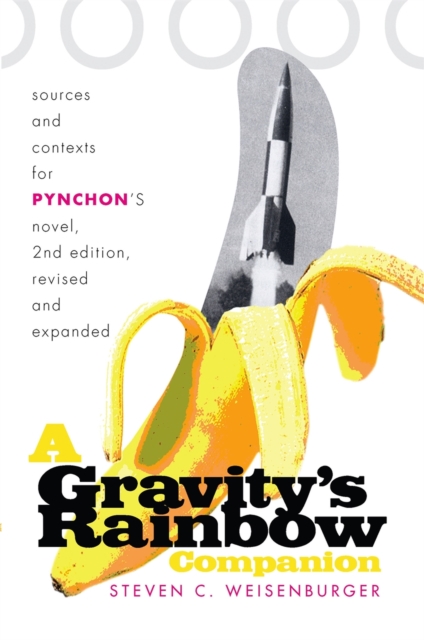
A Gravity's Rainbow Companion
Adding some 20 percent to the original content, this is a completely updated edition of Steven Weisenburger's indispensable guide to Thomas Pynchon's Gravity's Rainbow. Weisenburger takes the reader page by page, often line by line, through the welter of historical references, scientific data, cultural fragments, anthropological research, jokes, and puns around which Pynchon wove his story. Weisenburger fully annotates Pynchon's use of languages ranging from Russian and Hebrew to such subdialects of English as 1940s street talk, drug lingo, and military slang as well as the more obscure terminology of black magic, Rosicrucianism, and Pavlovian psychology. The Companion also reveals the underlying organization of Gravity's Rainbow--how the book's myriad references form patterns of meaning and structure that have eluded both admirers and critics of the novel. The Companion is keyed to the pages of the principal American editions of Gravity's Rainbow: Viking/Penguin (1973), Bantam (1974), and the special, repaginated Penguin paperback (2000) honoring the novel as one of twenty \"Great Books of the Twentieth Century.\"
eBook